Symposium · Political Philosophy · Pl. 15Mary Wollstonecraft · 1759–1797
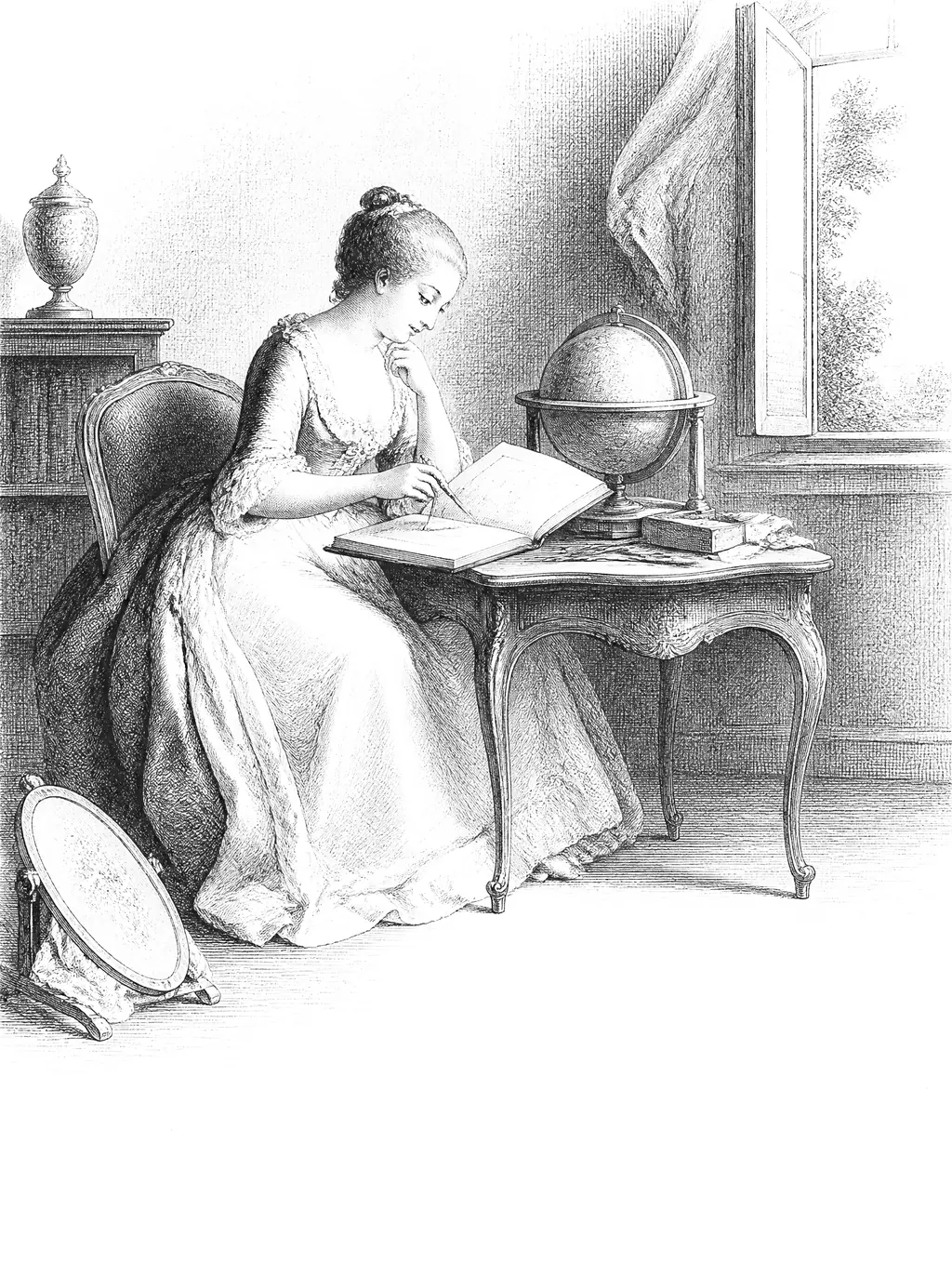
Power Over Themselves
A warning that misses the target
Rousseau, the same philosopher who argued men are born free, wrote that educating women like men would only make them resemble men, and gain unwelcome power over them. Wollstonecraft, reading this, does not deny the fear so much as redirect it entirely, insisting the whole argument was aimed at a goal she never asked for in the first place. She had reasons to take Rousseau seriously. She admired him, had reviewed him, and had borrowed his conviction that people are corrupted by the societies that raise them. That made the fifth book of Emile, where he designs a girl's education entirely around pleasing a husband, feel to her like a betrayal by an ally.
The world it came from
Wollstonecraft was born in London in 1759 to a father who drank away the family money, and she educated herself. She ran a school in Newington Green among religious dissenters, including the preacher Richard Price, and then made a living as a reviewer and translator for the radical publisher Joseph Johnson. When Burke attacked the French Revolution in 1790, she published one of the first replies, before Paine. A Vindication of the Rights of Woman followed in 1792, addressed to Talleyrand, whose report to the French assembly had proposed public schooling for boys and a domestic education for girls. She went to Paris that December to watch the Revolution at first hand, and stayed through the Terror.
The idea
I do not wish them to have power over men; but over themselves. The demand is not for women to dominate men the way men have long dominated women, but for the same basic thing Enlightenment political philosophy already claimed for men: rational self-governance, the capacity to reason, choose, and answer for oneself, rather than remain a permanent dependent. Wollstonecraft's target is not only law but manners. A woman trained from childhood to be pleasing, soft, and helpless has been made weak on purpose, and then the weakness is cited as nature. Power over yourself means being educated to reason and then being allowed to use it.
How the reasoning runs
Start with a premise the Enlightenment already accepted: virtue is the same for every rational being, and reason is what makes virtue possible. Next, either women have reason or they do not. If they do not, they cannot be virtuous, and it is absurd to demand chastity, modesty, and good conduct from creatures who cannot understand them. So women have reason. Third, reason develops only through exercise, and an education designed to make women pleasing rather than capable starves it. So women's weakness is manufactured, not found. Therefore the same education, and the same standard of virtue, is owed to both sexes, and a wife who can reason is a better companion, a better mother, and a better citizen than an ornament who cannot.
Seen in life
You watch a friend's daughter, aged nine, being praised for being sweet while her brother is praised for being clever. Nobody in the room means harm. By fifteen she has learned that being liked is the skill that pays, and she is very good at it. By twenty-five she cannot say what she wants from a job, a partner, or a Sunday, because she was never asked to want anything except to be wanted. Wollstonecraft would not call her stupid. She would say that her reason had been left untrained on purpose, and that the people who now find her indecisive built the indecision. Power over yourself, on this account, is not a right you are born with. It is a capacity somebody either trained or neglected.
Why it matters
This applies the core Enlightenment claim about reason and rights, already used to justify revolutions against kings, to a group that argument had conveniently stopped short of including. If rational self-governance justifies political rights at all, Wollstonecraft argues, it cannot coherently be denied to half the human race on the grounds of sex alone. The move is one that keeps being made. Every later extension of rights, by race, by class, by sexuality, has taken the same form: you already believe that reason grounds rights, and here are reasoning people you left out. Wollstonecraft was the first to make the move at book length, and against the very philosophers who had supplied the premise.
“I do not wish them to have power over men; but over themselves.”
From the source
Responding directly to Rousseau's own warning that educated women would gain unwelcome power over men, Wollstonecraft answers him plainly: “This is the very point I aim at. I do not wish them to have power over men; but over themselves.” The exchange is in Chapter IV, on the state of degradation to which woman is reduced. Wollstonecraft has been quoting Rousseau's claim that women who become like men will lose their influence over them, and takes it as a concession rather than a threat. Elsewhere in the book she is blunter about the mechanism: women, she writes, are taught to obtain by cunning what they are forbidden to earn by strength, and she calls that training a form of slavery that corrupts both parties.
The pushback
Wasn't demanding rational self-governance, rather than full political equality outright, itself a limited ask by later standards, leaving voting rights and legal equality for a much later fight? Wollstonecraft's defenders note she was working within, and directly against, a tradition that denied women reason at all; establishing that premise was the necessary first battle, not the whole war. A second objection comes from later feminists. Wollstonecraft accepts the male standard of reason as the measure of a person, treats feeling and softness with contempt, and writes mostly about middle-class wives. On this reading she asked for women to be admitted to a club whose rules she never questioned, and left the women who could not join, or did not want to, out of the argument.
The reply
Wollstonecraft's defenders answer the first objection from her own text. She suggests, in Chapter IX, that women might study medicine and politics, run businesses, and have representatives of their own, which was further than any published writer had gone. The second objection has more force. She did treat sensibility as a weakness, and her book speaks for women like herself. Two things soften it without removing it. Her contempt was for a sensibility manufactured to keep women dependent, not for feeling as such, and she argued that the poor woman's drudgery and the rich woman's idleness were both forms of the same exclusion from reason. The reply is partial. Later feminism had to widen a door she opened but did not walk far through.
Where it went next
Wollstonecraft died in 1797 after giving birth to the daughter who would write Frankenstein. Her husband William Godwin published a candid memoir of her love affairs and suicide attempts, and for most of the nineteenth century her name was a scandal rather than an argument. The suffragists revived her: Millicent Fawcett introduced a centenary edition of the Vindication in 1891. Mill's Subjection of Women in 1869 restated her case with parliamentary force. Virginia Woolf, writing in 1932, judged that her influence could still be felt among the living. Simone de Beauvoir's claim that one is not born but becomes a woman is Wollstonecraft's manufactured weakness restated with the tools of a later century.
Where this leads
Existence precedes essence reaches a related conclusion nearly two centuries later from an entirely different tradition, Beauvoir's own extension of it arguing directly that womanhood itself is built rather than given, a claim Wollstonecraft's demand for self-governance was already quietly assuming. One is not born a woman is that extension, and it is Wollstonecraft's own argument turned inside out. She said that women's weakness was manufactured by education and could be unmade by a better one. Beauvoir said that everything called feminine was manufactured, and asked what a person would choose to be with the manufacturing exposed. The first demands a reform of the school. The second questions what the school was for.