Symposium · Political Philosophy · Pl. 14Jean-Jacques Rousseau · 1712–1778
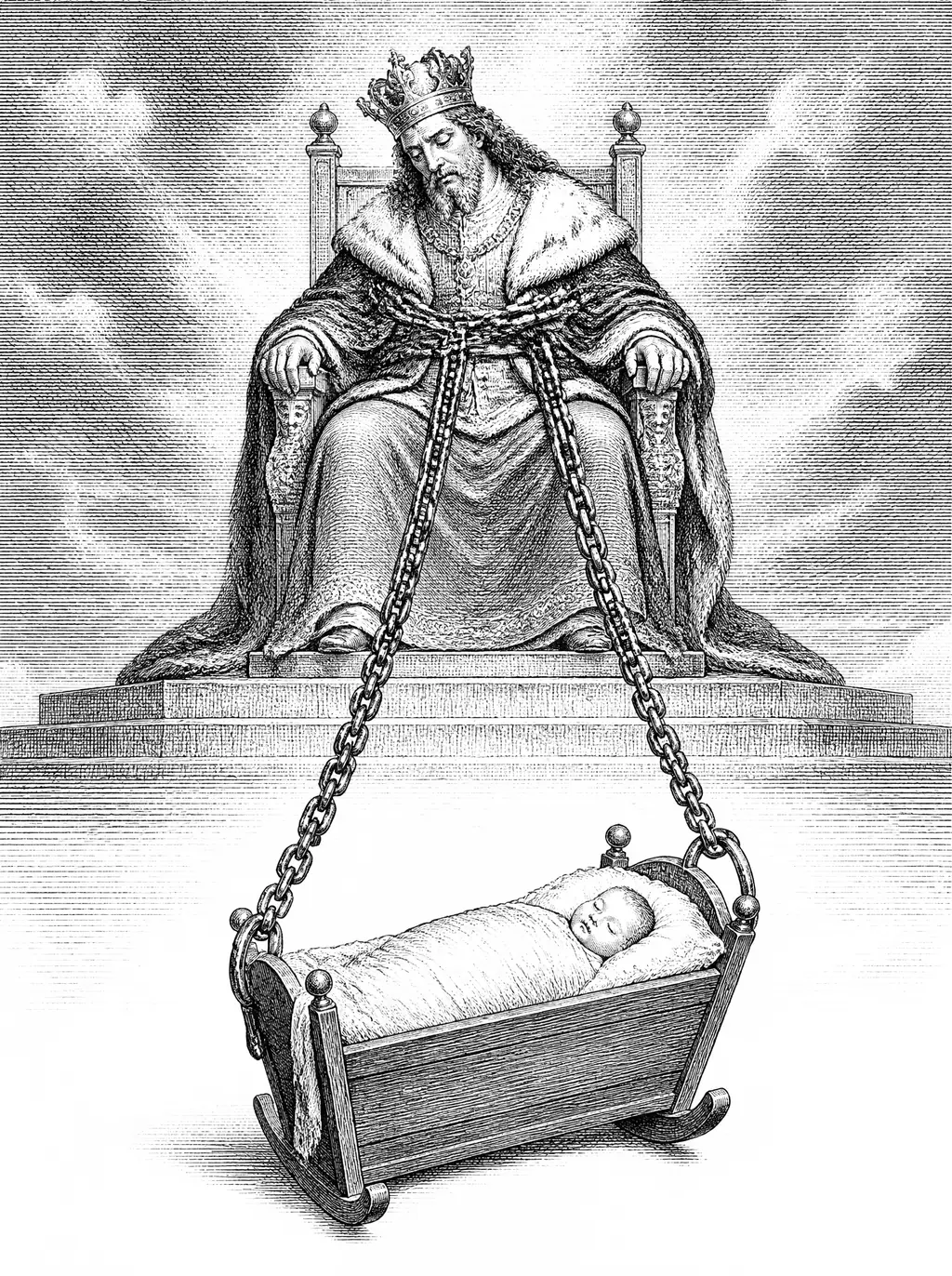
Man Is Born Free
A sentence that starts a fight
Most political treatises open with careful throat-clearing. Rousseau opens with an accusation aimed at every society that has ever existed: people arrive in the world free, and every one of them ends up bound by chains they did not choose. He admits he does not know exactly how this happened. He insists he can say what would make it legitimate. The sentence was read as a threat, and it was meant as one. Within months of publication the book was banned in Paris and burned in Geneva, and its author was on the run. A line that governments hurry to burn is usually a line that has found something out.
The world it came from
Rousseau was born in Geneva in 1712, a small Calvinist republic that called itself free while a few families ran it, and he signed The Social Contract as a citizen of Geneva. He wrote it in France under Louis XV, a monarchy that claimed authority from God and jailed authors without trial. He had already broken with Voltaire and with Diderot and the Encyclopedists, who thought progress would fix things; Rousseau's Discourse on Inequality of 1755 had argued that progress forged the chains. The Social Contract and Emile both appeared in 1762. Paris ordered his arrest, Geneva burned both books, and he fled to Switzerland. He spent most of the rest of his life moving from one refuge to the next.
The idea
Man is born free; and everywhere he is in chains. One thinks himself the master of others, and still remains a greater slave than they. The task Rousseau sets himself is not to undo all authority, which he thinks is impossible, but to find the terms on which a social order could bind people legitimately, rather than simply through inherited force. Notice the second sentence, which is usually forgotten. The master is in chains too. Whoever rules by force must spend his life defending what force took, and depends on the very people he holds down. Illegitimate power, for Rousseau, enslaves both ends of the chain.
How the reasoning runs
Start from the claim that freedom is the natural condition: no infant is born owing obedience, and nature gives no one the right to command another. Next, eliminate the usual justifications. Force cannot ground a right, since if might made right, the right would change hands with every victory. Nor can a person legitimately sell himself into slavery, because giving up all freedom is giving up being human, and an agreement that strips one side of everything is void. So neither conquest nor a supposed original surrender can bind anyone. What remains is agreement among equals. The only legitimate authority is one people could set up by a convention that leaves each of them as free as before. The rest of the book tries to find it.
Seen in life
You never signed anything. You were born into a country with a tax code, a border, a set of laws about what you can say and where you can walk, and a police force that will enforce them. Try the exercise Rousseau proposes. Which of those chains would you have agreed to, had anyone asked? Some, plainly: you want the roads and the courts. Others you accept because everyone does, and because the alternative is a fight you would lose. Rousseau's point is not that you should throw them all off. It is that the second kind, the ones held in place only by habit and force, have no claim on you beyond the force, and it is worth knowing which is which.
Why it matters
This reframes political authority as something that needs active justification, not something to be assumed as natural or divinely ordered. If freedom is the human starting point, then every chain, law, custom, hierarchy, has to answer for itself, and cannot simply claim legitimacy by having existed for a long time or by benefiting whoever currently holds power. That reframing is now so ordinary that it is hard to see how new it was. A ruler who must show why his subjects should obey has already lost the older argument, in which subjects were born owing obedience the way they were born owing breath. Rousseau moved the burden of proof, and it has never moved back.
“Man is born free; and everywhere he is in chains. One thinks himself the master of others, and still remains a greater slave than they.”
From the source
Rousseau opens The Social Contract with the line the whole book is built to answer: “Man is born free; and everywhere he is in chains. One thinks himself the master of others, and still remains a greater slave than they. How did this change come about? I do not know.” The passage begins Book I, Chapter 1. Having confessed ignorance about the history, Rousseau says what he does claim to know: what can make the chains legitimate. He then adds that if he considered only force, he would simply advise people to throw off the yoke whenever they could. The social order is a sacred right, he says, but it does not come from nature. It rests on conventions.
The pushback
Wasn't Rousseau's own solution, submission to the general will, just another chain dressed up in the language of freedom, since it still demands individuals set aside their private judgment for a collective one? Critics from his own century onward have worried that his cure for illegitimate chains could authorize a different, harder-to-resist kind. A second objection targets the opening premise itself. Nobody is born free in any usable sense. An infant is born wholly dependent, into a language, a family, and a set of obligations it did not choose and could not survive without. If that is the starting point, then the chains are not a corruption of the human condition but part of what makes a human at all.
The reply
Rousseau's answer to the first objection is that the general will is not another master. When you obey a law you helped to make, you obey yourself, and that is what freedom means for a being who lives among others. The answer holds only as long as the law really is made by everyone and applies to everyone alike, and Rousseau knew how rarely that condition is met. To the second objection he would say that born free means born without a master, not born without needs. Dependence on people is the chain; dependence on nature is not. Still, the line between the two is harder to draw than the slogan suggests, and his own account of education in Emile spends five hundred pages trying to draw it.
Where it went next
The Jacobins made Rousseau their prophet. Robespierre quoted him, and in 1794 the Revolution moved his remains to the Panthéon. Kant said that Rousseau had set him straight, teaching him to honor ordinary humanity, and the idea that a free will obeys only laws it gives itself runs from Rousseau's opening into Kant's ethics. Marx and Engels closed the Communist Manifesto with the same image, workers who have nothing to lose but their chains. Benjamin Constant argued in 1819 that Rousseau had confused the liberty of ancient citizens with the liberty modern people want, and Isaiah Berlin in 1958 made him the chief example of positive liberty turning into coercion. The sentence is still quoted by people on every side.
Where this leads
The general will is Rousseau's own proposed answer to the exact question this famous opening line raises, an attempt to describe an authority that binds without genuinely enslaving anyone, built on collective self-rule rather than one person's power over another. The state of nature is the picture Rousseau was writing against. Hobbes said that life without authority is war and that any sovereign is better than none. Rousseau said that people are born free and that the chains need to answer for themselves. Between the two lies the whole argument about what government is for: an escape from each other, or an agreement among equals who were never at war to begin with.