Symposium · Pragmatism · Pl. 15Chauncey Wright · 1830–1875
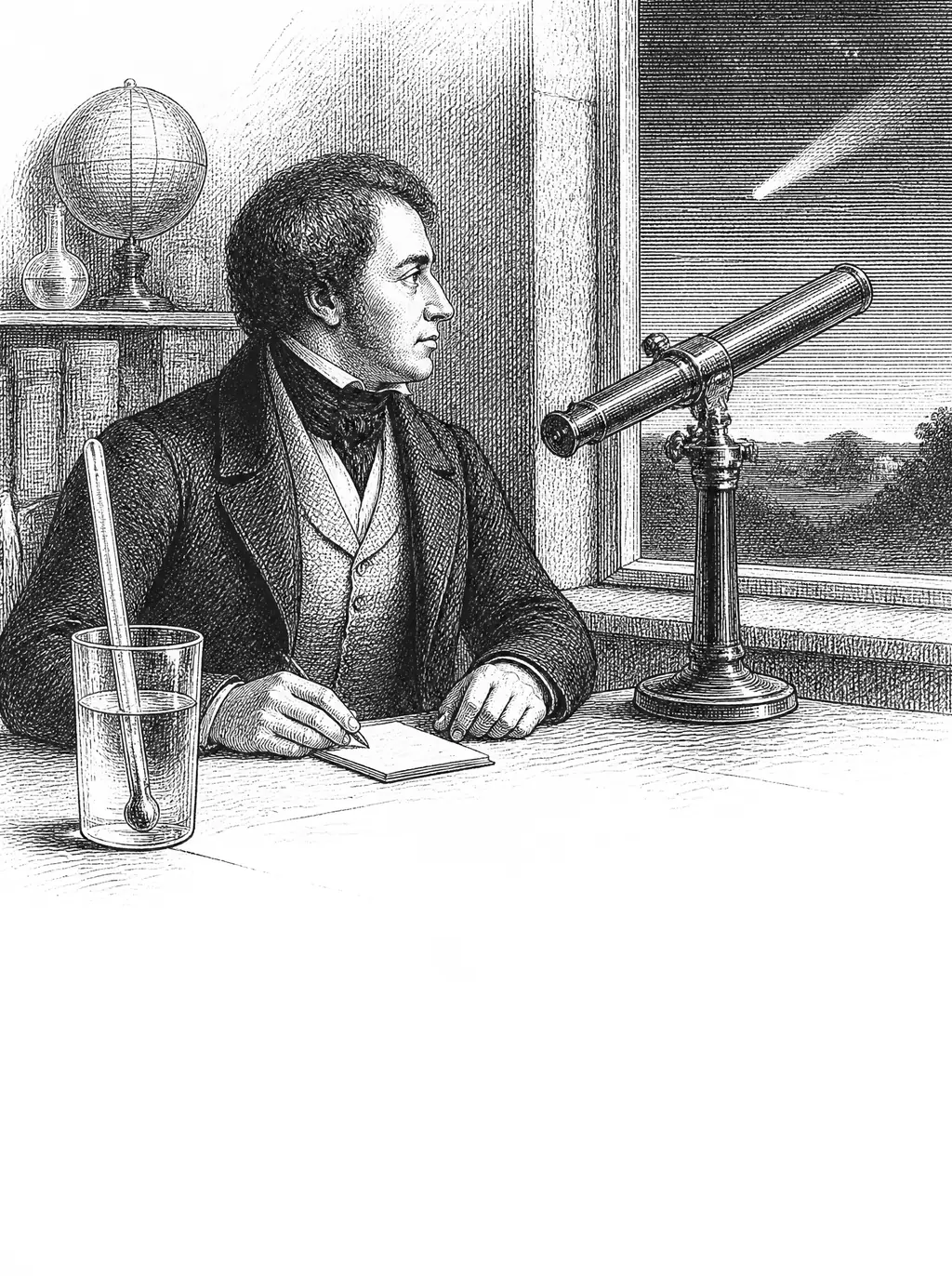
A Fact Is a Verified Theory
A forgotten founder
Before pragmatism became a movement, a small, informal Cambridge discussion group called the Metaphysical Club met to argue philosophy, science, and logic together. Wright, its sharpest and most rigorously scientific member, pushed Peirce and James both toward the empirical, verification-focused habits of mind that would later define pragmatism itself. He published little and died at forty-four. Almost everything he wrote appeared in reviews and letters, and the book that carries the quotation was assembled by friends after his death. Yet Peirce called him the club's boxing master, the man they went to be pummelled by, and James wrote his obituary in The Nation.
The world it came from
Wright was born in Northampton, Massachusetts, in 1830, studied at Harvard, and earned a thin living computing tables for the Nautical Almanac, a job he could finish in a few months each year so as to spend the rest reading and arguing. He was the first serious American defender of Darwin, and Darwin himself had Wright's 1871 reply to St. George Mivart reprinted in England. In the early 1870s Wright, Peirce, James, Oliver Wendell Holmes, and a few others met in Cambridge as the Metaphysical Club. Wright was its oldest member and its most uncompromising empiricist. The essay quoted here is his long examination of Herbert Spencer, whose grand evolutionary system Wright thought was all theory and no verification. The distinction between fact and theory is his reply.
The idea
A fact is a proposition of which the verification by an appeal to the primary sources of our knowledge or to experience is direct and simple. A theory, on the other hand, if true, has all the characteristics of a fact, except that its verification is possible only by indirect, remote, and difficult means. What separates a fact from a mere theory, on this account, is not their content but simply how directly each can be checked against experience. The word that matters is verification. Wright does not ask what a claim is about, or how confident anyone feels. He asks one thing: how many steps stand between the claim and an observation that would confirm it. A fact is a short path. A theory is a long one.
How the reasoning runs
Step one: every claim about the world is either checked against experience or it is not. Step two: some claims can be checked directly. Others can be checked only through chains of inference, instruments, and auxiliary assumptions. Step three: there is no third source. Intuition and elegance add nothing that verification does not. Step four: so the only difference between a fact and a theory is the length and difficulty of the path to verification. Step five: that path can shorten. A theory that once needed a long chain of reasoning becomes a fact when a new instrument lets you see it directly. Conclusion: fact and theory are not two kinds of proposition but two positions on one scale, and everything on the scale answers to experience alone.
Seen in life
A friend tells you a supplement improves memory. You ask how she knows. She says it stands to reason, because the compound is found in fish, and fish is brain food. Wright would ask how many steps separate that from an observation. Quite a few, and every one of them is a place to be wrong. Now imagine a trial: two hundred people, half on the supplement, half on a placebo, tested after six months. The path to verification has collapsed to one step. Nothing about the claim changed; its standing did. Wright's point is that you should hold beliefs at exactly the distance their verification allows. Most arguments you will hear this week are theories dressed as facts, and the dressing is the length of the path.
Why it matters
This gave the emerging pragmatist circle a sharply empirical model of what distinguishes settled knowledge from speculative theory, treating the difference as a matter of degree in verifiability rather than a fixed, permanent boundary. It fed directly into the verification-centered instincts Peirce and James would each carry into their own later, more famous work. It also gives you a way to read any confident claim. Do not ask whether it sounds like a fact. Ask what it would take to check it, and how far you are from doing so. That question turns the difference between fact and theory from a label into a measurement, and a measurement is something you can act on.
“A fact is a proposition of which the verification by an appeal to the primary sources of our knowledge or to experience is direct and simple. A theory, on the other hand, if true, has all the characteristics of a fact, except that its verification is possible only by indirect, remote, and difficult means.”
From the source
Wright draws the distinction plainly: “A fact is a proposition of which the verification by an appeal to the primary sources of our knowledge or to experience is direct and simple. A theory, on the other hand, if true, has all the characteristics of a fact, except that its verification is possible only by indirect, remote, and difficult means.” The passage comes from his 1865 essay on Herbert Spencer, collected after his death in Philosophical Discussions in 1877, edited by his friend Charles Eliot Norton. Wright's target was Spencer's habit of stating vast evolutionary laws as though they were observed. Spencer, he says, does not distinguish the two, and so mistakes a system for a science. The distinction is offered as a corrective, not as a metaphysics.
The pushback
Doesn't treating facts and theories as differing only in ease of verification blur an otherwise useful distinction, since some claims called facts still rest on chains of inference nearly as indirect as many theories do? Wright's own answer is that this blurring is simply accurate, since the boundary between fact and theory genuinely does shift as verification methods themselves improve. A harder objection is that direct verification may not exist at all. What you see through a telescope depends on optics you accept on theory; what you remember depends on a memory you trust on theory. If every observation is already loaded with theory, then there are no short paths, only paths whose length we have stopped noticing, and Wright's scale has no fixed end.
The reply
Wright would concede the second point readily. He never said facts are certain, only that their verification is direct and simple relative to the theories built on them. A telescope's optics are themselves verified, by short paths, and their reliability is a fact in his sense: a claim we can check quickly and often. What he denies is that this regress makes the scale useless. The distance between a supplement claim and a trial is real even if neither end is bedrock. The honest gap is that Wright offers no rule for measuring path length; it is a judgment. His answer to that was temperament. He trusted the working scientist's sense of what counts as a check, and doubted philosophy could improve on it.
Where it went next
Wright left no school and almost no book, so his legacy runs through the people he argued with. Peirce's Fixation of Belief, published two years after Wright's death, keeps his insistence that only appeal to something outside opinion can settle a question. James took from him a lifelong suspicion of systems, though James's own pragmatism admitted far more than Wright's strict verification would allow. The clearest descendant is the verification principle of the Vienna Circle in the 1920s, which drew the line between meaningful and meaningless where Wright had drawn the line between fact and theory. Louis Menand's The Metaphysical Club, in 2001, brought Wright back into the story, and he is now usually named as the club's intellectual center.
Where this leads
The irritation of doubt shows Charles Peirce, a fellow member of the same Cambridge discussion circle, developing a related but distinct account of inquiry, one concerned less with distinguishing fact from theory in the abstract than with what psychologically drives a mind to search for either one in the first place. The problem of induction is the older question underneath Wright's scale. Hume had asked what entitles you to expect the future to resemble the past. Wright never solved that; he took the working scientist's answer, that verified predictions are the only warrant we have, and built his distinction on it. Read Hume first and Wright's modesty makes more sense.