Symposium · Epistemology · Pl. 7Francis Bacon · 1561–1626
The Idols of the Mind
Statues in the way
Bacon believed centuries of natural philosophy had made little real progress not from lack of intelligence, but because thinkers kept mistaking their own mental habits for facts about the world. He called these habits idols, borrowing the word for a false image mistaken for the real thing, and set out to catalog exactly which kinds of idols were blocking clear sight. The catalog is short and it has aged well. Four centuries on, a psychologist reading it will recognize survivorship bias, confirmation bias, the framing effect, and motivated reasoning, each described by a Jacobean lawyer who had no name for any of them and did not need one.
The world it came from
Bacon was a lawyer, courtier, and politician who rose to Lord Chancellor under James I in 1618 and fell three years later, convicted of taking bribes. The Novum Organum appeared in 1620, at the height of his power, as the second part of a Great Instauration he never finished. Its title is a challenge: Aristotle's logical works were called the Organon, and the universities had taught them for four hundred years. Bacon thought that instrument produced disputes, not discoveries. Around him, ships were returning from a New World that no ancient author had mentioned, and the frontispiece of his book shows a vessel sailing past the Pillars of Hercules. Knowledge, he argued, should do the same, and its aim was the relief of man's estate.
The idea
Bacon names four species of idol: of the tribe, distortions built into human nature itself; of the den, quirks from an individual's own upbringing and temperament; of the marketplace, confusion introduced by imprecise language; and of the theatre, false systems inherited wholesale from received philosophy and dogma. Each one has to be identified and guarded against before observation can be trusted. The order matters. The tribe's idols are universal and cannot be removed, only watched. The den's are personal. The marketplace's are the most troublesome, because words are the tools of thought, and a bad word thinks for you. The theatre's are the easiest to see and the hardest to abandon, since every stage play looks complete from the seats.
How the reasoning runs
First, the mind is not a clear glass. It is a false mirror that mixes its own nature with the light it receives, and so it distorts by default. Second, the distortions fall into kinds, and a kind can be named and watched for. Third, the human understanding supposes more order than it finds, notices what confirms and forgets what does not, and is moved by what it prefers to be true; these are the tribe's idols and they are the deepest. Fourth, no individual can police them by introspection, because the policing mind is the one that is bent. Fifth, therefore the cure is a method rather than a resolution: slow induction from tables of instances, with the negative instances given the most weight.
Seen in life
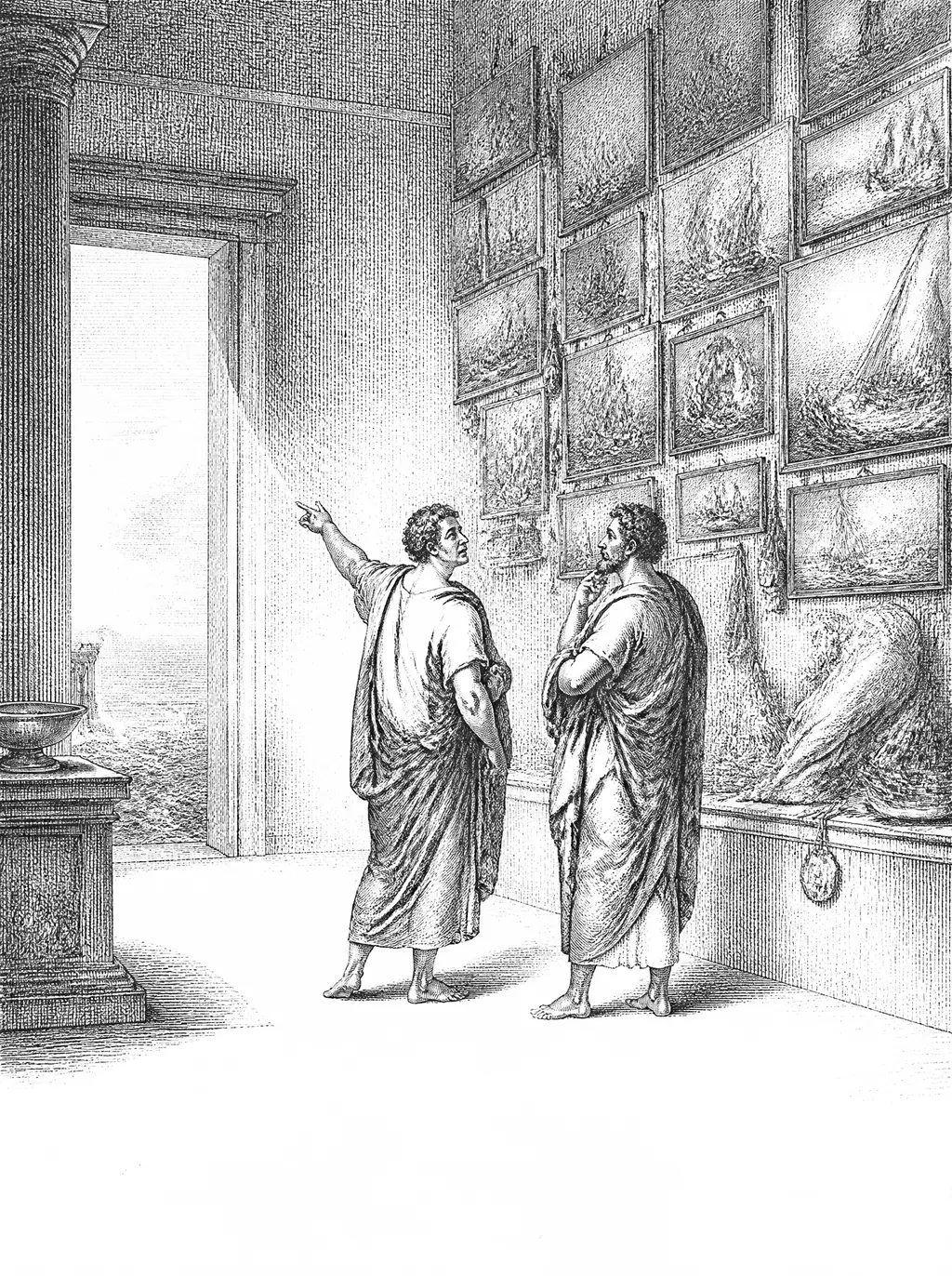
You read a profile of a founder who dropped out, ignored the advice, bet everything, and won. By the third such profile, a pattern seems to appear, and you begin to wonder whether caution is what has been holding you back. Bacon has a story for you. A man was shown a temple wall hung with portraits of sailors who had prayed and survived shipwreck, and was asked whether he now believed in the power of prayer. Where, he asked, are the portraits of those who prayed and drowned? Nobody profiles the founders who bet everything and lost, so the wall you are looking at was painted by survival. That is an idol of the tribe, and it has your attention right now.
Why it matters
This reframes the pursuit of knowledge as partly a defensive project: before you can reliably learn anything new about the world, you first have to clear away the distortions your own mind, language, and inherited beliefs have already introduced without your noticing. Bacon's idols anticipate, by centuries, the modern idea of cognitive bias, treated as a fact about minds to be actively managed. The practical point is humbling. Intelligence does not protect you; a quick mind builds a more elaborate idol. What protects you is procedure, a habit of looking for the case that would embarrass your conclusion and giving it the last word. Bacon called this the true induction, and it is the seed of every controlled experiment since.
“Four species of idols beset the human mind, to which (for distinction's sake) we have assigned names, calling the first Idols of the Tribe, the second Idols of the Den, the third Idols of the Market, the fourth Idols of the Theatre.”
From the source
Bacon names them all at once in the Novum Organum: “Four species of idols beset the human mind, to which (for distinction's sake) we have assigned names, calling the first Idols of the Tribe, the second Idols of the Den, the third Idols of the Market, the fourth Idols of the Theatre.” The naming is the thirty-ninth aphorism of Book I; the next twenty take the four in turn. Under the tribe he places the shipwreck portraits and the mind's love of order. Under the den, each person's private cave, colored by education, custom, and the books they happen to admire. Under the market, words that name nothing and words that name badly. Under the theatre, the received philosophies, stage plays neater than the world and just as invented.
The pushback
A fair question: if the mind is this thoroughly compromised by its own idols, what tool is left uncorrupted enough to identify and correct for them? Bacon's answer was his whole life's project, a disciplined method of careful, systematic observation and induction, meant to substitute for unaided judgment precisely because unaided judgment could not be trusted to police itself. A second objection targets that method itself. Karl Popper argued that science does not proceed by piling up observations and waiting for a law to appear; it proceeds by bold guesses that observation then tries to kill. On that view Bacon diagnosed the disease brilliantly and prescribed a cure nobody has ever actually used, since no scientist observes without a hypothesis.
The reply
To the first objection, Bacon's defenders point out that he never claimed a corruption-proof faculty. He claimed a procedure that catches errors the faculty cannot see, the way a ruler corrects an eye that thinks it can judge a straight line. The method is external for exactly the reason the objection raises. To Popper, the honest reply is a partial concession. Bacon underrated the guess; his tables of instances were never how discovery happened. But his insistence on the negative instance, the single case that breaks a rule, is the heart of Popper's own falsification, and Popper knew it. Where the reply thins out is method as cure for the tribe's idols. Those, Bacon admitted, can only be watched, and watching is the very thing they corrupt.
Where it went next
The Royal Society, founded in 1660, took Bacon as its patron and put him on the frontispiece of its history. The French Encyclopédie of Diderot and d'Alembert organized human knowledge on his plan and said so in its preface. Kant called the age of experiment Baconian. The four idols surfaced again in the twentieth century with new labels: Daniel Kahneman and Amos Tversky's work on heuristics and biases is a laboratory catalog of the idols of the tribe, and the statistician Abraham Wald's wartime study of bullet holes on returning bombers, which sent armor to the places with no holes, is the shipwreck story with data. The idols of the marketplace became the whole business of analytic philosophy.
Where this leads
The problem of induction returns, a century later, to interrogate the very method Bacon proposed as the cure for these idols, asking whether careful observation can ever fully justify a general conclusion about the future in the first place at all. Bacon trusted the patient table of instances; Hume showed that the step from the table to the next case has nothing under it. The method of doubt is Bacon's contemporary and rival. Descartes, writing twenty years later, also wanted to clear the ground before building, but he did it alone by his fire with a thought experiment, where Bacon wanted a whole institution of observers correcting one another. One trusted a single mind pushed to its limit; the other trusted a procedure precisely because no single mind could be.