Symposium · Epistemology · Pl. 2Zhuangzi · c. 369 – c. 286 BC
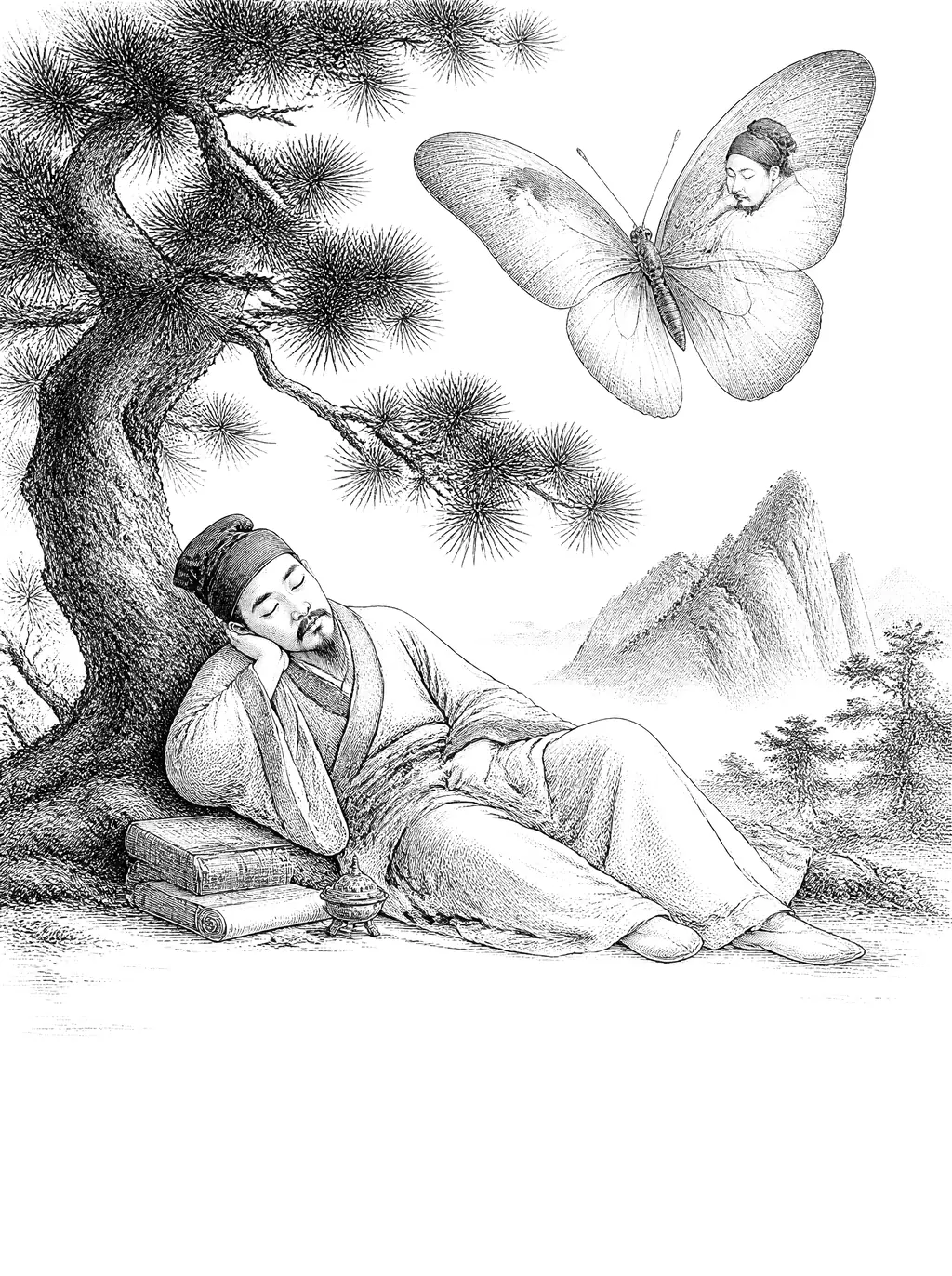
The Butterfly Dream
A perfectly convincing dream
In the dream, Zhuangzi was not a man imagining what it might feel like to be a butterfly. He was simply a butterfly, fluttering wherever fancy took him, with no sense at all of having once been anything else. The dream was total and convincing while it lasted, exactly as convincing, he realized on waking, as his waking life now felt. The story takes four sentences in the original, and it comes at the very end of a long chapter of arguments. That placement is the joke. After pages of reasoning about right and wrong, the chapter closes with a man who cannot tell whether he is a man, and seems perfectly cheerful about it.
The world it came from
Zhuang Zhou lived in the fourth century BC in the state of Song, during the Warring States period, when small kingdoms fought for survival and wandering thinkers sold rulers advice on how to win. One ancient story says he worked as a minor official at a lacquer garden and turned down the post of chief minister of Chu, saying he would rather be a live tortoise dragging its tail in the mud than a dead one honored in a temple. His close friend and favorite opponent was the logician Hui Shi, and the two argued constantly. Around them Confucians and Mohists debated what was right and wrong with great confidence. Zhuangzi's chapter on making all things equal is an answer to that confidence, and the butterfly is its last word.
The idea
If a dream can feel completely real from the inside, with no internal marker announcing itself as false, then feeling certain you are awake right now is not, by itself, proof that you actually are. Zhuangzi does not claim to know the answer. He sits with the uncertainty directly: perhaps he is a man who dreamed he was a butterfly, or perhaps a butterfly now dreaming he is a man. Then he adds a line most retellings drop. Between Zhou and the butterfly there must be some distinction, and this is called the transformation of things. The story is not only about doubt. It is about identity as a stage in a process, something you pass through rather than something you are.
How the reasoning runs
First, in the dream the butterfly did not know it was Zhou. The experience was complete and carried its own certainty. Second, on waking, Zhou is unmistakably Zhou, and that certainty feels complete too. Third, both states supply the same feeling of being real, so the feeling cannot be what tells them apart; a test that gives the same result either way tests nothing. Fourth, so from inside either state you cannot settle which is the dream. Fifth, and yet there is a distinction between Zhou and the butterfly; the story does not deny it. Sixth, the distinction is one of transformation: Zhou becomes butterfly becomes Zhou, the way things change into one another. Therefore hold your identity the way you would hold a dream, lightly.
Seen in life
You dream that your father is alive. Not a ghost, not a memory: he is in the kitchen making coffee, complaining about the news, and there is nothing strange about it because in the dream he never died. You wake and for four or five seconds you have to decide which world is the real one. The kitchen with him in it was complete. This bedroom, with the grief waiting in it, is complete too. Then the waking world wins, as it always does, and you notice that it won by force of habit and daylight, not by showing you a proof. Zhuangzi lived in those five seconds and asked why the rest of the day should be more certain.
Why it matters
This strikes at a foundation most people never examine: the assumption that ordinary waking experience carries some special mark of reality that dreams lack. Zhuangzi's point is not that nothing is real. It is that certainty about which state you are actually in cannot be settled from inside either state, since both can feel equally seamless and complete while they last. What follows for him is not anxiety but ease. If the self you defend so hard is one transformation among many, then the arguments you win, the rank you hold, and the rightness you insist on are butterfly business, real enough while the dream lasts. The chapter's title is making all things equal, and this is what equal comes to.
“Now I do not know whether I was then a man dreaming I was a butterfly, or whether I am now a butterfly dreaming I am a man.”
From the source
Zhuangzi tells the story himself: “Once upon a time, I, Chuang Tzŭ, dreamt I was a butterfly... Now I do not know whether I was then a man dreaming I was a butterfly, or whether I am now a butterfly dreaming I am a man.” The passage sits at the end of the second of the Inner Chapters, the seven that scholars most confidently assign to Zhuangzi himself. In Herbert Giles's translation the butterfly flutters hither and thither, to all intents and purposes a butterfly, conscious only of following its fancies. Then, suddenly, Zhou awakes. The last sentence, which the quotation above leaves out, says that between a man and a butterfly there is necessarily a barrier, and that this is the transformation of things.
The pushback
Doesn't ordinary life contain plenty of markers, consistency, pain, other people confirming what happened, that dreams typically lack, so the two states are not actually so hard to tell apart? Zhuangzi's response, consistent with the wider Daoist current he wrote within, is less concerned with settling the metaphysical question than with loosening your grip on certainty itself, wherever that grip has become rigid. A sharper objection comes from the story's own structure. The butterfly had no memory of Zhou, but Zhou remembers the butterfly. That asymmetry is exactly the marker the story claims not to have. The waking man contains the dream; the dreamer did not contain the waking. So we can tell, and the puzzle dissolves.
The reply
The asymmetry is real, and a careful reader of Zhuangzi will grant it. But notice what it shows. Memory tells Zhou that the butterfly was a dream; it does not tell him that this state, the one doing the remembering, is not itself contained in some further waking he cannot yet see. The chapter says as much a few lines earlier: someday there may be a great awakening after which we know that all this was a great dream. Every state that remembers a dream is still a candidate for being one. That is a partial answer. It moves the doubt back a step rather than removing it, and Zhuangzi seems content with that, because removing it was never his aim.
Where it went next
Guo Xiang's commentary in the third or fourth century AD fixed the text in the form we read and pushed the transformation reading: each state is complete in itself, and the point is to be fully what you currently are. Chan Buddhism, arriving in China a few centuries later, found in Zhuangzi a native vocabulary for its own suspicion of fixed selves, and Zen inherited the taste. The butterfly flew into Chinese poetry with Li Bai and into the West through translations from the nineteenth century onward. Borges collected it. Descartes's dream argument in the first Meditation asks the same question with none of the cheer, and every film about nested dreams, from Inception outward, is a retelling with a bigger budget.
Where this leads
The evil spirit poses an almost identical challenge from the opposite end of the world and centuries later, using a scheming demon instead of a butterfly to raise the very same unsettling question about what waking certainty is actually worth trusting. The difference is in the mood. Descartes wants a way out and finds one stone to stand on; Zhuangzi wants no way out and sits down in the middle of the doubt. Plato's cave puts the dreamer in chains and calls the waking a painful climb. Zhuangzi would say the man who climbs out and insists the sunlight is the real world has simply had a more strenuous dream, and would smile and offer him tea.