Symposium · Epistemology · Pl. 8René Descartes · 1596–1650
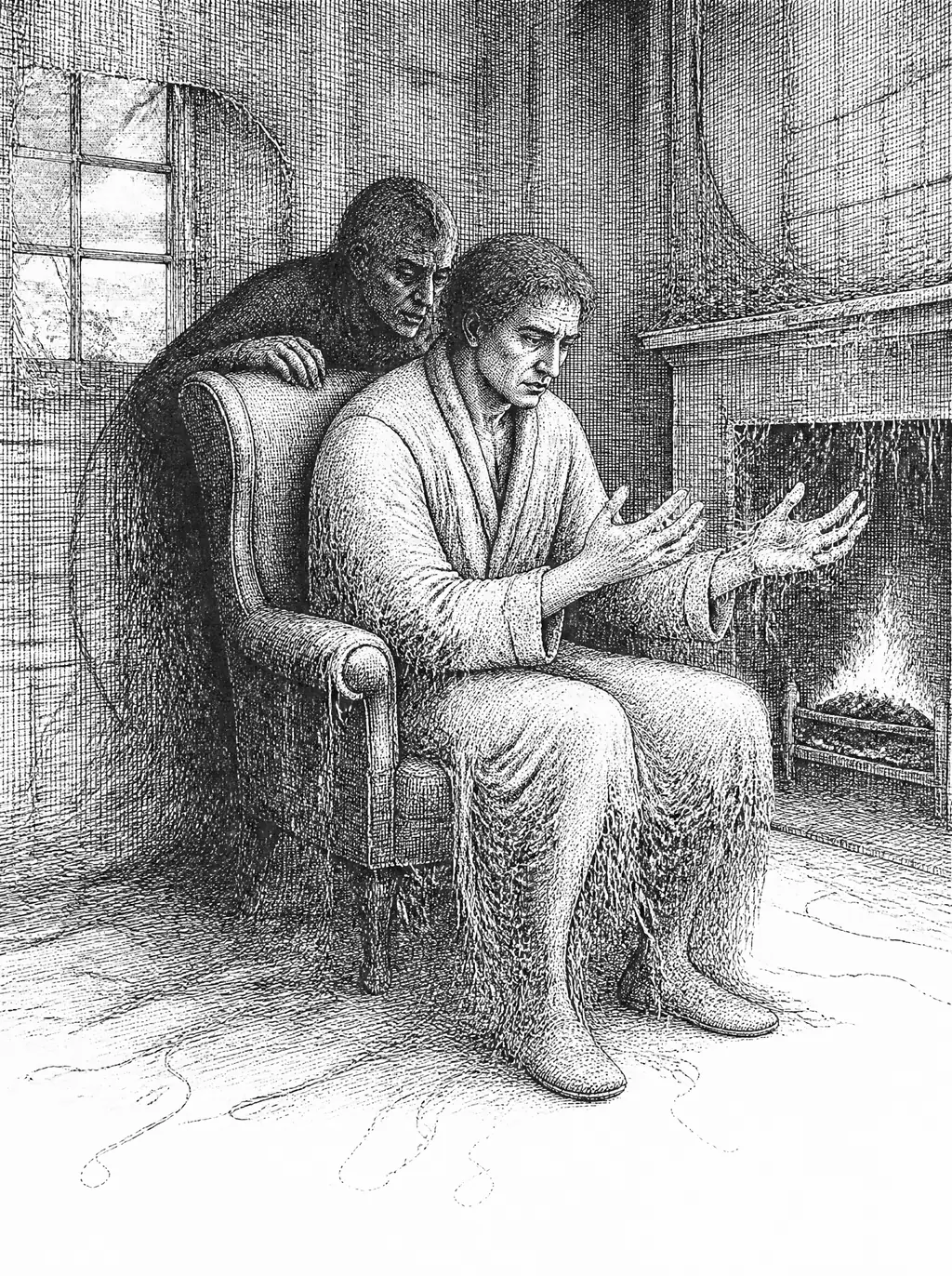
The Evil Spirit
A demon built to deceive
Sitting alone by his fire, Descartes decided to doubt everything he could possibly doubt, on purpose, as an experiment. To push the doubt as far as it would go, he imagined an evil, powerful, and cunning spirit devoted entirely to deceiving him: making the sky, the earth, his own body, and even simple sums seem real when none of it was. He did this in stages, and each stage was worse than the last. First the senses, which sometimes lie. Then dreams, which lie completely. Then the demon, who could lie even about two and three making five. By the end of the first Meditation he has nothing left, and that was the plan.
The world it came from
Descartes was educated by Jesuits at La Flèche, served as a gentleman soldier, and on a November night in 1619, shut in a stove-heated room in Germany, had the dreams that convinced him to rebuild knowledge from the ground up. He settled in the Netherlands in 1628 for the quiet. The intellectual weather was skeptical: Sextus Empiricus had been reprinted, Montaigne asked what do I know, and Aristotle's physics was collapsing under Galileo. When Rome condemned Galileo in 1633, Descartes withdrew his own book on the world and looked for a safer route. The Meditations of 1641 was that route: a foundation the skeptics could not dig under, on which a new physics could be built without arguing with the Church.
The idea
The method of doubt means withholding belief from anything that could conceivably be false, no matter how certain it feels, until you find something that survives even the worst-case deceiver. Ordinary caution doubts only what looks suspicious. Descartes doubted everything, including his own senses and his memory, to see what bedrock, if any, was still standing underneath. The demon is the method's sharpest tool. You do not have to believe such a spirit exists. You only have to admit you cannot rule it out, and then notice that every belief it could counterfeit is, for now, off the table. What is left when the counterfeits are cleared is the only thing worth building on.
How the reasoning runs
First, a foundation is only as sound as its weakest stone, so if any belief could be false, it cannot serve. Second, rather than test beliefs one at a time, attack their sources. Third, the senses have deceived before, so nothing from the senses is certain. Fourth, dreams show that a whole waking scene can be fabricated, so even the existence of your hands is doubtful. Fifth, mathematics survives dreaming, since two and three make five asleep or awake; so suppose a deceiver powerful enough to make you err even there. Sixth, now nothing from the senses, memory, or reason is certain. Therefore anything still standing has been tested against the strongest possible doubt, and that is the foundation.
Seen in life
A video arrives on your phone. A politician you dislike says something appalling, and the clip has a million views. You know the tools now exist to fabricate a face, a voice, and a room, and that they are getting cheaper by the month. So run Descartes's exercise. Could this be fake? Yes. Could the reply that debunks it be fake? Yes. Could the news story confirming the debunk be generated too? In principle. Keep going and you reach the demon: a feed engineered to show you exactly what moves you. Now ask what survives. Not the clip, not the confirmation. Only the fact that something is here, watching, and deciding what to do about it.
Why it matters
Most beliefs are built on other beliefs, which are built on still others, with no one ever checking whether the bottom layer actually holds weight. Descartes wanted one belief that could not be shaken by any deceiver, however powerful, so that everything rebuilt afterward would rest on something other than habit, custom, or simply never having thought to ask. The method matters even if you never accept his answer. It sets the standard for what a real test of a belief looks like: not whether it feels obvious, but whether it would survive the strongest attack you can imagine. Every later attempt to say what knowledge is, and every fantasy about living inside a simulation, is an answer to the demon.
“I will suppose, not an infinitely perfect God, the fountain of truth, but that some evil spirit which is very powerful and crafty has used all his endeavours to deceive me.”
From the source
In his Meditations, Descartes sets the experiment up directly: “I will suppose, not an infinitely perfect God, the fountain of truth, but that some evil spirit which is very powerful and crafty has used all his endeavours to deceive me.” He goes on: the sky, the air, the earth, colors, shapes, sounds, and all external things are nothing but illusions this spirit uses to trap his belief. He will consider himself as having no hands, no eyes, no flesh, no blood, no senses, but falsely believing he has all these. He ends the first Meditation with a captive who dreams of freedom and dreads waking, and says he is like that captive: he would rather sink back into the old opinions than face the labor ahead.
The pushback
Isn't this an absurd amount of doubt to manufacture over a dinner-table thought experiment, when no one actually lives as though a demon might be lying about the floor beneath their feet? Descartes would agree that no one can live this way permanently. The doubt is a tool for one specific philosophical purpose, not a lifestyle, and he drops it the moment it has done its job. The harder objection is Charles Peirce's. Doubt that is merely announced is paper doubt, and it does no work: you cannot really doubt something by deciding to. Real doubt comes from a surprise, a belief colliding with the world. Let us not pretend to doubt in philosophy, Peirce wrote, what we do not doubt in our hearts.
The reply
A Cartesian answers that the method never asked for felt doubt, only for suspended assent. You do not have to feel the floor is unreal to notice that you cannot prove it is real, and the proof is what the method is looking for. The demon is a test rig, not a mood. That answer holds against Peirce, but it exposes a deeper problem. Descartes has to climb out of the doubt again, and he does it by proving that God exists and would not deceive him, using reason he has just declared suspect. Arnauld spotted the circle in 1641, and nobody has closed it since. The method is one of the great inventions in philosophy. The escape route is not.
Where it went next
The demon became the ancestor of every skeptical scenario since. Hume distinguished this antecedent doubt from the kind that arises in inquiry and judged it incurable if taken seriously. Hilary Putnam rebuilt it in 1981 as the brain in a vat and argued the scenario refutes itself, since a vat-brain's word vat cannot refer to real vats. G. E. Moore answered by holding up his hands. Wittgenstein's On Certainty argued that doubt needs a background of things not doubted, so the demon's total doubt is not doubt at all. Husserl turned the method into phenomenology's bracketing. The Matrix put the demon in sunglasses, and Nick Bostrom's simulation argument gave it a probability estimate.
Where this leads
Cogito ergo sum names the one single thing Descartes eventually found that the demon could never touch, the fixed point his entire method of doubt was built, from its very first sentence onward, deliberately and patiently to go looking and searching for. The demon and the cogito are two halves of a single gesture: tear down until one stone refuses to move, then build on that stone. Plato's cave is the older version, told as a story rather than a method. Plato's prisoners are deceived by a fire and a puppet show they cannot see; Descartes's prisoner is deceived by a spirit he invented for the purpose. Both ask the same question: if everything you see is staged, what is doing the seeing?