Symposium · Philosophy in Fiction · Pl. 11William Shakespeare · 1564–1616
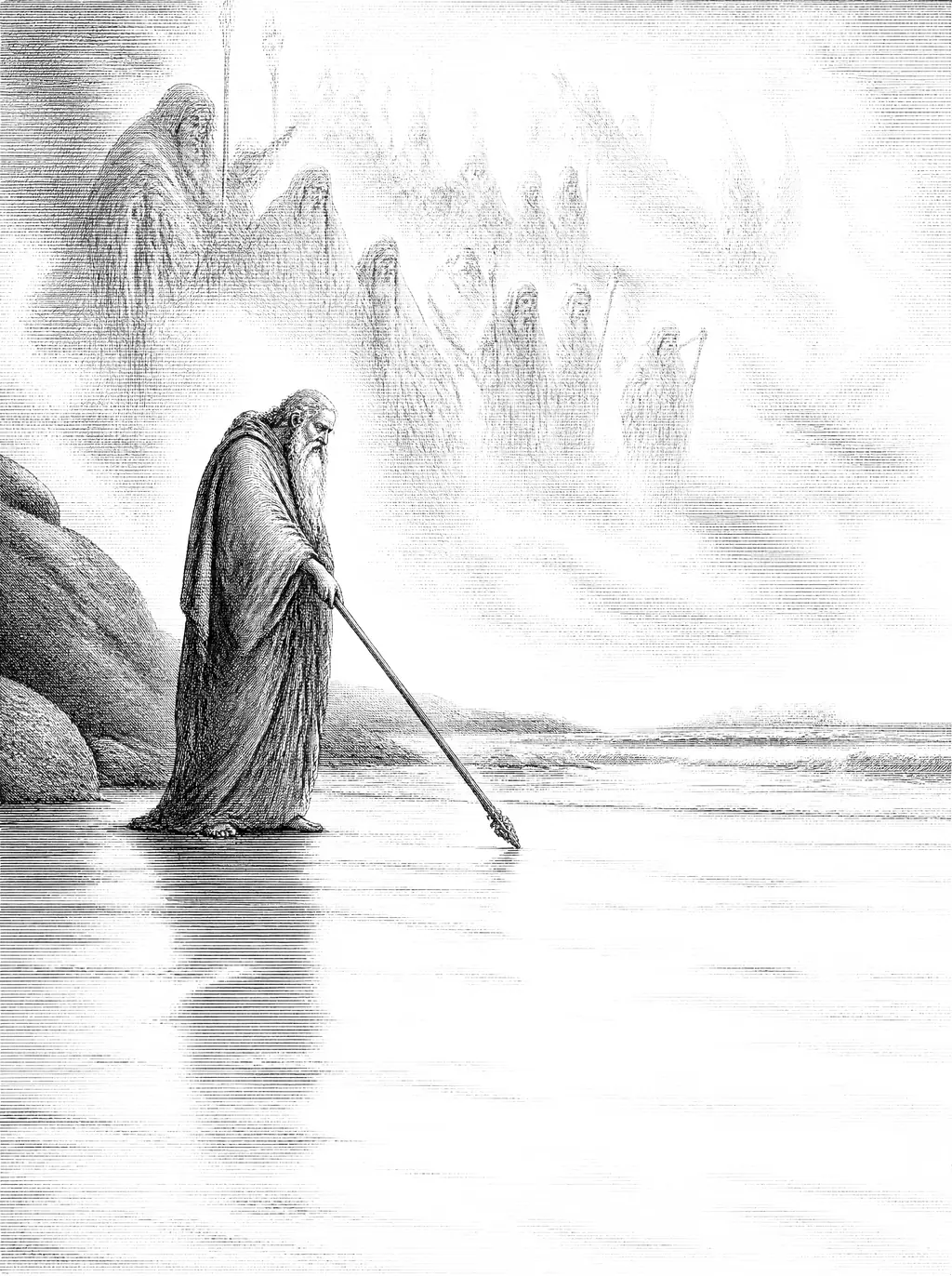
Such Stuff as Dreams Are Made On
The revels are ended
Prospero has conjured a wedding entertainment for his daughter and her betrothed: goddesses, nymphs, a harvest dance. Halfway through he remembers a plot against his life, breaks the spell, and the whole spectacle disappears. Ferdinand looks shaken. Prospero reassures him in the calmest voice in the play, and then, instead of stopping at the masque, keeps widening the frame. The actors were spirits. So are the towers and the palaces. So is the globe. The speech takes about ten lines to travel from a cancelled show to the dissolution of everything, and it never raises its voice.
The world it came from
The character is Prospero, exiled Duke of Milan and magician of the island; the play is The Tempest, first performed in 1611 and first printed in the 1623 Folio, seven years after Shakespeare died. It is very likely the last play he wrote alone, and readers have heard a farewell in it since the eighteenth century. The Globe theatre stood on the Bankside; the great globe itself is a pun a Bankside audience could see out of the window. Behind the lines lie older sources: Ovid's Medea, Montaigne on the vanity of human works, and the medieval commonplace that the world is a stage and the stage a dream.
The idea
Everything solid is temporary, and the difference between a stage illusion and a stone tower is duration, not kind. The masque lasted twenty minutes; the palace will last four hundred years; both dissolve, and both leave nothing behind. Prospero then folds the audience into the same category. We are not people watching insubstantial things vanish. We are made of the same material, a brief coherence with sleep on either side of it. The claim is not that life is worthless or false. It is that nothing in it has the permanence we quietly assume when we build, inherit, and plan.
How the reasoning runs
The speech argues by widening a category until the listener is inside it. First, the masque was insubstantial, which nobody disputes; the spirits melted into air. Second, the towers and palaces and temples differ from the masque only in how long they hold their shape, and Prospero names them in ascending order of apparent solidity to make the point. Third, if the difference is duration alone, then no member of the series is a different kind of thing from the first. Fourth, we inherit and inhabit that series; we are not observing it from outside. Therefore we are of the same stuff, and the sleep at each end of a life is the frame.
Seen in life
You walk through a company that no longer exists, in a building now converted to flats. Twelve years of your working life happened in a room that is somebody's kitchen. The org chart, the arguments about the org chart, the person whose approval decided your year: none of it is anywhere. It did not fail. It simply reached the end of the interval it had, exactly as the masque did when Prospero stopped clapping. The useful move is not to conclude that the work was pointless. It is to notice that you were treating the arrangement as ground when it was scenery, and to see what changes if you do not.
Why it matters
Almost every anxiety assumes a permanence that the speech denies: the reputation to be protected forever, the institution that must not change, the version of yourself that has to be preserved. If Prospero is right, the effort spent defending the fixed shape of things is spent against the grain of what things are. That reading can console or it can hollow you out, and the play knows it. Prospero says the lines while he is old, tired, and about to give up his art, and the last thing he does with the insight is forgive his enemies and go home.
“We are such stuff / As dreams are made on, and our little life / Is rounded with a sleep.”
From the source
The speech comes in Act 4, Scene 1, after the masque has been broken off and Ferdinand has looked alarmed. Prospero tells him the actors were all spirits, melted into air, into thin air, and that like the baseless fabric of that vision the cloud-capped towers, the gorgeous palaces, the solemn temples and the great globe itself shall dissolve and leave not a rack behind. Then the turn: “We are such stuff / As dreams are made on, and our little life / Is rounded with a sleep.” He apologises immediately for his own vexation, says his old brain is troubled, and asks the couple to withdraw so he can walk off his beating mind.
The pushback
The first objection is that this is mood, not argument. A tired magician speaks beautifully about dissolution, and readers have mistaken elegance for a proof. Nothing here establishes that a palace is metaphysically like a masque; long-lasting things really are different from illusions, and the difference matters to anyone deciding whether to build a hospital. The second objection is moral. If nothing holds, why keep a promise, finish a project, or repair a wrong? Prospero's own plot depends on obligations that outlast the moment, which sits awkwardly beside a speech saying nothing outlasts anything.
The reply
On the first charge, the speech is doing less than a metaphysics and more than a mood. It does not claim the palace is unreal; it claims the palace is temporary and that we treat it as though it were not. That is a psychological error with a factual correction, and the correction is true. On the second, the play answers by what Prospero does next rather than by argument. He drowns his book, releases his prisoners, and pardons the brother who tried to kill him. Impermanence does not remove obligations; it removes the excuse of waiting, since there is no later in which the accounts get settled instead.
Where it went next
The lines became the standard English text for the brevity of everything, carved on memorials and borrowed for titles; John Huston's 1941 film of The Maltese Falcon ends on a deliberate misquotation of them. Nineteenth-century critics read the whole speech as Shakespeare's own farewell to the stage, an identification that is unprovable and has never lost its grip. Twentieth-century productions pulled against it, staging Prospero as a colonial governor rather than a retiring artist, which makes the dissolution of the towers sound less like resignation and more like a threat. The Buddhist reading, that the passage states impermanence plainly, arrived late and has stuck.
Where this leads
Zhuangzi's butterfly reaches the same suspicion from the other end. Prospero argues down from the vanished masque to us; the dreamer wakes and cannot establish which side of the waking he is on. Read them together and the question splits into two: how long does a thing last, and how would you know which state you are in. Descartes turns the second into a method, using the dream deliberately as a tool for demolition rather than as a lament. And memento mori is the practical descendant, the same fact about duration handed over as a daily exercise instead of a farewell speech.