Symposium · Eastern Philosophy · Pl. 18Zhuangzi · c. 369 – c. 286 BC
The Usefulness of Uselessness
The tree nobody wanted
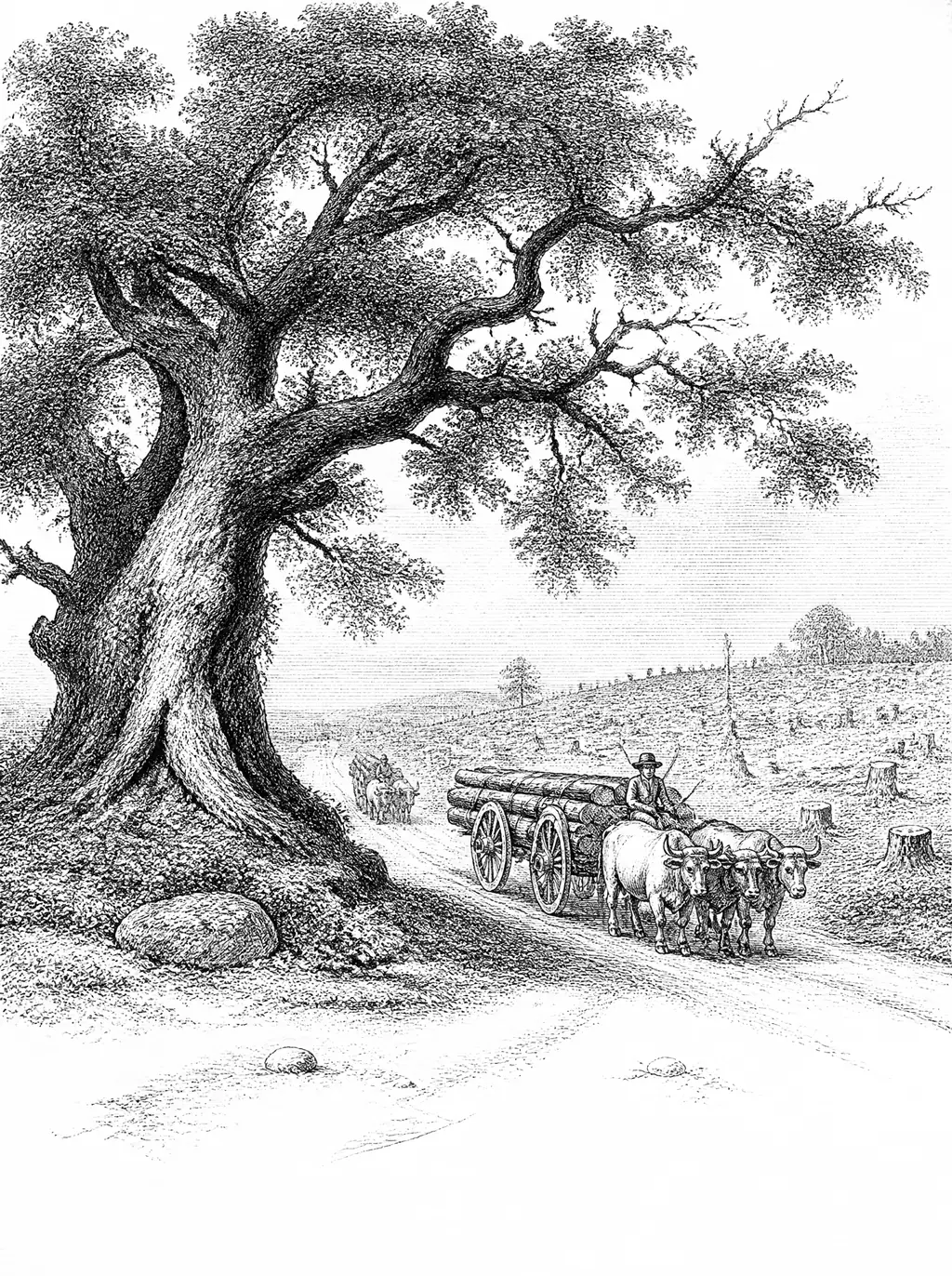
Tzŭ Ch'i comes across an enormous tree on Shang mountain and looks it over expecting fine timber, only to find branches too crooked for rafters, a trunk too irregular for coffins, leaves that blister the lips, and a smell strong enough to intoxicate. Every quality that would normally make a tree valuable is missing, which is exactly why it is still standing. Zhuangzi sets the scene on purpose. His reader has been raised to admire usefulness. The tree is the first argument in the book that a life can be ruined by being good at something.
The world it came from
Zhuangzi, or Zhuang Zhou, lived in the state of Song during the Warring States period, in the fourth century BC, when rival kingdoms hired talent and fed it into wars. The book that carries his name was assembled over centuries; the first seven Inner Chapters are usually taken as his own. The useless tree appears in the fourth of those, called In the Human World, alongside a carpenter who passes an enormous oak at a village shrine without a glance. Zhuangzi's targets are the Confucians and Mohists, who competed to make men useful to rulers, and his friend Huizi, a logician who once complained that Zhuangzi's teaching was as big and useless as a gnarled tree. The reply was this parable.
The idea
This tree is good for nothing, and that is how it has attained this size. Every straight, strong, useful tree nearby has already been cut down for exactly the qualities that made it valuable. The useless tree, wanted by no carpenter, was left alone to grow enormous, and Zhuangzi suggests a wise person might do well to follow its example. The last lines of the chapter say it outright: everyone knows the use of the useful, but nobody knows the use of the useless. Zhuangzi is not praising waste. He is pointing at a blind spot.
How the reasoning runs
Step one: ask why the good trees are gone. Not by accident; each was felled for a quality someone wanted, straight grain, sweet fruit, fragrant wood. Step two: notice that the felling was caused by the quality, not despite it. Usefulness is a signal that draws the axe. Step three: apply this to people. In Zhuangzi's world, a man known for talent was summoned by a court, used in a war, and executed when the war turned. Step four: the tree that survives is the one that offered nothing worth taking. Conclusion: safety and long life can lie in not being the obvious resource. The argument does not say talent is bad. It says talent is a hook, and a wise person watches what the hook catches.
Seen in life
You are the one on the team who fixes everything. Every crisis routes through you, every weekend call is yours, and the promotion list keeps naming people who did less and were less visible doing it. Three years in, you are exhausted and cannot leave, because the place would collapse. That is the straight tree. The colleague two desks over is pleasant, competent, and unremarkable, does the work assigned and goes home. Nobody thinks to lean on her, so she has a life, and a decade later she is still there and still whole. Zhuangzi would not tell you to become her. He would ask whether the usefulness you built was a gift to yourself or a fence around you.
Why it matters
A relentless drive to be maximally useful, visibly skilled, obviously valuable to everyone around you, can attract exactly the kind of attention and demand that wears a person down early. Zhuangzi's tree suggests real safety and longevity sometimes come from being harder to exploit, not from advertising your usefulness as loudly and constantly as possible. The lesson is sharper in an economy that measures everyone. When your value is legible, it will be spent. The tree's crookedness is a kind of privacy, and Zhuangzi thinks privacy is what a long life is made of.
“This tree is good for nothing, and that is how it has attained this size. A wise man might well follow its example.”
From the source
Zhuangzi delivers the tree's lesson directly: “This tree is good for nothing, and that is how it has attained this size. A wise man might well follow its example.” He would then escape danger from his surroundings, the text adds, exactly as the tree escaped the carpenter's axe. Herbert Giles published this translation in 1889, the first widely read English version. The same chapter gives a tree its own voice in a dream: the shrine oak tells the carpenter that it spent a long time trying to be useless, and that being useless is its use. Zhuangzi lets the tree be smarter than the man.
The pushback
Doesn't celebrating uselessness risk becoming an excuse for laziness or a wasted life, dressed up in philosophical language? Zhuangzi is not against skill or contribution as such; his target is a narrower trap, the way visible usefulness specifically invites being used up by others, a danger genuine uselessness, oddly, is protected from entirely. There is a harder pushback. The parable only works for trees. A person who hides every talent is not spared; they are ignored, underpaid, and unprotected. Uselessness has costs that the tree, rooted and patient, never pays.
The reply
Zhuangzi partly concedes this. In a later chapter a host kills a goose that cannot honk and spares the one that can, and Zhuangzi's students ask which he would choose. He answers that he would sit somewhere between usefulness and uselessness, and adds that even that is not quite safe. The honest reading is that the tree is not a formula but a corrective. Its job is to loosen the grip of a single value, being wanted, that most people never question. Where the answer stays partial is exactly where the objection lands: a poor person cannot afford to be a crooked tree. Zhuangzi was a minor official who turned down a chancellorship. The parable comes from someone who could.
Where it went next
Guo Xiang's commentary, from around 300 AD, made Zhuangzi a classic for the Neo-Daoist gentlemen of the Wei-Jin period, who quoted the tree to justify withdrawing from court politics. Chan Buddhists borrowed his taste for paradox and his suspicion of the earnest. Poets from Tao Yuanming to Su Shi wrote their retirements in his voice. Herbert Giles's 1889 translation reached Oscar Wilde, who reviewed it and relished a sage who found governing beneath him. Martin Buber published German selections in 1910, and Heidegger read them. Today the phrase the use of the useless turns up in defences of pure research and the humanities, sometimes with Zhuangzi's name attached, sometimes without. The tree keeps being cited by people who want to be left alone.
Where this leads
The butterfly dream shows this same restless Zhuangzi questioning another comfortable certainty from a completely different angle again, this time about which side of a dream, waking or sleeping, actually earns the right to be called the truly real one. The two parables share a method. Each takes a distinction everyone trusts, useful and useless, waking and dreaming, and shows that the confidence was never earned. Zhuangzi does not replace the distinction; he leaves you holding it more loosely.