Symposium · Philosophy in Fiction · Pl. 3Voltaire · 1694–1778
Twenty Acres
The last thing Candide learns
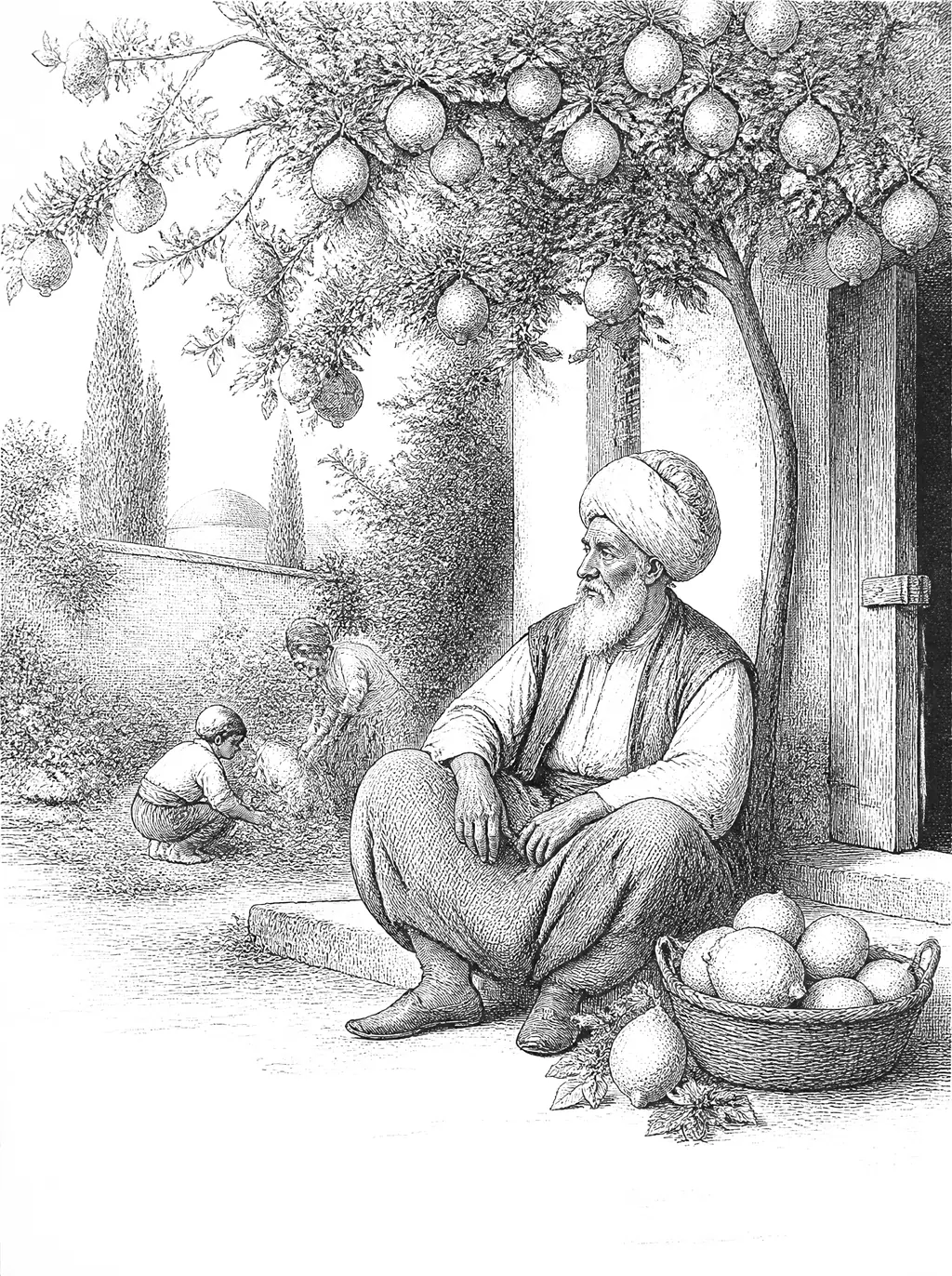
Candide has crossed two continents, lost and found Cunegonde, been rich in El Dorado and poor everywhere else, and heard his tutor explain each catastrophe as a link in a perfect chain. Near Constantinople, after a dervish shuts a door in their faces, the survivors pass a small farm. An old man is taking the air under an orange bower. He has twenty acres. He has not heard that two viziers and the mufti were strangled that morning, and he does not care. He works the land with his children and sells fruit in the city, and he is visibly better off than anyone else in the book.
The world it came from
The character is unnamed and appears for one page. Voltaire calls him the good old man, the honest Turk, and he is the last teacher Candide meets, arriving after the philosopher Pangloss, the pessimist Martin, the six deposed kings, and the silent dervish who refuses to discuss the origin of evil at all. The book was written in 1758 in the aftermath of the Lisbon earthquake and during the Seven Years' War, and its final chapter empties the stage of every grand explanation on offer. What is left is a farm, six damaged people, and a division of labour. Cunegonde bakes, the old woman does the linen, the friar becomes a joiner.
The idea
The garden is a decision about scope. Candide does not settle whether the world is well made, whether providence exists, or whether his suffering was necessary; he stops asking, and starts on work whose results he can see by evening. The old Turk gives the reason: labour keeps off three evils, boredom, vice, and need. This is not a retreat into private comfort, since the farm is shared and everyone on it has a job that others depend on. It is a claim that a life is improved from inside its own reach, and that the questions too large to settle should not be allowed to eat the afternoon.
How the reasoning runs
Follow the eliminations. Grand theory has been tried and produced Pangloss, who explains everything and helps nobody. Pure pessimism has been tried and produced Martin, who is right about the world and equally useless. Wealth has been tried and produced nothing, since El Dorado's gold bought only more travel to more disasters. Power has been tried at the supper of the six kings, all of whom lost it. Religion has been tried and the dervish shut the door. Every large answer fails, and by the end the only proposal not yet refuted is the smallest one: pick a task within your hands, do it with other people, and let the rest go unanswered.
Seen in life
You spend an evening reading about a war you cannot influence, an economy you cannot steer, and a climate whose numbers you have memorised. You end the evening informed, angry, and no use to anyone, including yourself. Then you spend the next evening fixing a neighbour's fence, or teaching one person something, or cooking for four, and something in the house is different afterwards. The old Turk's argument is not that the war does not matter. It is that boredom, vice, and need arrive in every life that has nothing to do, and that they arrive faster in a life spent watching what it cannot touch.
Why it matters
Cultivating your garden became one of the few philosophical phrases that ordinary speech kept. It named a whole posture: work close to hand, scepticism about systems, suspicion of anyone who explains too much. It also marked a change in what a philosophical answer could look like, since Voltaire ends a book about metaphysics by describing a routine rather than defending a proposition. That move recurs later in Thoreau, in the pragmatists, and in modern arguments about attention and scale. The phrase is quoted so easily that most people never meet the disasters it comes after, which is the one thing Voltaire built the previous thirty chapters to prevent.
“I and my children cultivate them; our labour preserves us from three great evils—weariness, vice, and want.”
From the source
Candide asks the old man about his estate, expecting the vast holdings of somebody so untroubled. The answer is small: “I and my children cultivate them; our labour preserves us from three great evils—weariness, vice, and want.” The Turk has twenty acres, no interest in the strangled mufti, and two daughters who perfume the strangers' beards before they leave. Candide walks home making, in Voltaire's phrase, profound reflections on the conversation, and tells Pangloss and Martin that this man seems better placed than the six kings they once had supper with. The book closes a page later with everyone at work and the theorising, for the first time, put down.
The pushback
Isn't the garden a comfortable withdrawal dressed as wisdom? The world the novel described is still full of inquisitions and press gangs and slavers, none of which stop because six people took up gardening near Constantinople. Told to a person with no land and no options, the advice sounds less like philosophy and more like an instruction to stay quiet. A second objection is that the ending dodges the question the book raised. Candide never establishes that theodicy fails, only that arguing about it is tiring, and exhaustion is not a refutation of anything.
The reply
The strongest reply is biographical. Voltaire spent his own last years at Ferney running exactly such an estate, and from it campaigned publicly for Jean Calas, a Protestant broken on the wheel on a false charge, and won a posthumous acquittal that shook French justice. He did not read his ending as withdrawal, and the garden in his hands produced watches, a village, and a legal reform. On the second objection the reply is a concession with a point attached. The book does not refute theodicy. It argues that a question you cannot settle should not be allowed to decide how you spend a life, which is a claim about time rather than about God.
Where it went next
The line became a proverb in French and English alike and detached itself from the novel almost at once. Thoreau's bean field at Walden is a garden in this sense, and so is William Morris's workshop. Camus, who admired the ending, has Rieux in The Plague doing his rounds without a theory of why the plague came. Bernstein's 1956 operetta ends on it, sung as a chorus. Gardeners, Stoics, and burnt-out professionals all quote the phrase, usually as permission to stop reading the news, which is roughly what Voltaire meant and exactly what he did not do himself.
Where this leads
Pangloss keeps his theory is the other half of the same last chapter, the professor still explaining while Candide stops listening, and it shows what the garden is a reply to. The dichotomy of control gives the Stoic version of the same discipline, sorting the world into what answers to you and what does not, and spending effort only on the first. To live deliberately is Thoreau doing the experiment on purpose, moving to a pond with an axe to find out how much of life is necessary and how much is noise.