Symposium · Philosophy in Fiction · Pl. 10Voltaire · 1694–1778
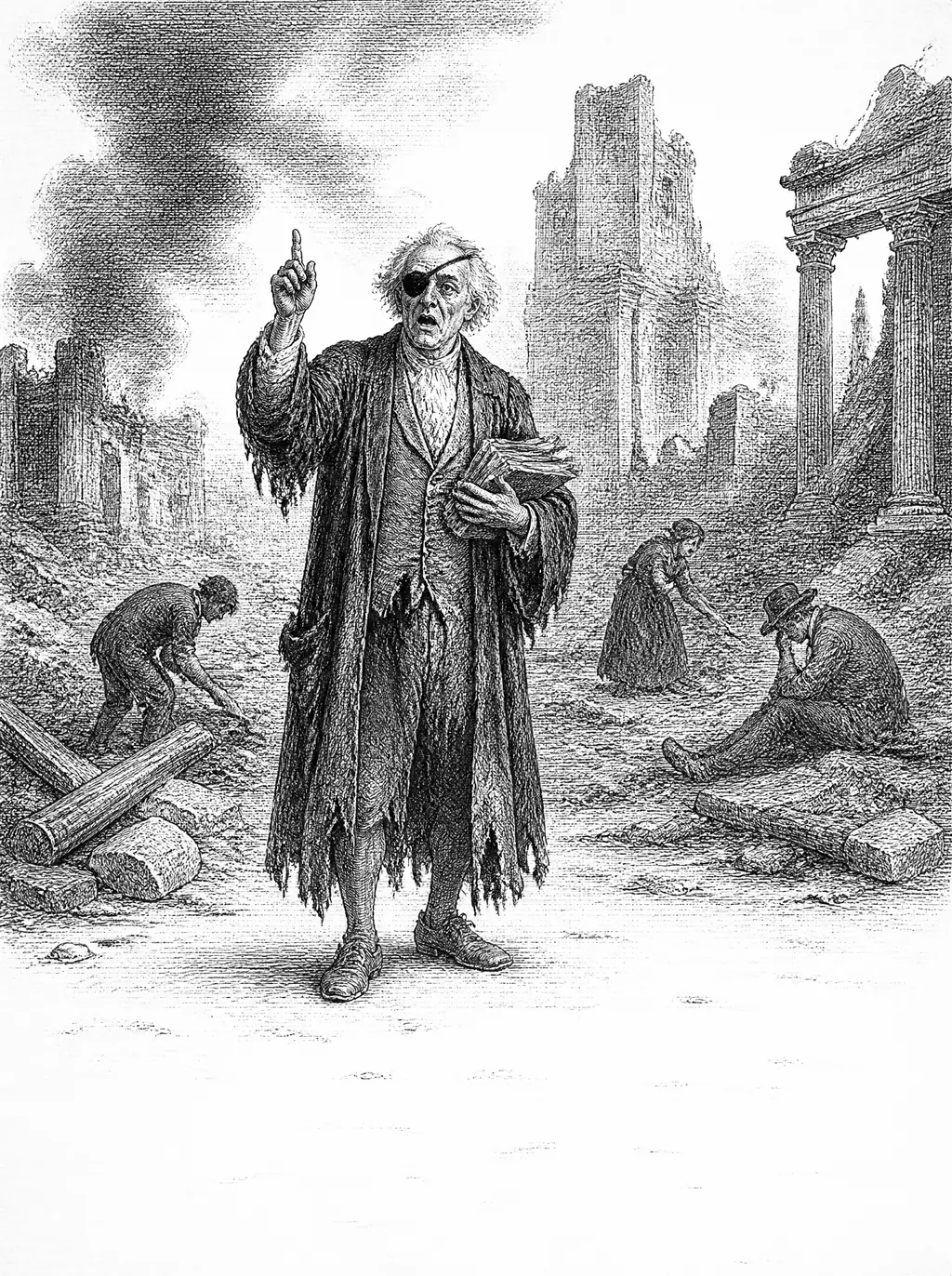
Pangloss Keeps His Theory
A man his own life cannot correct
Doctor Pangloss teaches metaphysico-theologico-cosmolonigology to a boy named Candide in a castle in Westphalia, and what he teaches is that this is the best of all possible worlds. Then the novel goes to work on him. He catches syphilis and loses an eye and an ear. He is hanged in an auto-da-fé, cut open by a surgeon, sold as a galley slave, and beaten daily. Every one of these events is survivable, and he survives them. What the book really tests is not whether he survives but whether the theory does, and on the final page the theory is still there, unmarked.
The world it came from
Voltaire wrote Candide in 1758 and published it in 1759, and Pangloss is a portrait with a target. Leibniz had argued in the Theodicy of 1710 that a perfect God, choosing among all the worlds he could have made, must have chosen the best, so that every evil is a necessary thread in a better whole. Alexander Pope had put the popular version into verse: whatever is, is right. Then on 1 November 1755 an earthquake destroyed Lisbon and killed tens of thousands, many of them at Mass, and the Seven Years' War began the year after. Voltaire, in his sixties near Geneva, gave the doctrine a name, a wig, and a body that could be broken.
The idea
Pangloss is not a bad philosopher because his conclusion is false. He is a bad philosopher because nothing can reach it. Every disaster is absorbed on arrival and re-emerges as evidence: the nose was made to carry spectacles, the earthquake was a necessary link, the syphilis brought chocolate to Europe on the same ships. A theory built this way costs nothing to hold and predicts nothing at all. The character is Voltaire's demonstration that a doctrine can be perfectly consistent, perfectly sincere, and perfectly empty, and that the way to expose it is not to refute it but to run it through a life and watch it never bend.
How the reasoning runs
The satire has a spine. Take a claim about the world and ask what would count against it. If the answer is nothing, the claim has stopped describing the world and started describing the speaker. Voltaire does not attack Leibniz's premise that God is good, and he never shows the world is not the best available. He does something cheaper and more damaging: he supplies case after case, each worse than the last, and lets Pangloss explain every one with the same formula. By the tenth explanation the reader has learned the shape of the reasoning and can produce it unaided, which is the moment the doctrine dies as a doctrine and survives only as a tic.
Seen in life
A manager tells you the reorganisation is a great opportunity. Half the team leaves, the project slips two quarters, and the same manager tells you the departures were an opportunity to bring in fresh thinking, and the slip an opportunity to get the foundations right. Nothing in the last year could have made him say the plan was bad. He is not lying, and he may be pleasant company. He has simply adopted a position that converts inputs into confirmation, and he will hold it whatever happens next. That is Pangloss without the wig, and recognising the pattern is more useful than winning any single argument with him.
Why it matters
Pangloss gave the language a word. Panglossian names the frame of mind that greets any evidence as support, and it is used far outside theology, in economics, in evolutionary biology, in corporate optimism. The character also modelled a method. Voltaire showed that a claim immune to counter-evidence is best attacked by exhibition rather than refutation, letting it perform until its emptiness is obvious. Two centuries before Popper made falsifiability a criterion, a comic novel had staged it. The lesson is portable, and it turns on a character rather than a proof, which is why more people have absorbed it from Candide than from any philosopher.
“There is a concatenation of events in this best of all possible worlds”
From the source
At the end of the book, settled on a small farm outside Constantinople, Pangloss reviews the whole catastrophe and finds it vindicating: “There is a concatenation of events in this best of all possible worlds: for if you had not been kicked out of a magnificent castle for love of Miss Cunegonde: if you had not been put into the Inquisition: if you had not walked over America: if you had not stabbed the Baron: if you had not lost all your sheep from the fine country of El Dorado: you would not be here eating preserved citrons and pistachio-nuts.” Every clause is a disaster, and each is offered as proof. Candide's reply is that they must cultivate their garden.
The pushback
Isn't this a caricature rather than a refutation? Leibniz never claimed that any particular event feels good, only that the sum of the world is the best achievable, and a novel that piles up horrors has not shown the sum to be wrong. Pangloss is a fool; the Theodicy is a careful book, and burning the first does nothing to the second. A second objection is that the charge cuts both ways. Voltaire's own pessimism about grand explanations is not falsifiable either, and Candide never tells you what evidence would show that the world is well made after all.
The reply
Voltaire's defenders concede the caricature and keep the point. What he attacked was the popular optimism that actually circulated, and that was Pangloss's version rather than Leibniz's; a doctrine can be judged by the use it gets. They add that Leibniz's defence has the same structure at its root, an appeal to a total no observer can inspect, so the parody is unfair in tone rather than in kind. On the second objection Voltaire does better than the charge allows. Candide advances no rival theory of providence. It advances a way of spending the afternoon, which is not a claim about the world and so needs no evidence against it.
Where it went next
Kant, once a Leibnizian, wrote in 1791 that every philosophical theodicy must fail. Schopenhauer answered that the world could not be the best possible since it could hardly be worse. Stephen Jay Gould and Richard Lewontin borrowed the name in 1979 for the adaptationist habit of finding a purpose behind every biological trait, and the Panglossian paradigm entered biology as an insult. Leonard Bernstein set the book as an operetta in 1956. The character has outlived the debate that produced him, which is what Voltaire would have predicted, since a doctrine is forgotten and a comic professor is not.
Where this leads
The best of all possible worlds is Leibniz in earnest, the serious argument behind the joke, holding that a perfect and rational God was bound by logic to select the best available world and that our complaints reflect the narrowness of our view. We must cultivate our garden takes Voltaire's own answer rather than his target, following Candide past the argument to the small work that ends the book. Falsifiability gives the whole objection its modern form, with Popper insisting that a theory which forbids nothing has told you nothing.