Symposium · Philosophy of Religion · Pl. 15Voltaire · 1694–1778
We Must Cultivate Our Garden
A philosophy that survives anything
Candide's tutor Pangloss insists, through every catastrophe the novel piles onto him, that this remains the best of all possible worlds, since it is the one an all-good, all-powerful God chose to create. Voltaire's satire lets that claim survive earthquake, slavery, disease, and war, becoming more absurd with each fresh disaster it must explain away. The book was written in 1758 and published in 1759, in the shadow of the Lisbon earthquake and the Seven Years' War. It was banned in Geneva and Paris on arrival and sold in enormous numbers anyway.
The world it came from
On 1 November 1755, All Saints' Day, an earthquake destroyed Lisbon and killed tens of thousands, many of them in church. Voltaire, then in his sixties and living near Geneva, wrote a poem asking how the optimists could call this the best of all possible worlds. Rousseau replied that the fault lay with cities and not with providence. The Seven Years' War began the following year. Candide, written quickly in 1758 and published in 1759, is Voltaire's second and sharper answer. Its target was the popular optimism that flowed from Leibniz's Theodicy (1710) and Pope's Essay on Man, the doctrine that whatever is, is right. Voltaire had once half believed it himself.
The idea
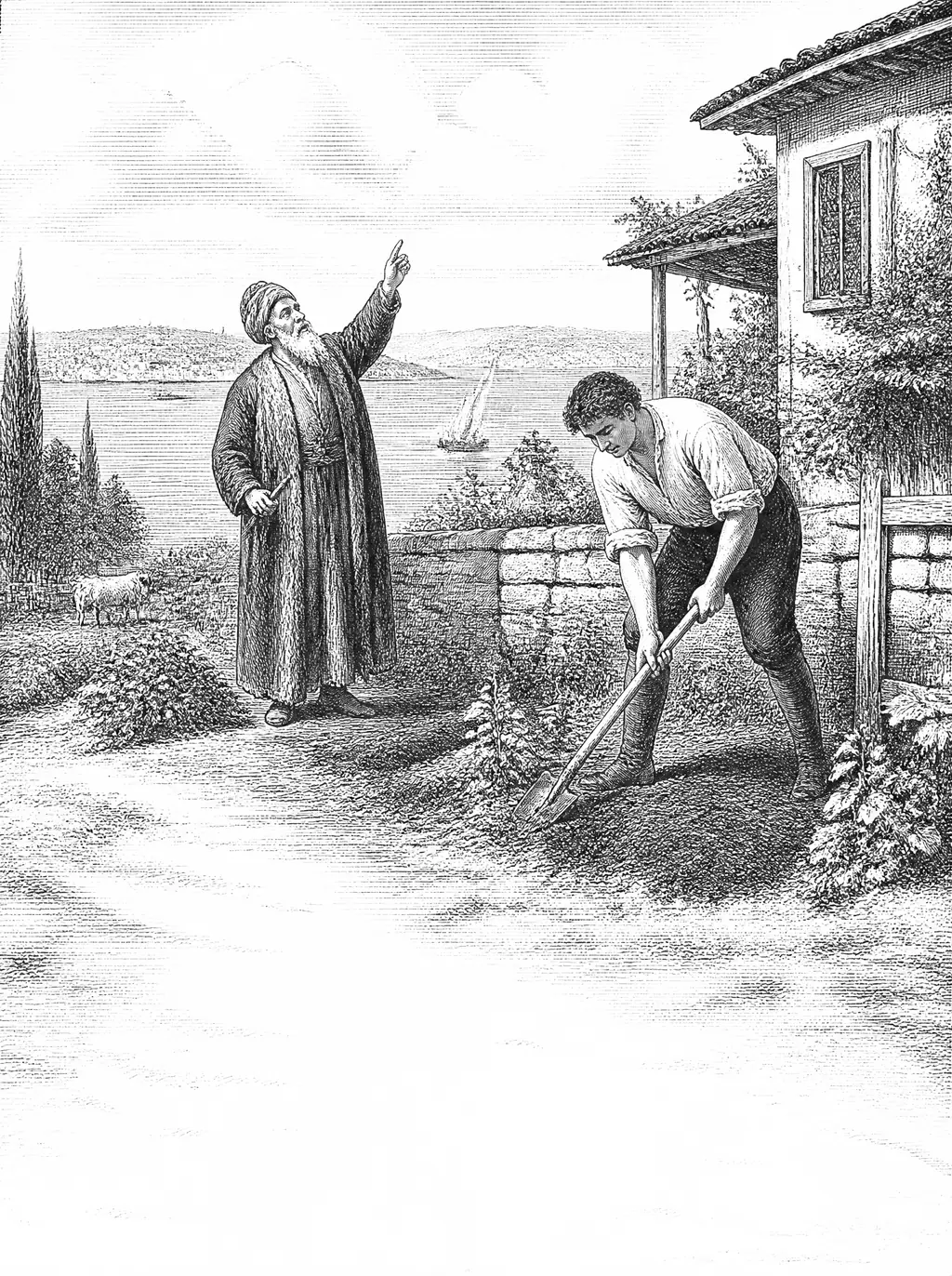
I know also that we must cultivate our garden. After a novel-length tour of catastrophe fails to dent Pangloss's optimism, Candide finally stops arguing about whether this is the best of all possible worlds and turns instead to small, concrete, local work, a deliberate retreat from grand theological explanation toward whatever good is actually within reach. The garden is a small farm near Constantinople where the survivors end up. Each has a job. The work is dull. It is also the first thing in the book that makes anyone better rather than merely luckier.
How the reasoning runs
The satire has a logical spine. Leibniz's claim is that a perfect God must have chosen the best of all possible worlds, so every evil is a necessary part of a greater good. Voltaire does not refute the premise. He tests the conclusion against cases: an earthquake, a slave with one hand and one leg, an auto-da-fé, a war fought for no reason anyone can name. Each time, Pangloss explains the evil away with the same formula. The lesson is not that the formula is false; it is that a claim which no possible event could count against has stopped saying anything. That is a point about evidence, not theology. The garden follows: if the grand question cannot be settled, spend your hours on what can be improved.
Seen in life
You are in a hospital corridor after a diagnosis, and a well-meaning relative says that everything happens for a reason. You know she means it kindly. You also notice that she would have said exactly the same thing if the scan had been clear. Voltaire's whole novel is that moment stretched to two hundred pages. Pangloss is not a villain; he is the relative who cannot stop explaining. Candide's answer is to stand up and ask the nurse what needs doing. Whether or not there is a reason behind it all, the drip needs changing and the paperwork needs signing. That is not an argument against providence. It is a decision about where to put the afternoon.
Why it matters
This gave the whole eighteenth-century optimism debate its most memorable literary rebuttal, using satire rather than counter-argument to expose how a philosophical claim can survive any evidence once its defenders are sufficiently determined to preserve it. Candide's garden became a lasting symbol of practical retreat from unanswerable metaphysical dispute. It also marked a shift in what a philosophical answer could look like. Instead of a competing system, Voltaire offered a way of life, and the shrug in Candide's last line has been the model for every later refusal to let a theory outrun the evidence.
“I know also that we must cultivate our garden.”
From the source
After Pangloss launches into yet another chain of philosophical reasoning about how every past disaster led necessarily to their present situation, Candide cuts him off: “I know also that we must cultivate our garden.” The grand theological question is quietly set aside in favor of concrete, achievable work. Pangloss agrees, in his way. Had Candide not been kicked out of the castle, not been in Lisbon, not lost his money, he would not now be eating candied citron and pistachios. Candide's reply is the same line again. The book ends with everyone working, and the theorising, for the first time, put to rest.
The pushback
Isn't cultivating your garden a retreat from the hard philosophical question rather than an answer to it, refusing to settle whether theodicy succeeds or fails instead of actually resolving the dispute? Voltaire's defenders reply that this is precisely his point: some grand questions may simply not be answerable, and pretending otherwise wastes a life. A harder objection comes from Leibniz's side. Satire is not refutation. Leibniz never claimed that every event feels good, only that the total is the best achievable, and a novel that piles up horrors has not shown the sum to be wrong. Voltaire mocked a caricature.
The reply
Voltaire's defenders make two replies. The first concedes the caricature: Pangloss is a parody, and the Theodicy is subtler than he is. But the point survives, since the popular optimism Voltaire attacked was Pangloss's version, and Leibniz's own defence has the same structure, an unfalsifiable appeal to a total no one can inspect. The second reply is that Candide is not a theodicy and does not claim to be. It is an argument about what to do while the theodicy remains unsettled. Where the answer is only partial is that the garden, too, can become an evasion. Voltaire spent his own last years campaigning against judicial murder, which suggests he did not read his own ending as retreat.
Where it went next
Candide became the most read work of the Enlightenment and the standard rebuttal to easy optimism. Kant, who had been a Leibnizian, later wrote On the Failure of All Philosophical Attempts at Theodicy (1791), agreeing that the project could not succeed. Schopenhauer said the world could not be the best possible because it could not be much worse. Dostoevsky's Ivan Karamazov, returning his ticket, is Candide with the jokes removed. Leonard Bernstein set the book as an operetta in 1956. Cultivate your garden has become a proverb, quoted by gardeners, stoics, and burned-out professionals alike, most of whom have not read the disasters that precede it.
Where this leads
The best of all possible worlds shows Leibniz's own original argument, the very target of Voltaire's satire, laid out in its serious philosophical form rather than its comic caricature, arguing in earnest that a perfectly good and rational God really was bound by logic to select the best of every available option. Epicurus's old questions gives the dilemma Voltaire dramatised, in Hume's cool prose. Hume wanted to know whether the argument for a good God could survive the evidence. Voltaire wanted to know whether a person could.