Symposium · Eastern Philosophy · Pl. 5Miyamoto Musashi · 1584–1645
Accept the World as It Came
Twenty-one lines and nothing left
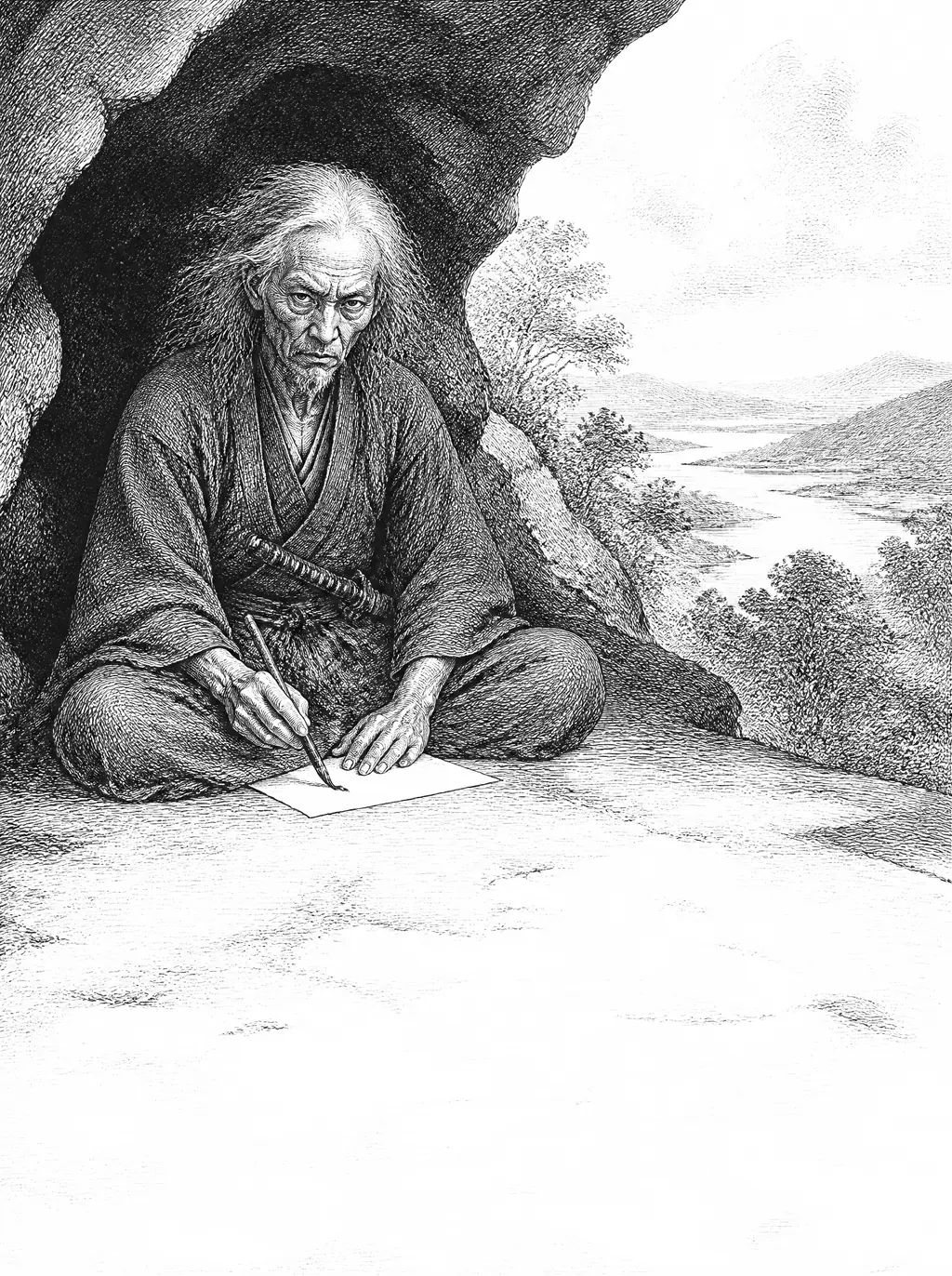
In the fifth month of 1645, in a cave on a hillside west of Kumamoto, a man of about sixty who knew he was dying wrote out twenty-one short lines on a single sheet and handed it to his student Terao Magonojō. He had already given away what he owned. The lines are refusals, one after another: no lust, no preferences, no fine food, no regret, no jealousy, no property saved for old age, no house he wanted. They are usually read as a discipline of renunciation. They are not. They are a set of consequences, and the first line is the premise they all run from.
The world it came from
The sheet is called the Dokkōdō, the way of walking alone, and it belongs to Musashi's last week. He had spent his life without a permanent post. From 1640 he was a guest of Hosokawa Tadatoshi, lord of Kumamoto, who died the following year, and by 1643 Musashi had withdrawn to the cave at Reigandō to write. He never married. He raised two adopted sons: Mikinosuke, who followed his own lord into death in 1626, and Iori, who rose to senior retainer of the Ogasawara and later put up his father's memorial stone. The Dokkōdō is the testament of a man with almost nothing left to renounce.
The idea
The first precept is not a claim about the universe. It is a stance towards what has already happened. The way of the world as it has come down means the actual order you were born into: the century, the body, the family, the losses that have already landed. Turning against it is a motion that cannot reach its target, and Musashi treats it as the first thing to stop. What separates this from resignation is everything after it. Twenty of the twenty-one lines are demands. The acceptance is not the programme. It is the clearing of ground that has to happen before the programme can begin.
How the reasoning runs
Musashi argues from the duel and then lets the duel stand for the life. First: in a fight, the man who wants the situation to be other than it is loses a beat to that wish, and the beat is not recoverable. Second: a life is the same situation, only longer, and it has beats too. Third: every wish for a different past draws on the same account as the next action, so the wishing is not free. Fourth: therefore the first discipline is to close that account. Notice what is absent. No providence, no rational order, no promise that things happened for a reason. Only the account.
Seen in life
You are passed over for the job you had already told people about. What follows is familiar. You reconstruct the interview sentence by sentence, find the answer you should have given, deliver it perfectly to nobody, and do this for a week. Somewhere in there you also decide what the decision means about you. None of that work reaches the decision, which was made in a room you were not in. The precept does not ask you to feel better about it or to call it a blessing. It asks you to notice that the week is being spent, and that the next application is being funded from the same week.
Why it matters
Most of the pain in a bad event arrives after the event, in the argument with it. The argument feels obligatory, because refusing to fight seems like agreeing that the thing was acceptable. Musashi's precept separates those two. Accepting that something happened is not a verdict on whether it should have. It is the recognition that the question is now closed and the energy is now needed elsewhere. That distinction is what makes the rest of the sheet possible. A person still fighting the past has nothing left over for the twenty other lines, all of which are about what to do next.
“Do not turn against the way of the world as it has come down through the ages.”
From the source
The Dokkōdō opens with the precept everything else rests on: “Do not turn against the way of the world as it has come down through the ages.” The Japanese is broad. The phrase covers both the world as it happens to be and the customary way things have long been done, and Musashi does not tell us which he means. The precepts that follow choose sides by implication. Do not regret what you have done. Do not envy anyone, in good or in evil. Do not grieve at a parting. Hold no resentment, on your own account or another's. Each is the first line applied to one department of a life.
The pushback
Read the other way, this precept is an instruction not to disturb the arrangements. In 1645 the way things had come down through the ages included a rigid caste order, hereditary rank, and a shogunate that had lately crushed a rebellion Musashi is reported to have helped put down. A rule telling everyone to stop turning against that is exactly the rule such an order would commission. There is a second problem, closer to home. The man advising acceptance had spent thirty years imposing himself on the world with a sword, and arrived at the cave only after the world had stopped offering him fights.
The reply
The political charge is probably half true and cannot be argued away. A seventeenth-century swordsman living on a daimyō's hospitality was not a critic of the Tokugawa settlement, and any reading that makes him one is wishful. What survives translation is the narrower psychological claim, which does not depend on approving of anything: the past is closed, and fighting it spends the same hours the future needs. That is thinner than the Stoic version. Marcus Aurelius could love his fate because he believed the whole was rational and good. Musashi offers no such backing. He offers an accounting, and leaves the comfort out.
Where it went next
The Dokkōdō stayed nearly invisible for two and a half centuries, held in private hands and known from copies, until the scholarship around Musashi in the early twentieth century brought it into print. Its modern career is recent and mostly English. Since the 2000s it has circulated as a list, printed beside Marcus Aurelius in the Stoic revival, and read as self-help, which is both a fair use and a strange one: a document written by a dying man giving away his possessions now works as a productivity poster. The cave at Reigandō remains, above the river west of Kumamoto, and people still climb to it.
Where this sits
Epictetus sorts the world into what is yours and what is not, and tells you to work hard on your own pile. Musashi's first precept is the same sorting done without the metaphysics that made it comfortable. Marcus Aurelius goes further than either, asking not for acceptance but for love of what happened, on the ground that the whole is rational. The Bhagavad Gita reaches a third version: act with everything you have and let go of what the acting earns. Put the four side by side and the question is what acceptance costs when you subtract the guarantee that the world is on your side.