Symposium · Eastern Philosophy · Pl. 10Miyamoto Musashi · 1584–1645
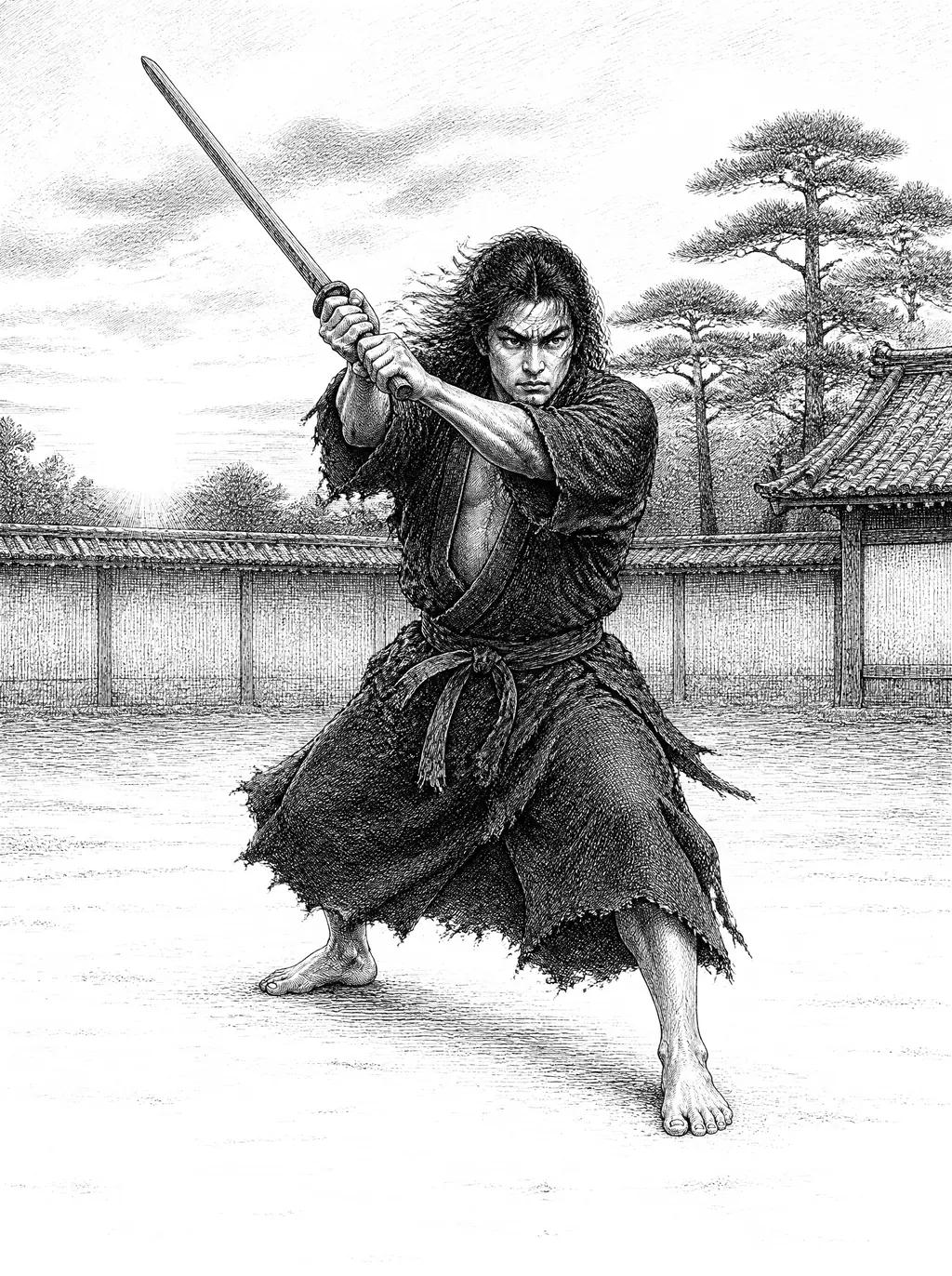
The Way Is in Training
Sixty wins and no gift
Musashi fought his first duel at thirteen, against a travelling swordsman named Arima Kihei who had posted a public challenge outside the village. The boy threw him down and finished him with a stick. By twenty-nine he had fought more than sixty contests and lost none of them. Then he stopped counting, and spent the next thirty years deciding that none of it had been talent. What he wrote at the end of his life is not a record of victories. It is an argument that the victories proved very little, and that the only thing worth handing on was the daily work underneath them.
The world it came from
Musashi was born in 1584, near the end of a century of civil war. He was sixteen when Sekigahara settled it, and the Tokugawa peace that followed slowly made his trade obsolete. A swordsman with no lord became a rōnin, moving between provinces and building a reputation duel by duel, because a reputation was the only thing that bought employment. Dozens of schools competed for students and for the patronage of a domain. Each sold a secret: a hidden stance, a transmitted grip, a scroll passed to one heir. Musashi founded a school too, Niten Ichi-ryū, the two heavens as one. Then he wrote a book whose first advice was to distrust secrets.
The idea
The Way is in training. Musashi lists it second among nine rules and means it as the ground of the other eight. Skill is not a gift you are issued at birth or a secret you are told in a back room. It is a deposit, laid down by repetition, over years. He splits the deposit into two stages and gives each its own word. Forging is the first thousand days, when the shape is beaten in and everything costs effort. Tempering is the ten thousand days after, when the shape is made hard and the effort stops being visible from outside. Most people quit inside the first stage and conclude that they lacked the gift.
How the reasoning runs
The argument starts from what a duel actually is. First: in a real fight there is no time to think, so whatever you do has to already be in the body. Second: what is in the body got there by repetition rather than by understanding, because understanding runs at a speed the fight does not allow. Third: therefore teaching can only point. A master who hands you his secret has handed you nothing usable at speed. Fourth: if repetition is the only channel into the body, then the length of the repetition is the variable that matters. Talent may set how steeply you climb. Time sets how high you get.
Seen in life
You decide to learn a language. You buy the book that promises the method, read about the method, and enjoy the reading, because reading about a method feels like progress and costs nothing. Two years later you still cannot order lunch. The colleague who spent twenty unglamorous minutes on the same drill every morning is holding a conversation. Nothing separated you except the deposit. Musashi's version is sharper than the usual encouragement, though. He is not saying that practice helps. He is saying the practice is the skill itself, and that the better method you keep shopping for is mostly a way of not beginning.
Why it matters
This cuts against the way we usually explain other people's competence. We look at someone who is very good and reach for a story about their nature, because a story about nature explains our own position at no cost to us. Musashi closes that exit. He presents himself as an ordinary man who did not stop. The practical effect is a change in which question you ask. Not am I the kind of person who could do this, which has no answer and never gets one, but am I willing to put in a thousand days. That question has an answer, and you can give it this morning.
“A thousand days of practice is forging; ten thousand days of practice is tempering.”
From the source
In the Ground book, the first of his five scrolls, Musashi sets out how the work divides: “A thousand days of practice is forging; ten thousand days of practice is tempering.” The two words are a blacksmith's. Tan is the beating that gives a blade its shape; ren is the heat and the quench that make the shape hold. Joined, they make tanren, the ordinary Japanese word for hard training, and Musashi is prising it back apart into its two halves. He wrote the scroll for his student Terao Magonojō, who received the finished text a few days before Musashi died in the summer of 1645.
The pushback
Two problems. The first is survivorship. Musashi tells us that training made him unbeatable, but every man he killed had trained too, some of them longer, and none of them is available to disagree. From inside a run of sixty wins, discipline looks like the cause. It may have been reach, or nerve, or the luck of who accepted the challenge. The second problem is that ten thousand days of anything will make you good at that thing and old. A rule that says keep going says nothing about whether to have started, and Musashi, who chose duelling, is not a neutral witness on that question.
The reply
The survivorship point lands, and Musashi half concedes it. Elsewhere in the same book he insists that a fighter who wins on strength or spirit alone has learned nothing he can pass on, which is his own way of admitting that a win is weak evidence. Modern work supports the shape of his claim if not its size. Anders Ericsson's studies of expert performers found that hours of focused, error-correcting practice predict skill far better than any measured talent, and also that unfocused repetition predicts almost nothing at all. On the second objection there is no reply, only a warning. The method is neutral about the goal.
Where it went next
Musashi's public reputation is now mostly a novel's. Yoshikawa Eiji serialised Musashi in the Asahi Shimbun from 1935 and turned a hard, unwashed rōnin into a national figure of self-cultivation; Inagaki Hiroshi's 1954 film of the novel won an Academy Award and carried the character abroad. The training doctrine travelled on its own. Victor Harris's 1974 English translation put the book on American office shelves, where a thousand days became a slogan for corporate persistence. The research arrived by a different road in Ericsson's 1993 paper on deliberate practice, which Malcolm Gladwell compressed in 2008 into the ten thousand hours Musashi had already counted out in days.
Where this sits
Confucius set the limit this rule needs: learning without thought is labour lost, and thought without learning is dangerous. Repetition on its own is only half an instrument. Aristotle arrived at the same ground from ethics, arguing that we become just by doing just acts, so that character is a deposit too, laid down the same way. The interesting disagreement is with Laozi. Wu wei says that strain is itself the symptom, and that the shape of the situation should be carrying you. Musashi agrees that the ease is real. He says you buy it with ten thousand days of exactly the strain Laozi warns you about.