Symposium · Philosophy in Fiction · Pl. 14Fyodor Dostoevsky · 1821–1881
Twice Two Makes Five
A man arguing with arithmetic
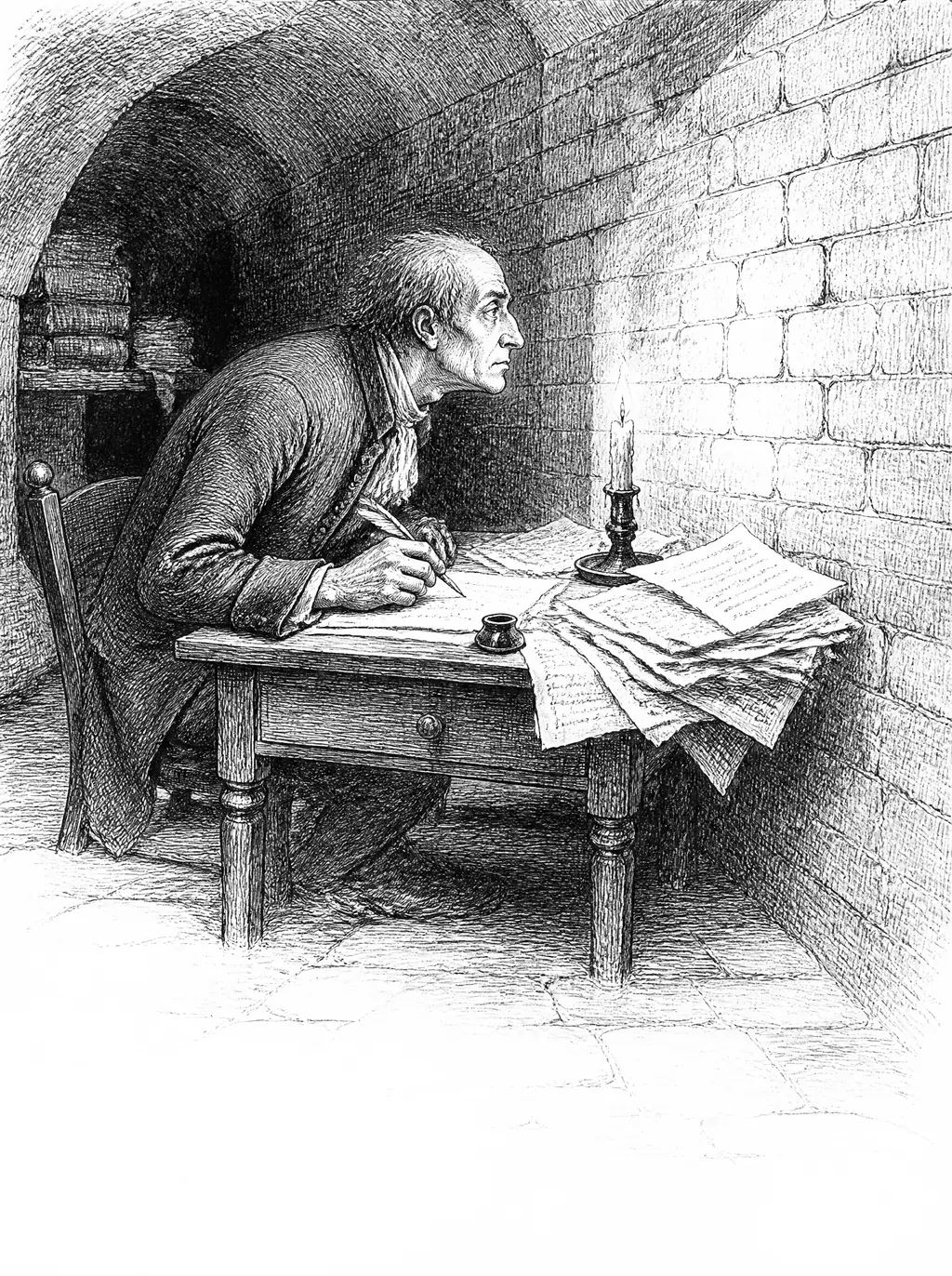
The narrator of Notes from Underground has no name, no job, and no readers. He is a retired civil servant of forty living in a rented corner of Petersburg, writing a confession nobody asked for. Half of it is an attack on the idea that a person, shown clearly what is good for him, will go and do it. He says he would rather stick his tongue out at the whole calculation. The stone wall of natural law is real, he admits, and he cannot knock it down by battering his head against it. He simply refuses to be reconciled to it, and calls that refusal the only thing that is his.
The world it came from
Dostoevsky published the novella in 1864, three years after the serfs were freed and while Russian radicals were selling a confident new picture of the human being. Chernyshevsky's novel What Is to Be Done? had appeared the year before, arguing that once people understood their real interests they would act on them, and that a rational society could then be engineered from that fact. Its symbol was the Crystal Palace of the London exhibition, all glass and iron and settled calculation. Notes from Underground is the reply, written while Dostoevsky's wife and brother were dying, by a man who had been sentenced to death, reprieved on the scaffold, and sent to Siberia.
The idea
The underground man's claim is that people want, above everything else, to want independently. Reason covers only a part of a person; the whole of him includes the part that would sooner suffer than be predictable. Give him a life of guaranteed comfort, arranged by people who have proved what is good for him, and he will smash it just to demonstrate that he is a man and not an organ stop. Two and two make four is not disputed. It is resented, because a truth that arrives without his consent is a truth that leaves him nothing to do but agree.
How the reasoning runs
The reasoning goes by cases. Suppose human behaviour is fully governed by laws of interest, so that a table of them could be drawn up. Then every act of yours could be calculated in advance, and you would be a piano key played by causes. But a piano key can want nothing, and you plainly do want; so either the table is impossible or wanting is an illusion. The underground man takes a third route: he grants that the table might be complete and points out that a man could destroy it out of spite, on purpose, at his own cost. The very possibility of that act is the disproof, and it costs him everything to make it.
Seen in life
An app tells you the optimal bedtime, the optimal route, the optimal spend, and it is right every time. After a month of following it you notice a small ugly wish to stay up, take the long way, and buy the wrong thing, for no reason you can defend. That wish is the underground. It is not a better plan, it is not a hidden preference the model failed to capture, and it makes your evening worse. It is the part of you that objects to being correctly predicted. Most people feel it and let it pass. The narrator built a whole life on it, and the book shows exactly what that life costs.
Why it matters
This is usually called the first existentialist text, and the label is fair. Before Nietzsche and fifty years before Sartre, it put freedom above happiness and made the irrational choice a philosophical position rather than a failure of nerve. It also spoiled a whole family of arguments in advance: any social scheme that starts from what a rational agent would prefer now has to explain why the agent should stay rational when the scheme is running. Economists rediscovered the point as spite and reactance a century later. Dostoevsky got there first, and made his witness a wretched man, so nobody could mistake the case for an advertisement.
“I admit that twice two makes four is an excellent thing, but if we are to give everything its due, twice two makes five is sometimes a very charming thing too.”
From the source
The narrator will not be argued out of his position by mathematics, and he says so in the plainest terms he uses anywhere in the book: “I admit that twice two makes four is an excellent thing, but if we are to give everything its due, twice two makes five is sometimes a very charming thing too.” A page earlier he has called twice two makes four a piece of insolence, a pert coxcomb standing with arms akimbo and barring the path. He does not deny the sum. He objects to its manner. What he wants preserved is the possibility of saying no to a truth, which the sum, by being true, denies him.
The pushback
Isn't the underground man simply unwell, and the book a portrait rather than an argument? He is spiteful, humiliated, cruel to Liza the prostitute who shows him kindness, and finally unable to leave his room. Treating his cellar as a philosophical vantage point looks like mistaking a symptom for a thesis. A second objection is sharper. If spite is what proves freedom, then freedom is only ever visible in self-harm, and a person who chooses the good freely could never demonstrate that he did. The theory makes its own evidence impossible to collect except by ruin.
The reply
Dostoevsky's defenders answer that the wretchedness is deliberate and is part of the case. Put the argument in the mouth of a hero and it becomes a boast; put it in a sick man and it survives as an observation about everyone, since the reader recognises the impulse without wanting the life. The second objection lands harder, and the honest reply is to narrow the claim. Spite is not what freedom consists in; it is the only proof available against a theory that has explained every other motive as interest. Dostoevsky spent the rest of his career looking for a positive form of the same freedom and located it, in the end, in love rather than refusal.
Where it went next
Nietzsche read Dostoevsky in French translation in 1887 and called him the only psychologist from whom he had anything to learn. Sartre's Roquentin and Camus's narrator in The Fall are both the underground man in later clothes. Ellison's Invisible Man opens in a cellar in explicit homage. The phrase two and two make five travelled furthest of all: Orwell put it in Nineteen Eighty-Four as the Party's test of obedience, inverting Dostoevsky exactly, so that what began as the last refuge of a free man became the proof that his mind had been taken.
Where this leads
Existence precedes essence is Sartre stating as doctrine what the underground man discovered by wrecking his own life: that no nature is handed to you in advance, and that what you are gets settled by what you do. Bad faith names the escape route he never takes, the comfort of pretending your choices were fixed for you by circumstance or role. The absurd is Camus reaching a nearby place with a steadier temper, holding on to a world that will not answer without concluding that the answer must be spite.