Symposium · Ethics · Pl. 7Confucius · 551–479 BC
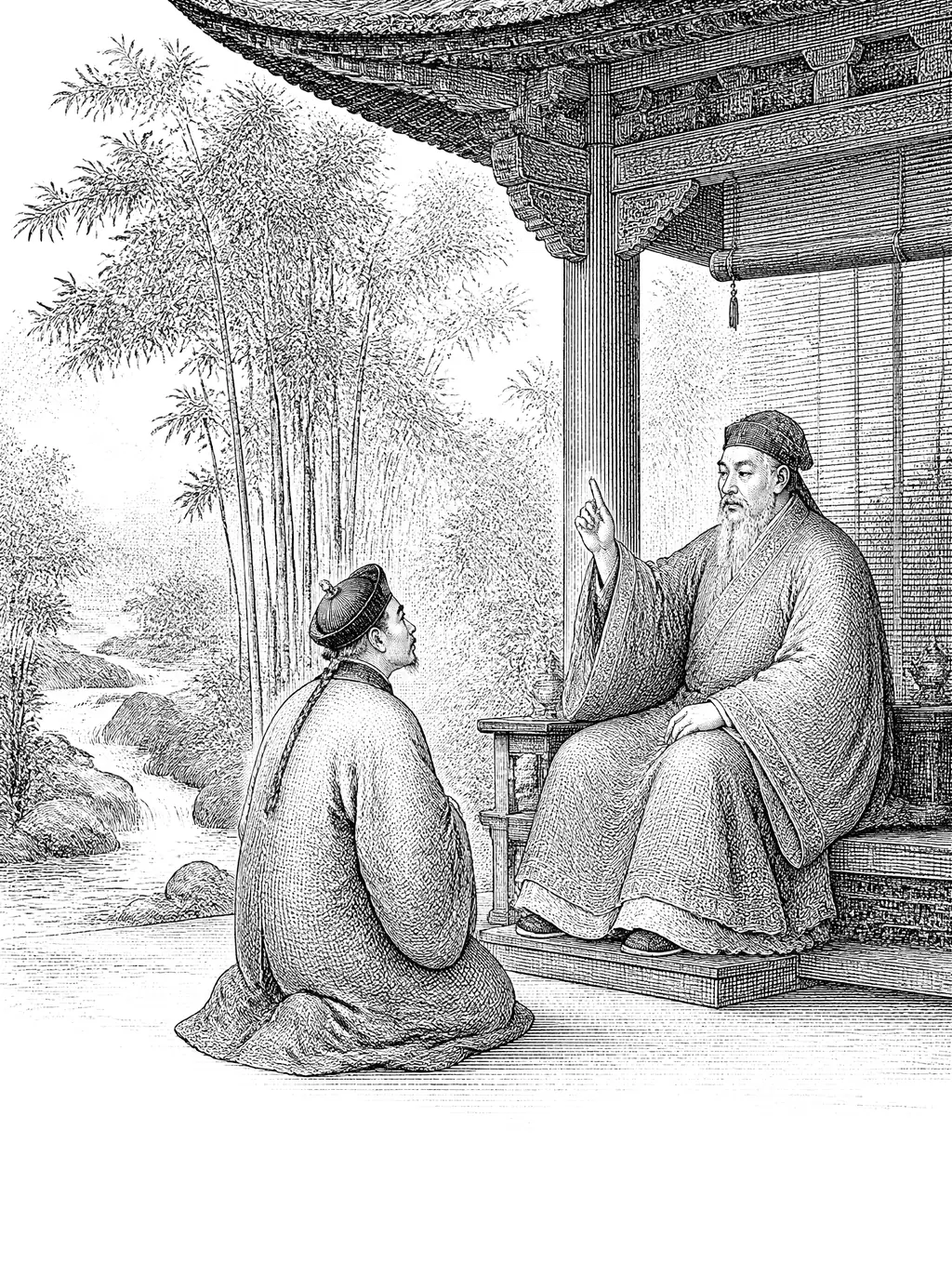
One Word for a Whole Life
One word, asked for directly
Tsze-kung, one of Confucius's students, put the hardest kind of question to his teacher: is there one word that could serve as a rule of practice for an entire life? Most teachers would have reached for a list, virtues, duties, careful qualifications. Confucius answered with a single word and one plain sentence explaining it. Tsze-kung was not a naive questioner. He was a merchant and a diplomat, the richest and most worldly of the disciples, and the Analects show him pressing his teacher again and again for something he could use. The answer he got was small enough to carry into a negotiation and large enough that the tradition is still unpacking it.
The world it came from
Confucius was born in 551 BC in the small state of Lu to a minor noble family that had lost its money. The Zhou kings still reigned in name, but real power had passed to warring states. He held minor offices, rose briefly in the government of Lu, and left around 497 BC to spend thirteen years travelling from court to court looking for a ruler who would govern by virtue rather than force. None did. He came home, taught, and died in 479 BC. His students and their students compiled his sayings into the Analects over the following generations. The question he was answering was how a person, and a state, could hold together when the old order had already broken.
The idea
The word is reciprocity: what you do not want done to yourself, do not do to others. This restrains action through a test anyone can apply instantly, without needing a whole moral theory first, since it only asks you to consult your own honest sense of what you would not want to receive, and hold your own conduct to that same standard toward everyone else. The Chinese word is shu, which also carries the sense of consideration or putting yourself in another's place. Elsewhere in the Analects a disciple says the Master's whole way comes down to two things: doing your utmost, and shu. And in another passage Confucius gives the positive form: wishing to be established yourself, seek to establish others.
How the reasoning runs
Confucius does not argue for the rule; he offers it and expects you to test it by living. But the reasoning can be reconstructed. First, you already know one moral fact with certainty: what it is like to be wronged, because it has happened to you. Second, other people are like you in that respect. Third, therefore your own experience of being wronged is a usable measure of what it is to wrong them, and it is a measure you always carry. Fourth, a rule that needs only that measure can be applied by anyone, which is what a rule for a whole life must be. The sophisticated virtues, benevolence and ritual propriety, are what shu becomes when it is practiced for years.
Seen in life
You are drafting an email to a contractor whose invoice is late and wrong, and the first draft is very good. It is precise, it is cold, and it copies his manager. Before you send it, run the one word. Think of the last time someone copied your manager on a mistake you had already noticed and were fixing. You remember exactly how that felt, and you remember what you thought of the sender. That memory is the whole test. It does not tell you to let the invoice slide. It tells you which draft to send: the one that says what is wrong and what you need, to him, and leaves his manager out until he has had the chance you would have wanted.
Why it matters
A rule this simple travels well: it requires no shared religion, no agreed theory of the good, only the capacity to imagine yourself on the receiving end of your own actions. Versions of it appear independently across nearly every major ethical and religious tradition, which is itself a kind of evidence that Confucius had located something close to a genuine moral bedrock. It also scales. The same word that governs an email governs a state: Confucius told rulers that a government which taxed and conscripted its people in ways the rulers would never accept for themselves had lost the right to their obedience. Reciprocity is the smallest unit of political legitimacy, and Confucius was among the first to say so.
“Is not reciprocity such a word? What you do not want done to yourself, do not do to others.”
From the source
The exchange is recorded directly in the Analects: Tsze-kung asks for one word to guide a whole life, and “The Master said, ‘Is not reciprocity such a word? What you do not want done to yourself, do not do to others.’” The passage is in Book XV in James Legge's translation. It is not the only place the rule appears. In Book V Tsze-kung says he does not wish to do to others what he would not want done to himself, and Confucius tells him, gently, that he has not yet reached that point. In Book XII the rule is given to another disciple, Chung-kung, as part of an answer about benevolence, alongside the instruction to treat everyone you meet as if receiving an important guest.
The pushback
Critics note the rule is stated negatively, forbidding harm, but says little about positive duties to actively help others, and that it can misfire when your own wants differ sharply from another person's, assuming everyone wants the same treatment you do. Later thinkers in the Confucian tradition supplemented it with more positive duties of care owed within specific relationships. George Bernard Shaw made the second objection into a joke: do not do unto others as you would have them do unto you, since their tastes may differ. The point is serious. A rule that uses your own preferences as the measure will get the other person wrong exactly when the other person is most unlike you, which is when a moral rule is most needed.
The reply
The Confucian reply to Shaw is that shu was never a rule about tastes. What you do not want done to you is not to be ignored, deceived, humiliated, or used, and those wants are shared by the people whose tastes differ most from yours. Applied at that level, the rule tells you to find out what the other person wants rather than to assume it. The negativity objection has a straighter answer: the positive form is in the Analects too, and the tradition read the two as one. What the rule cannot do alone is tell you what you owe a parent, a ruler, or a stranger in particular. Confucius filled that gap with ritual and the five relationships.
Where it went next
Mencius, a century later, argued that the sympathy behind shu is innate: anyone who sees a child about to fall into a well feels alarm before thinking. Under the Han dynasty the Analects became state doctrine, and from the seventh century candidates for the civil service were examined on it for over a thousand years. Zhu Xi's commentary in the twelfth century fixed the reading that East Asia learned. Jesuit missionaries translated Confucius into Latin in 1687, and Leibniz and Voltaire read him as proof that ethics needed no revelation. When Hans Küng drafted a global ethic for the Parliament of the World's Religions in 1993, the one rule every tradition would sign was this one, and the Chinese wording was the oldest on the page.
Where this leads
The categorical imperative arrives at a strikingly similar test from an entirely different tradition and two thousand years later, asking whether a rule could be willed universally rather than simply imagined from the other person's own side of the exchange. Kant, in a footnote, dismissed the golden rule as trivial and unable to ground duties to oneself, which tells you he had noticed the resemblance. Humanity as an end is the Kantian beat that comes closest to shu in feeling: do not use a person, because a person is a self like yours. Read the three in order and you can watch one thought being restated with rising abstraction, from a word you can say to a merchant to a formula that needs a book.