Symposium · Eastern Philosophy · Pl. 3Confucius · 551–479 BC
Learning Without Thought
Two failures, one sentence
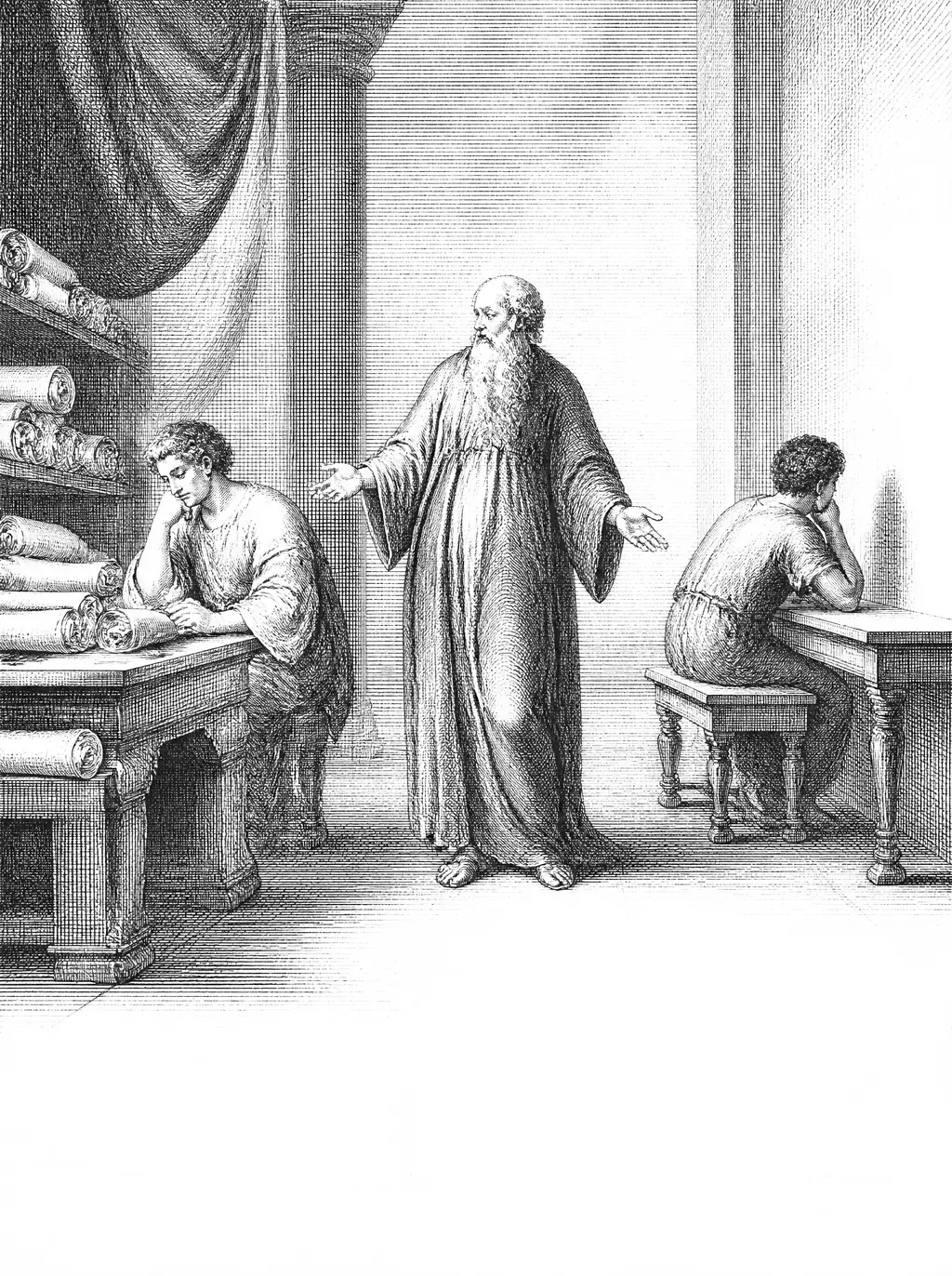
Students of Confucius came to him from two different directions of error: some had memorized volumes of received wisdom without ever testing it against their own reasoning, others trusted their own untrained reasoning without ever checking it against anything learned before them. Confucius named both failures in the same breath, refusing to treat either as safer than the other. The sentence has stayed in circulation for twenty-five centuries partly because it is balanced: two clauses, two failures, and no escape route for either kind of student. Whichever side you lean toward, the line is pointing at you.
The world it came from
Confucius lived from 551 to 479 BC in the small state of Lu, in what is now Shandong, during the long collapse of the Zhou order. Ritual, music, and the old texts still carried authority, but the lords who were supposed to embody them were fighting each other. Confucius held minor office, left Lu in his fifties, and spent about fourteen years travelling between courts looking for a ruler who would take his advice. None did. He taught instead. The Analects were assembled by his students and their students over generations after his death; this line is in Book II. Learning, xue, meant the Odes, the Documents, and the rites. Thinking, si, meant working out what they required now, in a world the texts had not foreseen.
The idea
Learning without thought is labour lost, effort spent accumulating information that never becomes genuine understanding because nothing is done with it. Thought without learning is perilous, reasoning that spins freely with no grounding in what others have already tested and found true, prone to confident, ungrounded error with nothing to check it against. Confucius puts the two words in the same sentence because he had watched students fail from both sides, and because neither failure feels like failure from inside. The hoarder feels diligent. The freelancer feels original.
How the reasoning runs
Take learning without thought first. Memorized material sits in the mind as words. Words that are never turned over are never tested against a case, so they never become judgment. When a new situation arrives, the student recites and cannot act. Effort has been spent and nothing usable was built: labour lost. Now take thought without learning. Reasoning starts from what the reasoner already believes. With nothing learned to check it against, error compounds with confidence, and the confident error is the dangerous kind. Confucius reports trying it: he once went a day without food and a night without sleep, only thinking, and found it useless; better to learn. So each half needs the other. Learning supplies the material; thought makes it yours.
Seen in life
You have bookmarked three hundred articles on management and read most of them. Your team is still unhappy, and when a real conflict lands on your desk you find you can quote four frameworks and apply none. That is labour lost. Your colleague down the hall never reads anything. He runs his team on instinct and his own past, is sure of every decision, and keeps making the same mistake in new clothes, because he has nothing outside himself to catch it with. That is peril. Confucius would not send you to read less or him to think less. He would ask you to take one article and argue with it, and ask him to read one and let it argue back.
Why it matters
This names a trap that looks like progress from either side: memorizing facts feels like education, and independent reasoning feels like wisdom, yet each is incomplete without the other. Real understanding sits at the intersection, where what has been learned is actually turned over, tested, and questioned, rather than simply stored or spun freely. The line also explains why so many well-read people are unwise and why so many clever people are wrong. It is not a lack of ability. It is that each has practised one half and called it the whole.
“Learning without thought is labour lost; thought without learning is perilous.”
From the source
In the Analects, addressing exactly this pair of failures head on, and speaking to students on both sides of it, Confucius states the rule in one short, balanced line meant to be memorized: “Learning without thought is labour lost; thought without learning is perilous.” This is Analects 2.15 in James Legge's translation, first published in 1861. The Chinese is twelve characters in two matched halves: xue er bu si ze wang, si er bu xue ze dai. Wang can mean lost or deluded; dai means endangered. Book II is largely about governing, which tells you what kind of person the line was meant to produce.
The pushback
In an age of information overload, isn't the greater risk clearly on the side of too much unexamined learning rather than too much untethered thought, given how much content people absorb passively without ever thinking it through? Confucius's balance still holds as a diagnosis, even if which half of the failure is currently more common has shifted with the times. A sharper objection: Confucius stacked the deck. His learning meant a fixed canon of ancient texts. A student who thinks hard and concludes the canon is wrong would be, by his lights, thinking without learning. The balance protects tradition.
The reply
The first objection Confucius would accept as a description of the moment, not a change in the rule; the rule was always about proportion. The second is harder, and the honest reply is mixed. Confucius did revere the canon, and he said he transmitted rather than created. But his own practice was not rote. He told students he would not repeat a lesson to anyone who could not come back with the other three corners of it, and he praised the disciple Yan Hui for taking what he heard and extending it. What the line does not settle is what happens when thought and canon conflict. Confucius lived before that question was forced on his school. His followers argued about it for two thousand years.
Where it went next
Mencius and Xunzi, the two great followers, split along this line: Mencius trusted the reflecting heart, Xunzi trusted accumulated learning and ritual. In 136 BC the Han emperor Wu made the Confucian classics the basis of state education. Zhu Xi, in the twelfth century, made the Analects one of the Four Books, and from 1313 until 1905 the imperial civil service examination tested candidates on them. The irony is that the exam rewarded exactly the memorizing that 2.15 condemned, and reformers quoted the line against it. Today the sentence hangs in classrooms across China, Korea, Japan, and Vietnam. Elsewhere, arguments about content versus critical thinking in schools replay the same balance, usually without knowing that Confucius had already refused to pick a side.
Where this leads
One word for a whole life shows the same teacher applying this exact balance in practice: distilling an entire lifetime of learning down to a single word, reciprocity, only after thinking hard about what all that learning actually amounted to. The pairing shows the method whole. Learning gathered the material of a life. Thought pressed it until one word remained. The maxim on labour lost is the rule; the single word is what the rule produced when it was followed for sixty years.