Symposium · Philosophy in Fiction · Pl. 8William Shakespeare · 1564–1616
Nothing Either Good or Bad
Denmark is a prison
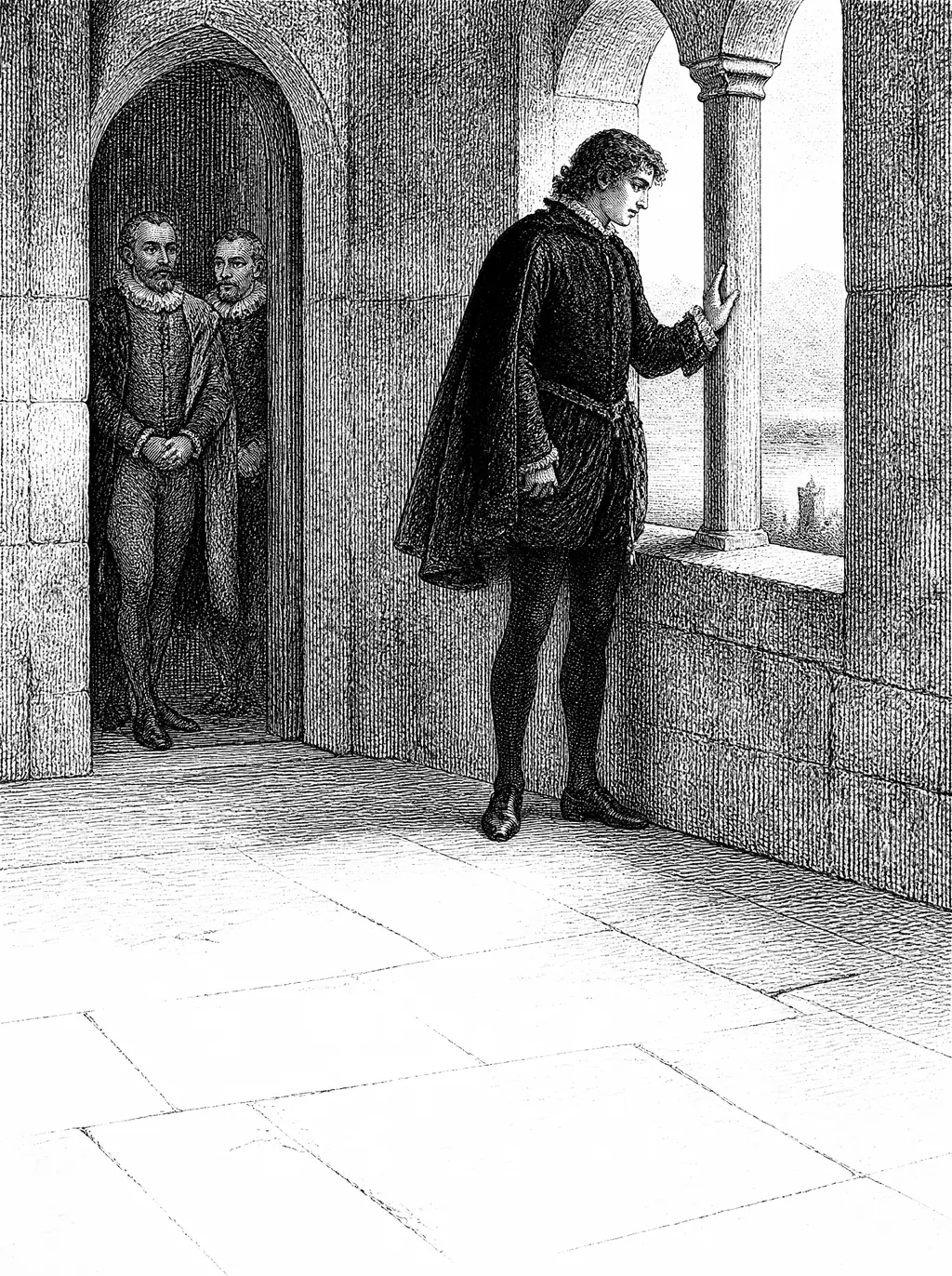
Rosencrantz and Guildenstern have been sent for, and Hamlet knows it. He tests them with a proposition rather than an accusation: Denmark is a prison. They protest that they do not find it so. Hamlet does not argue that they are wrong about Denmark. He grants them their Denmark and keeps his own, and in a single clause he moves the whole dispute out of the country and into the head that judges it. The line is among the most quoted in the play, and it is dropped almost carelessly, in the middle of a conversation about ambition and bad dreams.
The world it came from
The character is Hamlet, Prince of Denmark; the work is Shakespeare's longest play, written around 1600 for the Lord Chamberlain's Men and first printed in 1603. Hamlet is a student called home from Wittenberg, a university town that carried the smell of new learning and religious argument. Shakespeare's England had begun to absorb Montaigne, whose essays keep asking how much of a misfortune belongs to the event and how much to our opinion of it; Florio's English Montaigne appeared in 1603. The Stoic form of the thought was older and closer to hand, taught out of Epictetus and Seneca in every grammar school.
The idea
No situation carries its own moral weather. Good and bad are not properties a prison has, the way it has stone and cold; they are added by the mind that appraises it. Change the appraisal and the thing changes for you, because for you it was never anything but appraised. Hamlet is not saying facts are optional. Denmark's walls are real and his father is really dead. He is saying that the second layer, the verdict of intolerable or tolerable, was supplied by a judge who could rule otherwise. That is why he can call a nutshell infinite space, and why his dreams, not his geography, are what hold him.
How the reasoning runs
Start with the premise the scene hands you: two people face one identical circumstance and only one of them suffers. Rosencrantz does not find Denmark a prison; Hamlet does. Second, nothing in the circumstance can explain the difference, since the circumstance is shared. Third, the difference must therefore lie in what each man brings to it, which is his judgment. Fourth, judgments are formed by us, and what is formed by us can in principle be reformed. So the leverage over suffering sits where the judgment sits, not where the event sits. The Stoics ran that argument all the way to a therapy. Hamlet runs it to a shrug, and then cannot use it.
Seen in life
The email is four lines long. One colleague reads it as brusque, concludes she is being managed out, and does not sleep. Another reads the same four lines as a busy person typing on a train. Nothing in the words settles which reading is correct, and both readers are certain the meaning was in the message. Hamlet's line asks you to catch the instant you supplied it. It does not promise the kinder reading is available on demand, because often it is not. It insists only that the verdict had an author, and that the author was you, which is a different discovery from learning the email was harmless.
Why it matters
If the sentence holds, a great deal of what looks like fate is really interpretation, and interpretation is the one part of a bad situation a person can still reach. That is the practical hope in the line, and the reason it survives on posters and in consulting rooms. But Shakespeare put it in the mouth of a man it does not save, which turns the maxim into a question. Knowing that your suffering is authored does not tell you how to stop authoring it. The play holds both halves at once: the insight is real, and the insight is not a cure, and it declines to say which fact is larger.
“there is nothing either good or bad but thinking makes it so”
From the source
The exchange falls in Act 2, Scene 2, after Hamlet has called Denmark a prison and his old schoolfellows have politely declined the description. He answers: “Why, then ’tis none to you; for there is nothing either good or bad but thinking makes it so. To me it is a prison.” Rosencrantz suggests that ambition is the trouble, that Denmark is simply too narrow for so large a mind. Hamlet's reply gives the whole game away. He could be bounded in a nutshell and count himself a king of infinite space, he says, were it not that he has bad dreams. The mind that enlarges a nutshell can also shrink a kingdom.
The pushback
Is the claim not obviously false about the worst things? Torture is bad, famine is bad, and a philosophy that files their badness under appraisal insults the people enduring them. The complaint is ancient; the Stoic version drew it in antiquity on exactly these grounds. A second objection is closer to home and harder to shake off. Hamlet is not a sage delivering a maxim. He is a grieving student being clever at two spies he does not trust, in a scene built to show him performing. Taking the line as Shakespeare's own doctrine ignores who is speaking, to whom, and for what purpose.
The reply
The strongest defense narrows the claim. Nothing in the line denies that pain hurts or that famine kills. It denies that the further verdict, this is unbearable and my life is ruined, comes from the event rather than from the person meeting it. Even under torture, Epictetus argued, that second layer is still being added by someone. Whether the layer can be removed at will is a separate question, and there the play sides with the objectors. Hamlet states the principle in Act 2 and spends three more acts unable to live by it. Shakespeare gives the doctrine its clearest English sentence and then shows a mind it cannot house.
Where it went next
The line detached itself from the play early and now circulates as folk wisdom, quoted by therapists, coaches, and prison memoirists who have never met Rosencrantz. Albert Ellis and Aaron Beck built rational-emotive and cognitive therapy on a version of it, usually crediting Epictetus rather than the prince. Critics have pushed back for two centuries. The Romantics read Hamlet as a mind poisoned by precisely this habit of appraisal, and later readers noticed that a play about an actual murder is a strange home for a doctrine about mere thinking. Both readings survive because the play refuses to say which one it holds.
Where this leads
Epictetus supplies the argument Hamlet is quoting, in a school where it was meant to be practiced rather than said. Read the dichotomy of control next and the change in temperature is the whole lesson: the same claim offered as a daily discipline instead of a debating move. Prospero's speech, some years later, pushes the thought further out. Where Hamlet relocates good and bad into the mind, Prospero relocates the towers and the actors too. Berkeley's argument that to be is to be perceived is the metaphysical version of the move, made in earnest by a bishop rather than in irony by a prince.