Symposium · Epistemology · Pl. 4George Berkeley · 1685–1753
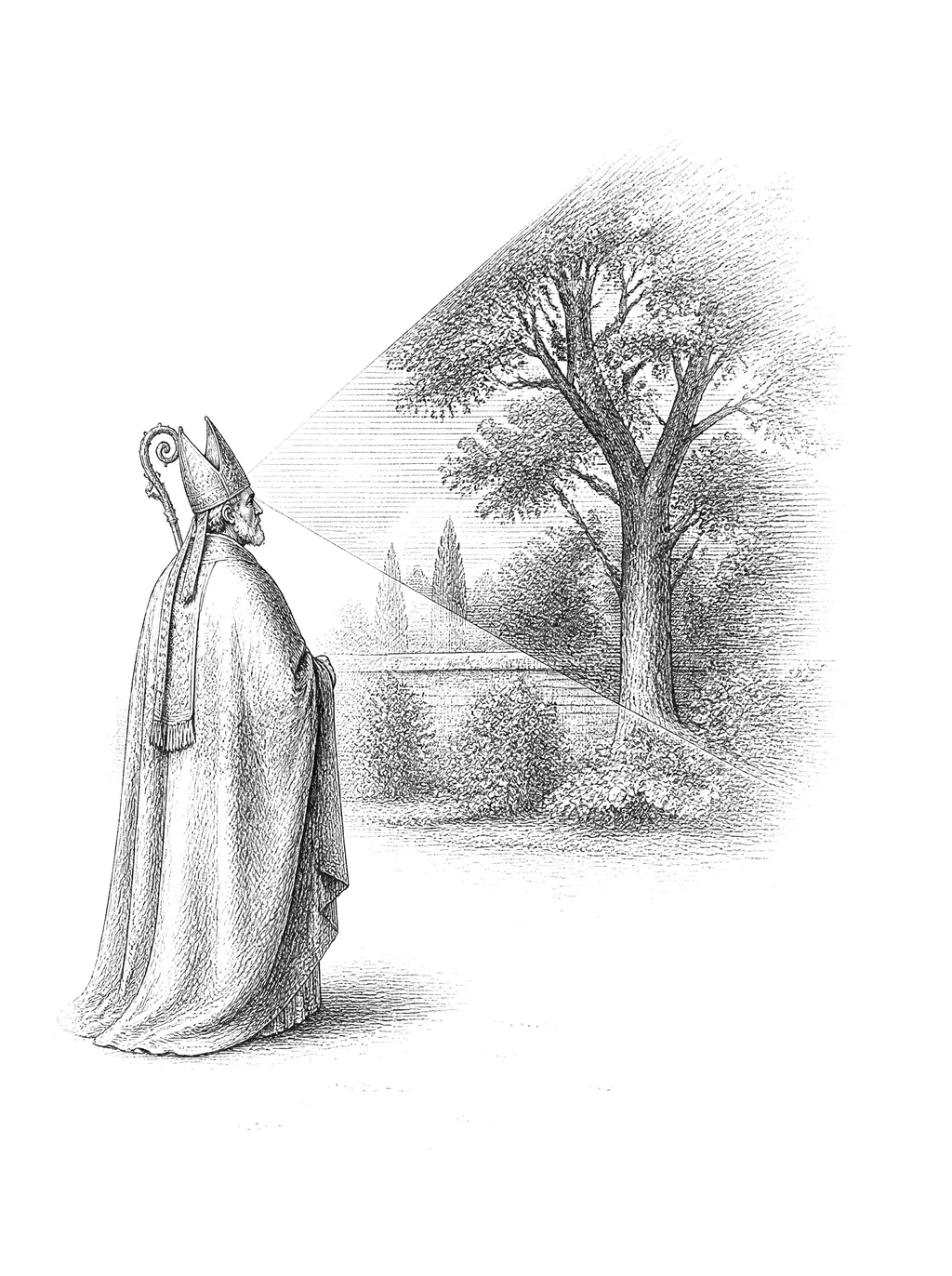
To Be Is to Be Perceived
The table you write on
Berkeley points at an ordinary table and asks what you actually mean when you say it exists. You mean, he argues, that you see it and feel it, or that you could, or that some other mind does. Strip away every possible act of perceiving it, by anyone, and ask what is left over. Berkeley's answer is: nothing you can coherently describe. He was twenty-five when he published this, and he insisted he was the defender of common sense, not its enemy. Ordinary people believe the things they see are real. Berkeley agreed completely. It was the philosophers, with their invisible matter lurking behind the visible world, whom he accused of inventing something nobody had ever met.
The world it came from
Berkeley was born in Kilkenny in 1685, educated at Trinity College Dublin, and published the Principles of Human Knowledge in 1710, followed by the Three Dialogues in 1713 when the first book was ignored. He was answering Locke. Locke had said we perceive only ideas, that ideas are caused by external matter, and that matter itself is a something we know not what. Berkeley thought that picture led straight to skepticism and atheism: if the real world is an unknowable substance behind a veil of ideas, nobody can know anything, and God becomes optional. Remove matter and the veil vanishes. Berkeley later became an Anglican bishop, spent three years in Rhode Island trying to found a college, and gave his name to a town in California.
The idea
For sensible things, colors, shapes, sounds, textures, to exist just is to be perceived. There is no further, separate fact about an unthinking object sitting there unobserved, with existence somehow attached to it independently of any mind. Ideas cannot exist except in a mind perceiving them, which means physical objects, built entirely out of such ideas, cannot either. Berkeley's world contains two kinds of thing: minds, which perceive, and ideas, which are perceived. Nothing else. The apple you left in the kitchen does not blink out when you close the door, because God perceives everything always; that is what keeps the world steady when human attention wanders. Berkeley meant this as a proof of God, not a complication.
How the reasoning runs
First, what you immediately perceive are ideas: this red, this hardness, this sweetness. Second, a sensible thing, an apple, is nothing but a collection of such ideas going together. Third, an idea can exist only in a mind; an unperceived sensation is a contradiction in terms. Fourth, so an apple can exist only in a mind. Fifth, try the escape route: Locke's primary qualities, shape and motion, existing outside the mind. But you cannot perceive or even imagine a shape without some color, so they fall together. Sixth, the strongest move: try to conceive a tree that nobody perceives. In conceiving it, you perceive it. The attempt refutes itself. Therefore matter, as an unperceived support for ideas, is a word without a meaning.
Seen in life
You are playing a video game, walking through a forest. Turn to look behind you and the trees are there. Turn back and they are there. Now open the engine's debug view and watch what the machine is actually doing. Everything outside the camera's cone of vision is not drawn. It is not hidden; it is not computed at all. The forest exists exactly as far as it is rendered to a viewer, and not one tree further. Berkeley's universe runs like that engine, with one difference that matters to him. The renderer never stops, never sleeps, and has every viewpoint at once. He called it God. Your console calls it the frame loop. The philosophical claim is the same: to be is to be shown.
Why it matters
This dissolves an entire category most people never question: matter existing independently of any observer at all. If Berkeley is right, the everyday picture of a solid, mind-independent physical world sitting there whether or not anyone looks at it is not a safe common-sense default. It is a substantial and, on his argument, unsupportable metaphysical claim. The consequence for knowledge is what he cared about. Once matter is gone, there is no gap between how things appear and how they are, because appearing is all that being ever was. The skeptic who says you never reach the real world behind your perceptions has nothing left to point at. You are already there. There was never anywhere else.
“Their esse is percipi, nor is it possible they should have any existence out of the minds or thinking things which perceive them.”
From the source
Berkeley states the principle directly, discussing the very table he is writing on as he writes it: “Their esse is percipi, nor is it possible they should have any existence out of the minds or thinking things which perceive them.” The table exists, he says, meaning that he sees and feels it; and if he were out of his study he should say it existed, meaning that if he were in his study he might perceive it, or that some other spirit actually does. That is all the word can mean. The passage is the third section of the Principles. One section later he calls the contrary opinion, that houses, mountains, and rivers exist unperceived, a strange one, and asks the reader to consider what it could possibly signify.
The pushback
The obvious objection is Samuel Johnson's, kicking a stone and declaring, “I refute it thus”: doesn't the stone's resistance prove it exists independently of anyone's perceiving it? Berkeley's actual answer is subtler than the objection assumes: the resistance you feel is itself a perception, exactly the kind of thing his argument already accounts for, not evidence of anything existing outside perception at all. The harder objection is about the master argument, the tree nobody conceives. In trying to conceive an unperceived tree, you form an idea of a tree; that much is true. But the idea is in your mind, while the tree it is an idea of need not be. Berkeley seems to confuse the act of conceiving with the content conceived.
The reply
To Johnson, Berkeley's reply stands: kicking is one more experience, and a philosophy of experience has no trouble with it. To the harder objection, Berkeley's defenders answer that he was not committing a simple slip. His point is that the content of the idea is always something perceivable, made of colors and shapes, and that a thing made of perceivables cannot be the kind of thing that exists unperceived. Whether that answers the objection or restates the thesis is still argued. Most philosophers think the master argument fails, and that Berkeley's real force lies elsewhere, in the challenge to say what unperceived matter would add to the world. Nobody has answered that one to universal satisfaction either, which is why he is still read.
Where it went next
Hume took Berkeley's arguments, removed God, and found that neither matter nor the self survived. Kant wrote a refutation of idealism aimed partly at Berkeley and then built a system in which we know only appearances, which Berkeley might have called a compliment. John Stuart Mill turned the view into phenomenalism, matter as the permanent possibility of sensation, and A. J. Ayer carried that into the twentieth century. Ernst Mach's version influenced the young Einstein. Popular accounts of quantum measurement, in which the observer makes the outcome real, are often Berkeley half-remembered, though physicists dispute the reading. Borges gave him the best tribute: in the story Tlön, Uqbar, Orbis Tertius, a whole planet runs on Berkeley's principles, and it slowly replaces ours.
Where this leads
Plato's cave asks a related question from the opposite direction, about a real world lying beyond what appears to the senses, while Berkeley denies there was ever a further world to reach beyond those appearances in the first place at all. Where Plato's prisoner climbs out toward the sun, Berkeley says the wall was the world and the climb a philosopher's fantasy. Cogito ergo sum supplies the other half of Berkeley's universe. Descartes proved that a thinking thing exists; Berkeley kept that and threw away the extended thing Descartes put beside it. Minds and their ideas, nothing more. Read the two together and you see how much of Berkeley is Descartes with one substance deleted.