Symposium · Stoicism · Pl. 12Marcus Aurelius · 121–180 AD
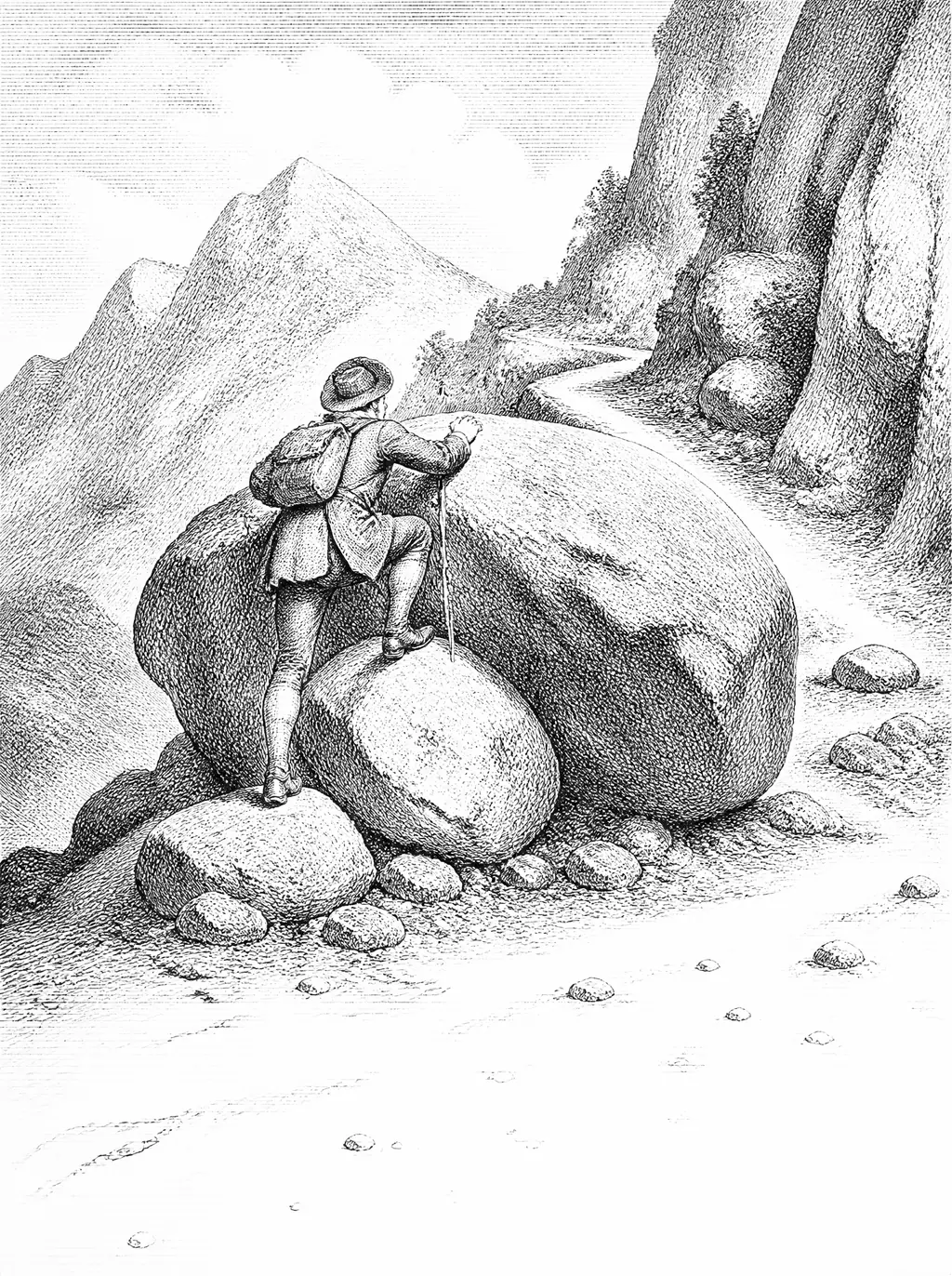
The Obstacle Is the Way
A wall in the road
Marcus Aurelius ruled through a war he never asked for, on a frontier that kept collapsing behind him, while plague thinned the cities he was supposed to protect. He did not wait for smoother ground to show up. He wrote himself a rule for turning every blockage he met into the very thing that moved him forward. The rule survives as a few lines in Book V, written in a camp, by a man who had run out of smooth ground years before and had stopped expecting it back.
The world it came from
From 166 AD Marcus Aurelius spent most of his reign at war on the Danube, against Germanic and Sarmatian tribes who had broken through the frontier and, in 170, reached northern Italy. He had not trained for this. He was a scholar by temperament, raised on Epictetus and Stoic ethics, and he wrote the Meditations in camp at Carnuntum and on the river Gran, in Greek, at night. The plague ran through his army. In 175 his most trusted general in the east, Avidius Cassius, declared himself emperor on a false report of Marcus's death. The passage on impediments comes from this period. It is not a general's motto. It is a tired man's instruction to himself about the next thing to go wrong.
The idea
Whatever blocks your path can be converted into fuel for the path itself. A mind fixed on its purpose does not treat a setback as a detour around the goal. It treats the setback as new material, folding the hindrance into the task the way a fire folds fuel into itself and burns brighter for it. The conversion is deliberate, and it has a direction. The fire does not pretend the log is not there; it uses the log. A mind with a purpose treats the obstacle the same way, as the next thing to work on, and the only thing in front of it.
How the reasoning runs
The reasoning depends on one Stoic premise: what matters about any action is not its outcome but the quality of the intention and the effort behind it. Grant that, and the rest follows. First, an obstacle blocks a particular outcome. Second, it does not block the exercise of virtue, since you can act justly, bravely, and wisely toward the obstacle itself. Third, the exercise of virtue was the real aim all along; the outcome was preferred but not essential. So the obstacle has not blocked the aim. It has supplied the aim with new material. Fourth, a mind that understands this treats the blockage not as a stop but as the next occasion for the thing it was doing anyway. Hence the impediment becomes the way.
Seen in life
The funding falls through in March. You had a team, a plan, and eighteen months of runway; now you have the team and the plan. The easy story is that the work is on hold until money returns. Marcus says the money was never the work. Ask what the blockage is now the material for. It is the occasion to find out which two features the product actually needs, since you can only afford two. It is the occasion to learn which of the team stays when the pay is late, and which investors were waiting for exactly this test. Six months later the company that survived on two features is better than the one that had eighteen months to build ten.
Why it matters
Most people wait for a clear path before they act, and stall the moment one obstacle appears. This idea removes that excuse. There is no clear path waiting for you, only the one you build out of whatever is actually in front of you, obstacle included, so the delay you were planning for was never coming. It also changes what an obstacle tells you. Most people read a blockage as a verdict on the goal, and quit or sulk accordingly. Marcus reads it as an instruction about the next step, which is a very different kind of message, and one you can act on this afternoon.
“The mind doth turn and convert any impediment whatsoever, to be her aim and purpose. So that what before was the impediment, is now the principal object of her working; and that which before was in her way, is now her readiest way.”
From the source
In Book V of the Meditations, Marcus Aurelius wrote to himself: “The mind doth turn and convert any impediment whatsoever, to be her aim and purpose. So that what before was the impediment, is now the principal object of her working; and that which before was in her way, is now her readiest way.” The passage is about other people. Marcus begins by noting that men are the nearest thing to us, and that we must do good to them and bear with them; but when they hinder our proper work, they become one of the indifferent things, like sun or wind, and the mind turns the hindrance into its object. The impediment he had in mind was a difficult colleague, not a mountain.
The pushback
Doesn't this just dress up bad luck as good news, refusing to admit when something has actually gone wrong? Marcus Aurelius is not claiming every obstacle is secretly a blessing. He is claiming your mind decides what it does with the obstacle, and a mind trained to convert hindrance into purpose loses nothing by trying, even when the obstacle stays exactly as bad as it looked. A second worry is about scale. The rule works for a delayed shipment. It is not obvious what it means for a bereavement, and a philosophy that says the same thing about both may not be listening to the difference.
The reply
Marcus's reply to the good-news charge is in the text: he never says the obstacle is good, only that the mind can use it. The bad remains bad; what changes is what you do next. The scale worry gets a more honest, partial reply. Marcus lost children, and the Meditations do not treat grief as fuel; they treat it as something to be borne with the help of the same discipline. What the obstacle passage offers a bereaved person is narrower than the slogan suggests: not a use for the loss, but a way to keep acting well inside it. That is real, and it is less than the modern version of the idea sometimes promises. Marcus promised less, and delivered it.
Where it went next
The passage stayed a footnote for eighteen centuries and then became a title. Ryan Holiday's The Obstacle Is the Way, published in 2014, sold in enormous numbers and turned up in NFL locker rooms and Silicon Valley reading lists, which is how a Roman camp notebook became a coaching idea. Nietzsche had already compressed the thought in 1888: what does not kill me makes me stronger, though he meant something fiercer by it than Marcus did. Psychologists in the 1990s gave the phenomenon a name, post-traumatic growth, and found it in a large minority of people who survive serious hardship. None of them cite Book V. The idea got there first anyway.
Where this leads
Amor fati pushes the same idea one step further: not just converting the obstacle into fuel, but loving the obstacle itself, exactly as it arrived, without needing it to have been anything else. The inner citadel asks a related question: where inside you does that conversion actually happen, and can anyone reach in and touch it? The dichotomy of control is the premise underneath both. The obstacle was never yours to prevent, and your response to it was never anyone else's, which is why Marcus could write the rule in a camp and expect it to hold anywhere.