Symposium · Metaphysics · Pl. 14Gottfried Wilhelm Leibniz · 1646–1716
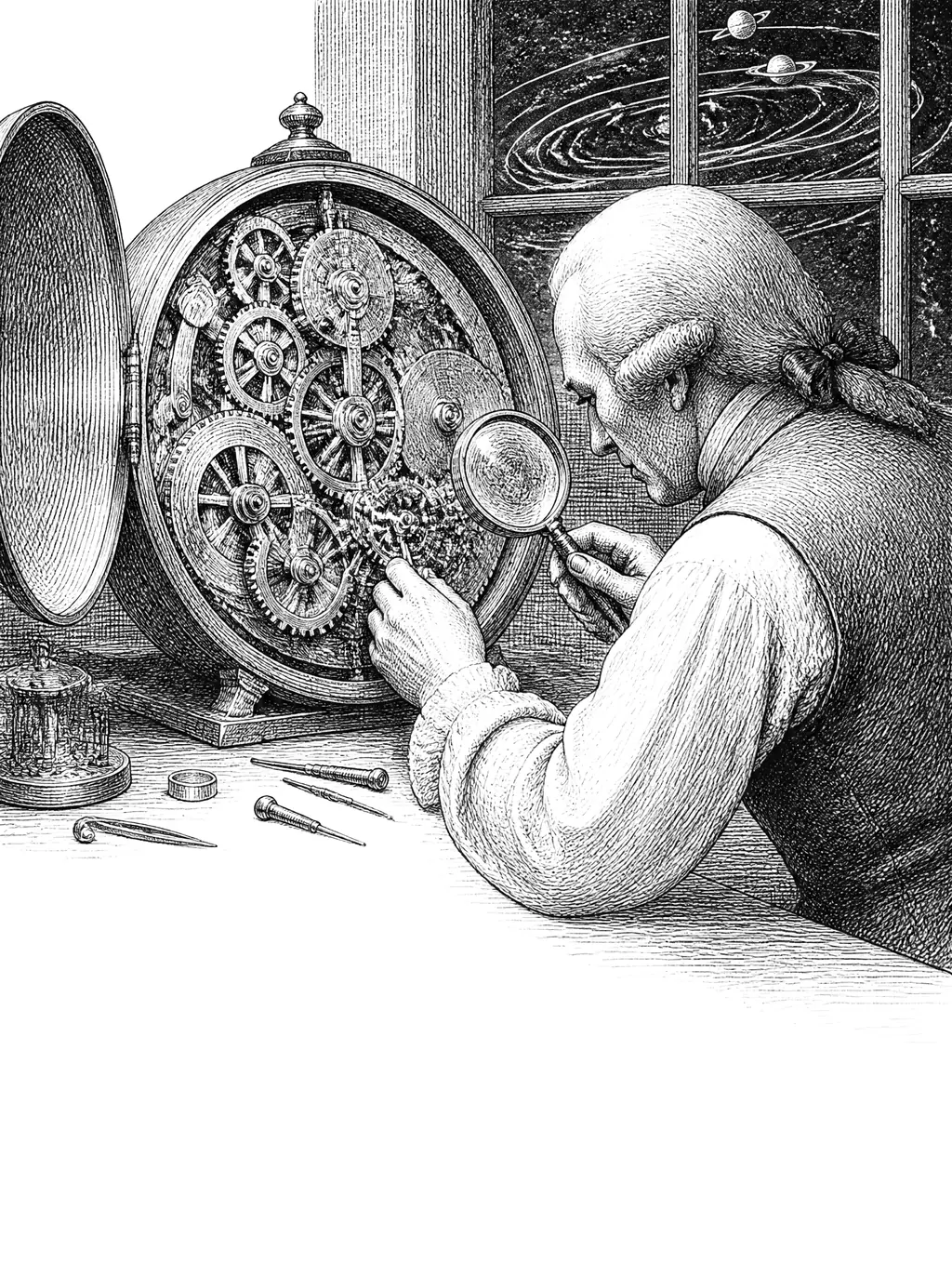
The Principle of Sufficient Reason
A question that refuses to go away
Nothing seems to require less explanation than pure emptiness, and yet the universe is stubbornly, undeniably full of things instead. Leibniz treated this as a real question demanding a real answer, not a rhetorical flourish to marvel at and drop. If something exists, he insisted, there has to be a reason it does rather than not. He put the question in a short late essay, the Principles of Nature and Grace: why is there something rather than nothing? Nothing, he observed, is simpler and easier than something. So the existence of anything at all is the most surprising fact there is, and the one most in need of a reason. The principle that every fact has one is his answer to how the question can even be asked.
The world it came from
Leibniz stated the principle throughout his working life, but its clearest formulations come late: in the Theodicy of 1710, in the Monadology of 1714, and in his correspondence with Samuel Clarke in the last two years before his death in 1716. Clarke was defending Newton's physics, which included absolute space, an infinite empty container in which God had placed the world. Leibniz objected that if space were absolute, God would have had no reason to put the world here rather than three feet to the left, since every position in empty space is identical. A choice without a reason was, to him, impossible. The principle was his weapon in that debate, and the Newtonians thought it proved too much.
The idea
There is no true enunciation whose reason could not be seen by one possessing all the knowledge necessary for its complete understanding. Every fact, however small or however cosmic, has a sufficient reason behind it, even when human knowledge falls short of finding that reason. Nothing simply happens for no reason at all, however deeply the reason may be buried. Leibniz paired it with the principle of contradiction. Contradiction governs truths of reason: what is necessary and whose opposite is impossible. Sufficient reason governs truths of fact: what is contingent, could have been otherwise, and therefore needs something outside itself to explain why it is this way. The first principle rules mathematics. The second rules everything that actually exists.
How the reasoning runs
Take any contingent fact: that it rained this morning. Ask why. The answer cites earlier facts, the pressure, the humidity, and each of those is contingent too. Follow the chain back and you never reach a fact that explains itself, since every member of the chain could have been otherwise. So the whole series of contingent facts, even if it is infinite, lacks a sufficient reason within itself. Premise: every contingent fact has a sufficient reason. Conclusion: the reason for the whole series must lie outside it, in something that is not contingent, a being whose existence is necessary and which therefore contains its own reason. Leibniz calls that being God. The argument moves from why is there anything to a first cause in a few steps.
Seen in life
The server went down at 3:14 on a Tuesday, and the incident report says root cause: unknown. Nobody on your team believes that. Someone will spend the weekend in the logs, because you all share an assumption you have never stated: something made it happen, and the something can be found. That assumption is Leibniz's principle in working clothes. Notice how strong it is. You do not merely hope there is a cause; you treat unknown as a temporary label, an admission about your logs rather than a fact about the server. Now push the same instinct upward. Why does the universe exist at all? Leibniz says root cause: unknown is not an option there either.
Why it matters
This principle underwrites the entire project of explanation, science, history, even ordinary curiosity, since it assumes that asking why is always in principle a legitimate question with a real answer waiting somewhere, rather than a question the universe is free to simply refuse. It turns brute, unexplained fact into an admission of ignorance rather than a genuine metaphysical dead end. It also has teeth. Leibniz used it to argue that no two things can be exactly alike, since God would have no reason to place one here and the other there. He used it against absolute space and time, against a beginning of the universe in an empty, uniform time, and for a necessary being. Accept the principle and a surprising amount of metaphysics follows.
“There is no true enunciation whose reason could not be seen by one possessing all the knowledge necessary for its complete understanding.”
From the source
In the Theodicy, Leibniz names it one of the two great principles of all reasoning: alongside the principle of contradiction sits that of the sufficient reason. “There is no true enunciation whose reason could not be seen by one possessing all the knowledge necessary for its complete understanding.” The Monadology of 1714 puts it in a numbered paragraph: no fact can be real or existent, no statement true, unless there is a sufficient reason why it is so and not otherwise, though these reasons most often cannot be known by us. That last clause matters. Leibniz did not claim we can always find the reason. He claimed there always is one, and that a mind with complete knowledge would see it.
The pushback
Doesn't this simply push the question back a level, since the sufficient reason for the universe as a whole would itself need a further sufficient reason, threatening an endless regress with no final stopping point? Leibniz's own answer reaches for a necessary being, something existing by its own nature, to serve as the reason that finally needs no further reason behind it. A harder objection comes from the other direction. If every fact has a sufficient reason, then given the reasons it could not have been otherwise. So nothing is contingent, everything is necessary, and Spinoza was right. Leibniz had to hold that the reason inclines without necessitating, and critics from his time to ours have doubted that a reason can fully explain a choice yet leave it open.
The reply
To the regress, Leibniz's reply is that a necessary being is precisely one whose reason is internal: it exists because its nature includes existence, so asking for a further reason misunderstands the answer. Whether the concept of a self-explaining being is coherent is a live dispute, but the reply is not circular. To the necessity objection, Leibniz distinguished absolute necessity, whose opposite is contradictory, from hypothetical necessity, given God's choice of the best. The world is necessary only in the second sense. Many readers find this a relabelling rather than a solution. Leibniz himself wrote that the problem of contingency was a labyrinth he had entered and never fully left, which is as honest as a reply gets.
Where it went next
Christian Wolff made the principle the foundation of German school philosophy, and Kant learned it from Wolff before turning on it: the Critique of Pure Reason argues that reason's demand for a complete explanation is legitimate as a method and illegitimate as a claim about things in themselves. Schopenhauer's doctoral thesis, On the Fourfold Root of the Principle of Sufficient Reason, sorted its uses into four kinds. Twentieth-century physics gave the principle its hardest test: quantum mechanics, on most readings, contains events with no sufficient reason for their particular outcome. Cosmologists still argue about whether the universe needs an explanation or is simply a brute fact, and the two sides are still Leibniz and his critics.
Where this leads
The best of all possible worlds is Leibniz's own attempt to apply this exact principle to the single biggest question of all, arguing that God's choice among every possible universe must itself have had a sufficient reason standing behind it. Falsifiability approaches explanation from the opposite end. Popper did not ask whether every fact has a reason; he asked what makes a proposed reason worth taking seriously, and answered that it must be capable of being wrong. The two ideas mark the boundaries of the scientific attitude. Leibniz supplies the confidence that the question why always has an answer. Popper supplies the discipline that keeps the answers honest.