Symposium · Metaphysics · Pl. 3Gottfried Wilhelm Leibniz · 1646–1716
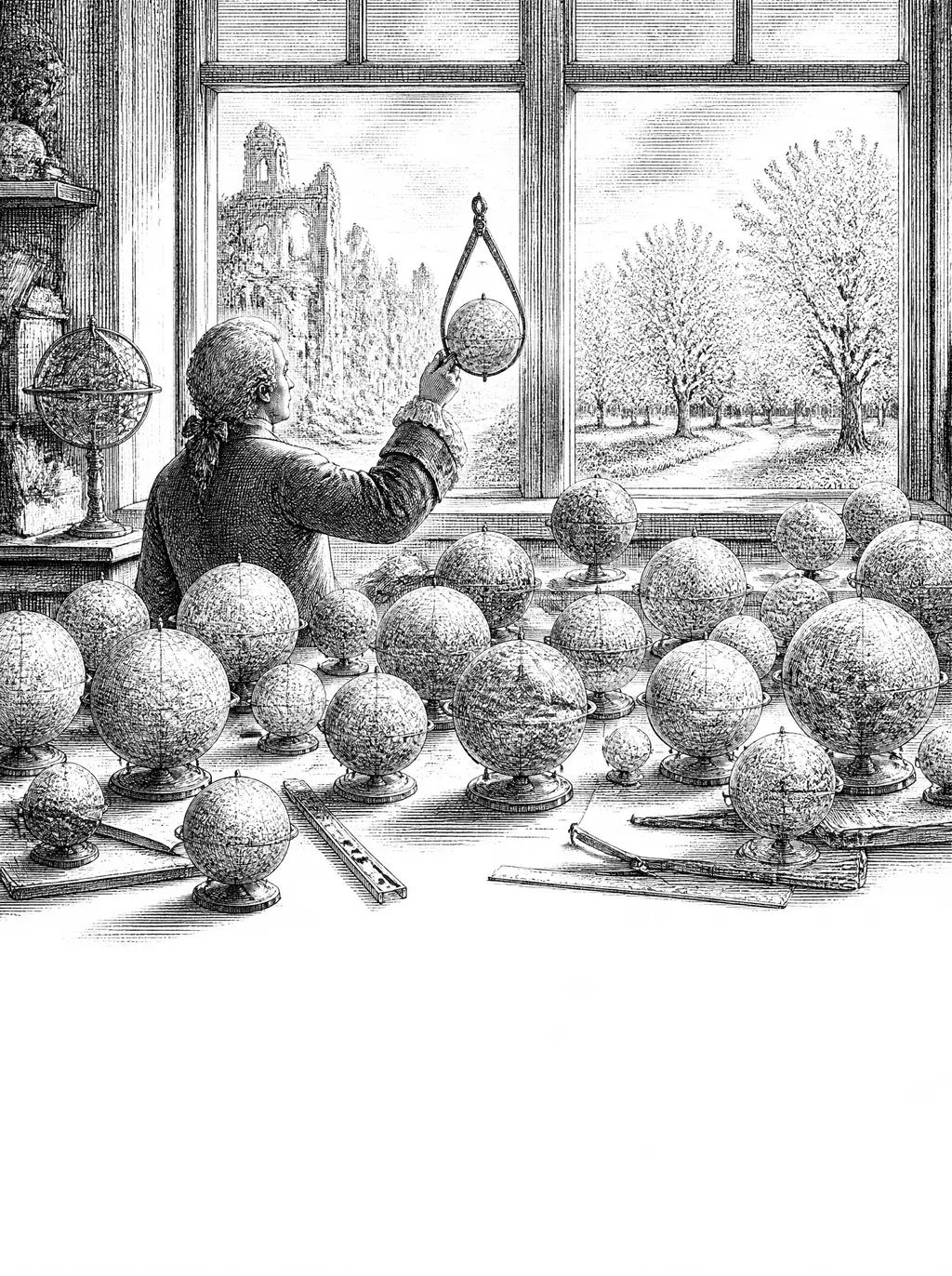
The Best of All Possible Worlds
A defense against the obvious objection
The problem of evil asks how a perfectly good, all-powerful God could allow the amount of suffering the actual world clearly contains. Leibniz took the question seriously rather than dodging it, and answered with a claim that sounds strange at first: this world, evils and all, is still the best one that could possibly have existed. Notice what the claim does not say. It does not say the world is good, or that your suffering is good, or that things will work out. It says only that every alternative would have been worse on balance, taken as a whole. That is a much narrower thesis than the one Voltaire mocked, and it is worth seeing why Leibniz thought a rational God could not have chosen otherwise.
The world it came from
Leibniz was born in Leipzig in 1646 and spent the last forty years of his life as librarian, historian, and adviser to the ducal court of Hanover. He invented calculus independently of Newton, designed calculating machines, and wrote endless letters. The Theodicy of 1710 was the only philosophical book he published in his lifetime. It grew out of conversations with Sophie Charlotte, queen of Prussia, about the Dictionary of Pierre Bayle. Bayle had argued that reason cannot reconcile a good God with the world's evils, and that faith must simply override reason. Leibniz refused that surrender. He wanted to show that faith and reason agree, and the best-of-all-possible-worlds thesis was the hinge of the demonstration.
The idea
God has chosen the best of all possible worlds. Before creation, an infinite number of possible universes existed only as ideas in the divine mind, each internally consistent but mutually incompatible with the others. A perfectly good, all-knowing, all-powerful God, surveying every option, could only have selected the single best one available, which is therefore the world that actually exists. Best, for Leibniz, has a precise meaning. The best world combines the greatest variety of phenomena with the simplest laws, the richest effects from the most economical means. Evil enters in three forms: metaphysical evil, which is the mere imperfection of any created thing; physical evil, suffering; and moral evil, sin. God permits the second and third only because removing them would spoil the whole.
How the reasoning runs
Step one: God exists and is perfect in power, knowledge, and goodness. Step two: a perfect being always acts for a sufficient reason, and the only sufficient reason for choosing one world over another is that it is better. Step three: not every conceivable good is compatible with every other; a world with free creatures cannot also be a world in which no one ever chooses wrongly. So the possible worlds are packages, and each must be judged whole. Step four: an all-knowing God sees every package completely, and a perfectly good God chooses the best. Conclusion: this world is the best. Any evil in it is a feature that, removed, would have required removing a greater good elsewhere in the package.
Seen in life
You run a small hospital with one budget. You can fund a second dialysis machine or a mental-health nurse, not both. Whichever you choose, someone suffers who would not have suffered under the other plan. A visitor who sees only the dialysis waiting list concludes that you do not care about kidney patients. You know the choice was between whole plans, and that the plan you chose was the least bad on balance. Now scale that up to every event in every life, seen by a mind that can compare all the plans at once. Leibniz's claim is that the world's evils are the waiting list of the best plan. Whether that thought comforts you at a hospital bedside is a separate question, and Voltaire's.
Why it matters
This reframes evil and suffering not as evidence against God's goodness, but as the necessary cost of a world that is best overall, the way a painting's shadows are not flaws but part of what makes the whole composition work. Removing every apparent evil, on this view, might make the total picture worse, not better, in ways not always visible from inside it. It matters beyond theology. The thesis is the first fully worked-out version of a trade-off argument that now appears everywhere: no policy, design, or life can maximise every good at once, so the question is never whether a system has costs but whether any alternative has fewer. Leibniz also gave optimism its name; the word was coined for his view.
“God has chosen the best of all possible worlds.”
From the source
Leibniz states the thesis plainly in the Theodicy, defending it against philosophers who denied any real possibility existed beyond what actually happens: his entire argument for permitting evil rests on the assumption that “God has chosen the best of all possible worlds.” The Theodicy is a long, loose book, part treatise and part running commentary on Bayle. Leibniz ends it with a fable. Theodorus, a priest of Jupiter, is shown a palace of possible worlds arranged as a pyramid, every room a complete universe. The best is at the summit, and there is no lowest room, since worse worlds go down forever. Sextus Tarquinius appears in many rooms, and only in the topmost does his crime lead to the founding of the Roman republic.
The pushback
Voltaire's Candide mocked this argument mercilessly, marching its characters through earthquake, war, and disease while a foolish philosopher insists all is for the best in the best of all possible worlds. The satire lands because the claim is genuinely difficult to reconcile with the sheer, specific weight of real suffering, however logically tidy it sounds in the abstract. There is a harder, quieter objection. If this world is the best possible, then God could not have made it better, and a being who could not do otherwise did not really choose. Leibniz's God appears to be bound by the same necessity he was supposed to stand above. Spinoza had already drawn that conclusion openly, and critics accused Leibniz of hiding the same necessitarianism behind kinder words.
The reply
To Voltaire, Leibniz's defenders point out that Candide attacks a claim Leibniz never made. He did not say that each event is for the best, only that the whole is; and he did not counsel passivity, since striving against evil is one of the goods the best world contains. To the necessity objection, Leibniz drew a distinction. The best world is necessary only morally: God's goodness inclines him toward it without compelling him, and other worlds remain possible in themselves. Whether that distinction does any work is disputed. If a perfect being cannot choose worse, moral necessity looks like necessity. Leibniz's own letters return to the problem again and again, which suggests he did not think he had settled it.
Where it went next
The Lisbon earthquake of 1755 killed tens of thousands on a feast day, and Voltaire answered it with a poem and then with Candide in 1759. Leibnizian optimism never fully recovered its reputation. Kant, in 1791, declared that all philosophical attempts at theodicy had failed. Yet the structure of the argument survived. Modern philosophers of religion, Alvin Plantinga most prominently, reworked possible worlds into a free-will defense that aims only to show evil and God are compatible, not that this world is best. Possible worlds themselves became a standard tool of logic through Saul Kripke and David Lewis. And the phrase best of all possible worlds entered English as shorthand for a hopeful trade-off, usually said with a wince.
Where this leads
Why bad things happen to good men reaches Seneca's own answer to the identical problem centuries earlier still, treating hardship as evidence of providence testing the strong rather than proof of a poorly chosen universe that God should have corrected. The principle of sufficient reason is the engine under the whole argument: God chose this world because a reason had to exist for the choice, and only being best would count as one. Read the two Leibniz ideas together and the theodicy looks less like an excuse and more like a consequence. If every fact has a reason, then the existence of this world rather than another needs one, and Leibniz could think of only one candidate.