Symposium · Eastern Philosophy · Pl. 6Miyamoto Musashi · 1584–1645
Do Nothing That Serves No Purpose
The rule that closes the list
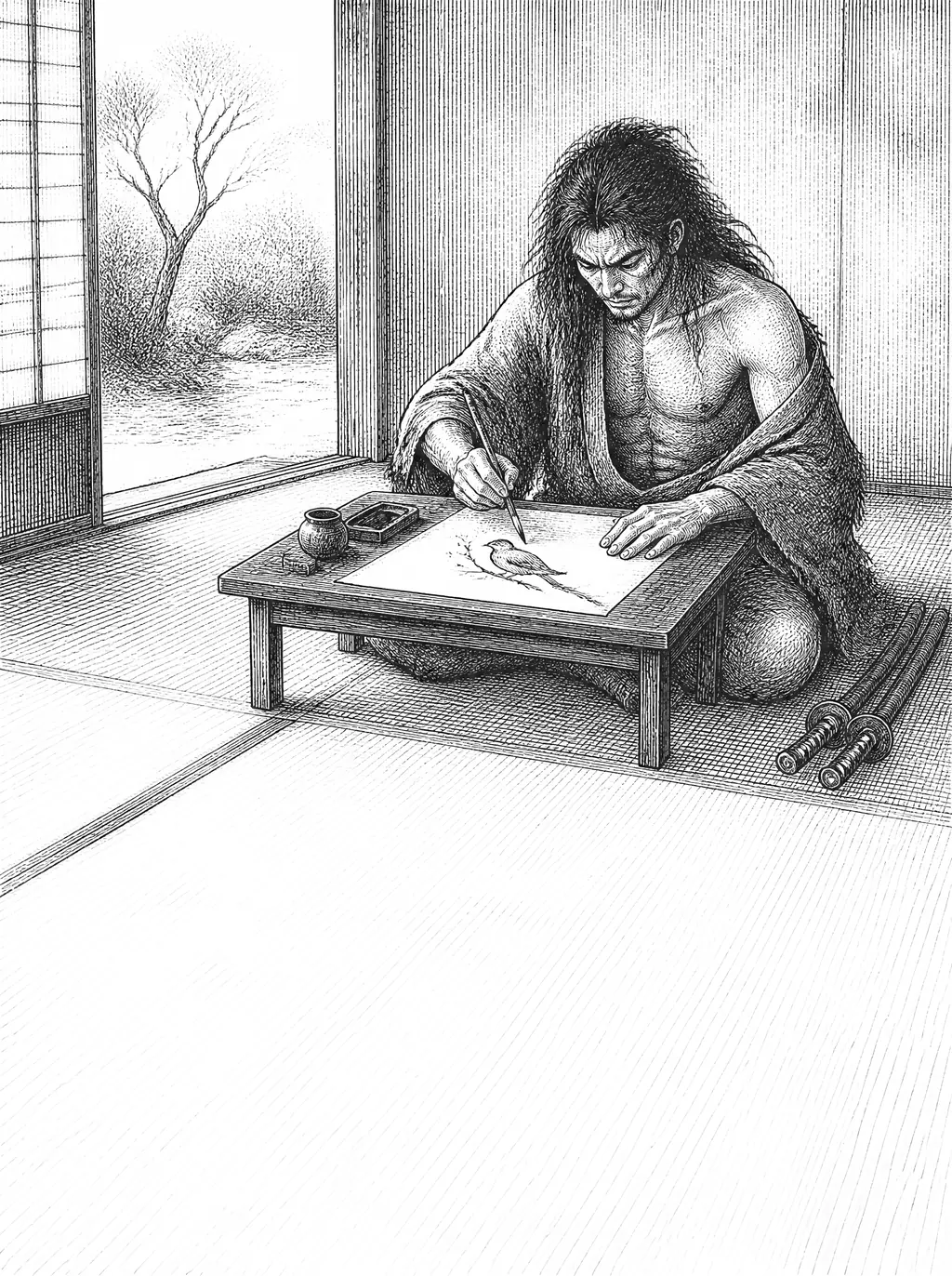
The Ground book finishes with nine rules for anyone who wants to learn the Way, and the ninth is the shortest: do not do things that serve no purpose. Coming from a duellist, it sounds like a rule against comfort. It was not. The same man painted in ink, and one of the surviving pictures is a shrike on a withered branch, a small bird on a dead stem with a caterpillar climbing below it and most of the paper left empty. He also cast sword guards and made saddles. None of that was leisure to him. All of it was the road.
The world it came from
Two generations of peace had turned the sword schools into institutions. A school sold a syllabus: named cuts, ceremonial forms, weapons of unusual length, and a licence at the end. Musashi's own school, Niten Ichi-ryū, was built on the opposite instinct. He fought with the long and the short sword at once, and defended it with an argument from waste: a man who dies with one hand empty has thrown away a hand. He wrote his book in a cave at Reigandō, above the Iwato river west of Kumamoto, in the last two years of his life, and he names almost no techniques in it.
The idea
The rule is a filter, and the other eight rules run through it. Useless does not mean unpleasant, unpaid, or unserious. It means it does not serve the Way you have actually chosen. That definition does two things at once. It forbids the impressive-looking motion, the ceremony, the collected equipment, the named stance that exists to be admired. It also refuses to hand you the list, because the list depends on which road you are on and Musashi will not choose your road for you. This is why the rule is last. It cannot be applied until everything before it has been settled.
How the reasoning runs
First: days and attention are finite and do not come back. Second: most of what fills them was never chosen. It arrived by habit, by what the school taught, or by what looks like seriousness to other people. Third: no activity is useless in the abstract. Usefulness is a relation between an act and a named end, so the judgement is impossible until the end is stated. Fourth: therefore the order is fixed. Name what you are doing with your life, and only then prune. Fifth: pruning is continuous work, because uselessness accumulates quietly, one reasonable acquisition at a time, and never announces itself.
Seen in life
You decide to write. Within a month you have a system: a notes application, a tagging scheme, a folder of articles about how writers write, a subscription that syncs it all. Every piece of it was a reasonable purchase, defended at the time by a real problem. None of it is a sentence. The system is pleasant precisely because it feels like the work and cannot fail like the work can. Musashi's rule is not a complaint about spending money. It is a question you have to answer out loud: name the end, then look at the folder and say which parts of it are moving you there.
Why it matters
Addition is easy and almost always feels responsible. Every extra tool, meeting, obligation, and side interest arrives with a reason attached, and reasons are cheap. Subtraction is hard because it requires you to have said what the thing is for, and most people would rather stay busy than say that out loud, since saying it makes failure legible. The rule's real work happens before any pruning. It forces a statement of purpose by making one necessary. Once the statement exists, most of the cutting is obvious and takes an afternoon. Without it, no amount of tidying changes anything at all.
“Do not do things that serve no purpose.”
From the source
The ninth rule is four words in Japanese and only slightly more in English: “Do not do things that serve no purpose.” It closes a list that runs: do not think dishonestly; the Way is in training; become acquainted with every art; know the ways of all professions; understand gain and loss in worldly matters; develop judgement and understanding; perceive what cannot be seen; pay attention even to trifles; and then the ninth. The order matters. Rule three, which tells you to touch every art there is, sits five lines above the rule that tells you to cut. Whatever Musashi meant by useless, he did not mean narrow.
The pushback
This is instrumentalism with a sword. Everything must earn its place against a purpose, and whatever cannot make the argument is cut, which is a fine rule for a workshop and a poor one for a life. Rest does not serve. Play does not serve. A friendship that goes nowhere does not serve. And we have the finished result to look at: Musashi ended with no house, no wife, no post, and a cave. Zhuangzi had already answered this rule with a story. The twisted tree is still standing precisely because it was no use to anybody, and every straight one nearby is lumber.
The reply
Musashi's defence is rule three, and his own life is the evidence. He painted, carved, forged guards, and wrote, and counted all of it inside the Way rather than beside it. That either rescues the rule or empties it, and honestly it does some of both: once every art can be shown to serve, useless stops naming much. The fair reading is narrower than the slogan. It is a local rule, addressed to somebody who has already committed to a single road, and it says nothing about whether having one road is a good way to live. On that question Zhuangzi's tree still wins, and Musashi never argues with it.
Where it went next
Victor Harris translated the five scrolls into English in 1974, and within a decade the book was on American office shelves, marketed during the anxiety about Japanese industry as the businessman's answer to a Harvard degree. The ninth rule was the easiest line to lift, and it reappears with the swordsman filed off in productivity writing, in essentialism, and in the minimalism of the 2010s. Something is lost each time. Musashi wrote for a man who expected to be killed by whatever he had neglected, so the cost of a useless habit was not a wasted evening. Read as advice about cupboards, the rule is much safer and much smaller.
Where this sits
Seneca reached the same rule from the opposite culture and the opposite class. He did not tell his readers to own nothing; he told them to stop measuring what they owned by how it looked to other people, which is Musashi's filter with the vanity named directly. Thoreau went to the pond to run the experiment rather than argue it, and came back with a list of what a life actually requires. Zhuangzi is the standing objection to all three of them, and the useless tree is his answer: the thing that serves no purpose is the only thing in the grove that nobody has cut down.