Symposium · Eastern Philosophy · Pl. 7Miyamoto Musashi · 1584–1645
Perceive What the Eye Cannot See
The island in the strait
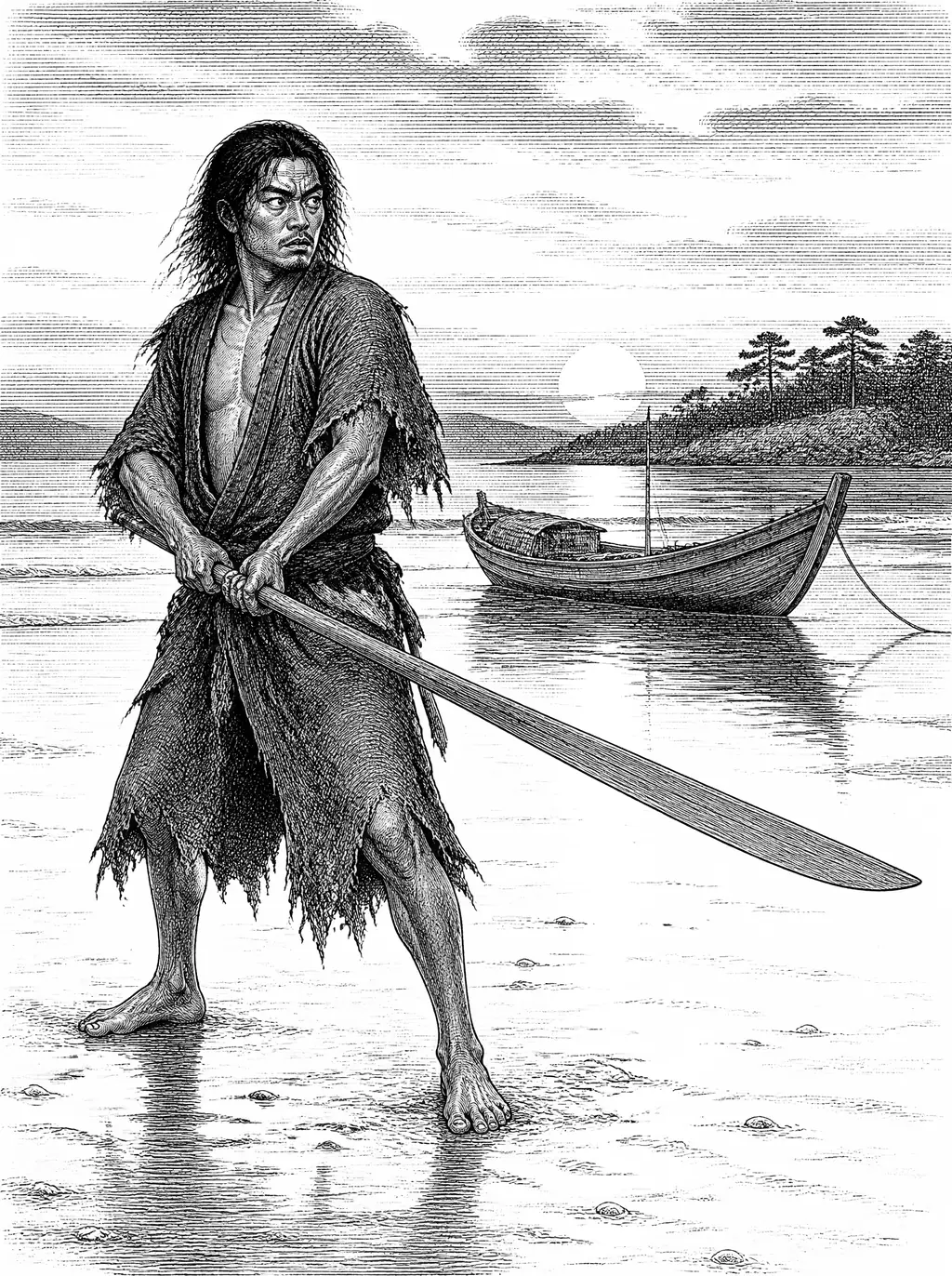
In 1612, on a small island in the strait below Kokura, Musashi fought a swordsman called Sasaki Kojirō, who carried a blade so long it was nicknamed the drying pole. The later accounts say Musashi came hours late, cut a sword from a spare oar on the crossing, and placed himself so that the light and the tide were behind him. When Kojirō threw his scabbard into the water, Musashi remarked that he had already lost. The details come from chronicles written a century afterwards and cannot be trusted in full. What they preserve is a claim about what he was looking at, and it was not the drying pole.
The world it came from
By the 1640s the sword schools of Japan had turned into curricula. A student paid for named stances, named cuts, a fixed order of transmission, and eventually a scroll certifying that he had received the tradition. Musashi devotes the fourth of his five scrolls, the Wind book, to attacking them: schools that specialise in very long swords, schools built on strength, schools with elaborate footwork, and schools that teach a student where to fix his eyes. He thought the eye instruction was the worst of it, because a rule about where to look is a rule about what you will not see. The Water book gives his replacement.
The idea
Musashi separates two words that both mean seeing. Ken is ordinary sight, the eye fastening on an object, and in a fight the object is the opponent's sword. Kan is perception: a wide, undirected reading of the whole field, including distance, breathing, weight, and intention, none of which are objects you can stare at. His instruction is blunt and asymmetric. Make kan strong and make ken weak. He adds a second drill in the same passage: see far things as though they were near, and near things as though they were far. The sword in front of you deserves less attention than it demands.
How the reasoning runs
The argument is about lateness. First: a cut is the last link in a chain that began in the feet, the hips, the shoulders, and the breath. Second: by the time the eye reports the moving sword, the chain has already run and there is no time left to answer it. Third: what actually kills you is therefore the intention, which becomes visible earlier and in more places at once, but never as a single object. Fourth: an eye locked on one object cannot gather a diffuse signal. Fifth: worse, a locked eye can be steered, which is what a feint is for. So the fix is not to look harder. It is to stop looking at all.
Seen in life
Watch a learner drive. The eyes lock on the bumper of the car ahead, because that is the object that looks like the danger, and everything else in the windscreen becomes wallpaper. Watch an experienced driver on the same road. The gaze is soft and long, aimed far down the street, and the hands move before anything has happened, because the child on the kerb has already been read from the angle of a shoulder. Nurses describe the same thing about patients who look wrong an hour before the numbers move. Nobody in either case saw a thing. They read a field, and the reading arrived as a feeling.
Why it matters
Attention is a budget, and whatever you spend it staring at is the place you cannot be warned from. That would matter less if you chose the object yourself. Usually you do not. The object is chosen by whoever is moving in front of you, by the loudest number on the dashboard, by the item that arrived most recently. Musashi's instruction is a deliberate withdrawal of that budget from the obvious thing so that it is available for the whole field. It is uncomfortable to practise, because a wide eye feels like inattention and a fixed eye feels like concentration, and the feelings are exactly backwards.
“Of the two kinds of seeing, perception and sight, let the eye of perception be strong and the eye of sight weak.”
From the source
The Water book gives the rule in one line: “Of the two kinds of seeing, perception and sight, let the eye of perception be strong and the eye of sight weak.” Around it Musashi builds a whole posture. The face is unremarkable and the forehead unwrinkled. The eyes are narrowed slightly and held steady, with the space between them widened so that both sides of the field stay live. You must be able to see to either side without turning the eyeballs. He adds that all of this is difficult in the middle of a fight, and that it should therefore be examined in ordinary daily life until it stops being a technique.
The pushback
This is the sort of advice that cannot fail. Perceive what cannot be seen is what every master of every art has said to every student, and no student has ever been able to check whether he is doing it. Worse, the psychology is not on Musashi's side by default. Daniel Kahneman spent years arguing that expert intuition is real only under two conditions, a world with stable regularities and fast, honest feedback, and that outside those conditions the same confident feeling is noise. Plenty of people who trust their perception of a room are simply wrong, at speed, with conviction.
The reply
Musashi is narrower than the mystics he is often filed with. He does not ask for a sixth sense; he gives an eye drill, with a posture, a width, and an instruction to practise it while walking down a road. And duelling is precisely the kind of world Kahneman's conditions describe: stable regularities, feedback within a second, and no way to explain away a loss. Gary Klein found the same capacity in fireground commanders who read a burning building before they could say why. The honest limit is transfer. Perception trained in one field is worth nothing in another, so a swordsman's reading of a boardroom is only a swordsman's opinion.
Where it went next
The distinction survived into modern kendō as metsuke, the placing of the gaze, usually taught as looking at the whole opponent rather than at any part, and into aikidō and iaidō in similar words. Sports science arrived at a cousin of it in the 1990s with quiet eye research, which found that expert performers fixate later, longer, and in different places than novices. Decision research reached it from another side in Klein's studies of experts under time pressure, published in 1998. The line itself has become a fortune-cookie in English, printed as perceive that which cannot be seen, which loses the two words that were the whole point.
Where this sits
Ruskin ranks seeing above thinking, and complains that thousands can think for every one who can look and report back honestly. Musashi would agree and then push further: the report itself is late, and what you want is the thing before it becomes reportable. Bacon comes at the same problem from the other end. His idols are the fixed shapes the mind has already installed in front of nature, which is Musashi's locked eye described as a habit of belief rather than a habit of the body. Suzuki's Zen points past the reportable altogether, which is where Musashi's fifth scroll ends up too.