Symposium · Stoicism · Pl. 10Seneca · c. 4 BC – 65 AD
Measure Things by Their Use
Outward show
Seneca wrote to Serenus, a friend restless and dissatisfied despite a comfortable life, and part of his prescription was oddly practical: look at your possessions again, and ask what they are actually for. A house is for shelter. Clothing is for warmth. Somewhere along the way, most people stopped asking that question at all. The essay he wrote in reply became On Tranquillity of Mind, and the passage about possessions sits inside a longer argument about how a restless person, living in the richest city on earth, can settle.
The world it came from
Seneca wrote On Tranquillity of Mind in the late 50s AD, at the height of his power as Nero's adviser and one of the richest men in Rome. In 58 AD a rival, Publius Suillius, attacked him in public for that wealth: by what philosophy, he asked, had Seneca amassed three hundred million sesterces? The charge stuck, and Seneca knew it. Serenus, his correspondent, was a younger official who complained that he admired simplicity but kept being seduced by luxury the moment he saw it in someone else's house. Seneca's answer had to work for a man who lived in the capital, with money, and could not walk away from either. It is not an argument for the desert.
The idea
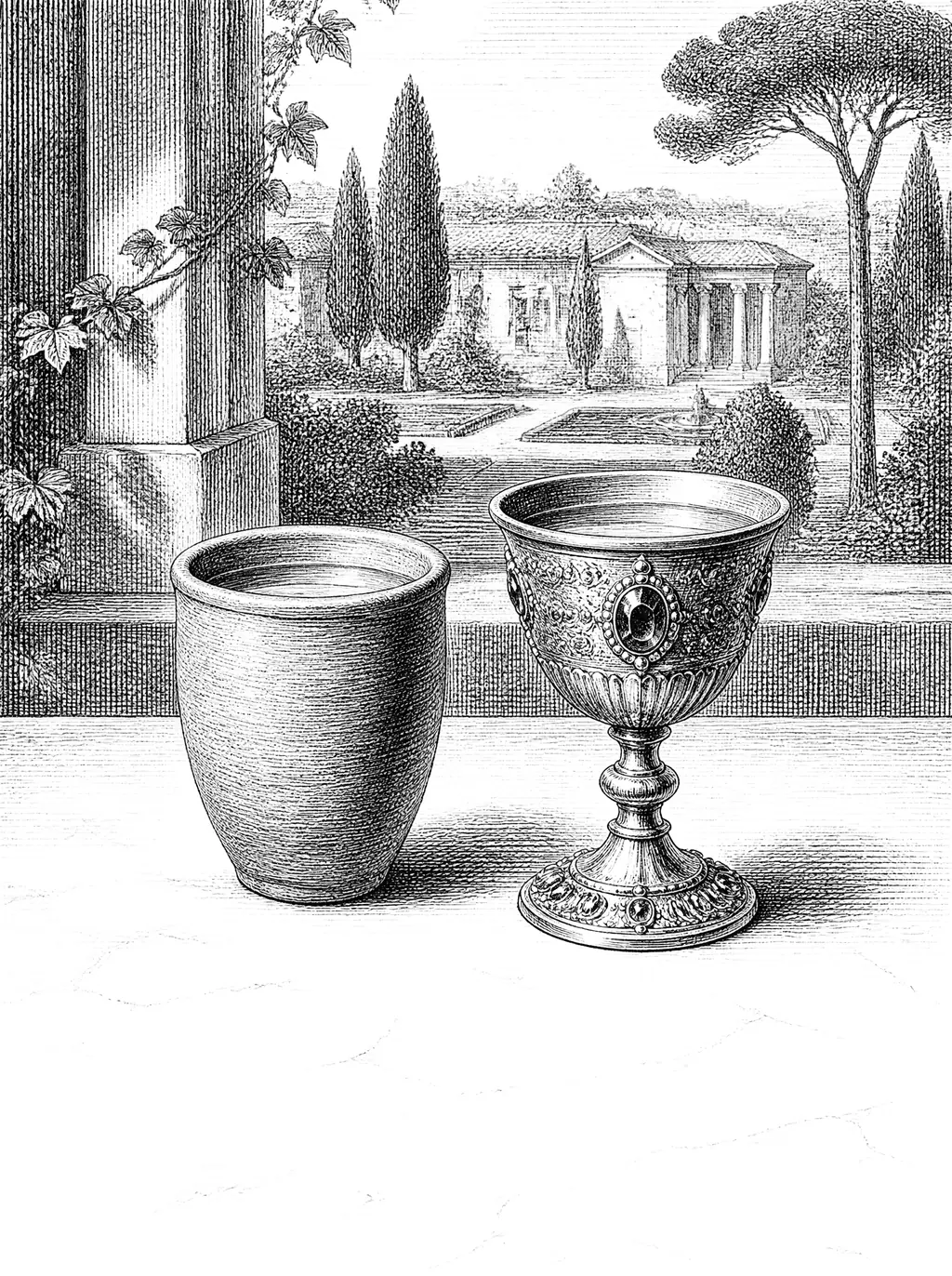
Set aside mere outward show, and measure things by their uses, not by their ornamental trappings. A cup that holds water does its whole job as well as one plated in silver. Once you judge your possessions by function instead of display, you stop needing more of them to feel adequately provided for, because adequate was already reached. The rule does not require poverty. It requires an honest answer to one question about each thing you own or want: what is this for, and does it already do that? Most of what fills a house, asked that question, has no answer.
How the reasoning runs
Seneca's reasoning starts from the two ways a thing can be valued. One is by its use: a cup for drinking, a house for shelter. The other is by its show: what it signals about you to others. Now, use has a limit built in. Once the cup holds water, more cup does nothing. Show has no limit, because it is measured against other people's show, and there is always someone with more. So a person who values by use reaches enough and stops; a person who values by show can never reach enough, by definition. Restlessness, Seneca concludes, comes from valuing by show. The cure is not to throw the cup away. It is to change the question you ask of it.
Seen in life
You are choosing a car. The one that gets you to work, fits the children, and starts in winter costs a certain amount. The one you keep looking at costs twice that, and you have already found yourself explaining to nobody in particular why it is worth it. Stop and run Seneca's question. What is a car for? Both cars do that. What is the second one for, then? Be honest: it is for the moment someone sees you in it. That is a real want, but it cannot be satisfied, because next year someone will park beside you in a better one. Buy the first car. Notice, in a month, that you have stopped thinking about cars.
Why it matters
Judging your life by display instead of use puts your peace of mind in competition with everyone else's display, a contest with no finish line, since there is always a bigger house or a newer version to fall short of. Judging by use has a finish line: the moment the thing does its job, the need is satisfied, and the anxious comparing simply has nothing left to attach to. This is also the only version of frugality that does not turn into its own kind of showing off. Nobody admires a plain cup. They just drink from it, which was the point.
“Let us accustom ourselves to set aside mere outward show, and to measure things by their uses, not by their ornamental trappings.”
From the source
In his essay addressed to his restless friend Serenus, on the subject of peace of mind, Seneca writes: “Let us accustom ourselves to set aside mere outward show, and to measure things by their uses, not by their ornamental trappings.” — Of Peace of Mind. The passage continues in the same register: let food serve to quiet hunger and drink to quench thirst, let the house keep off the weather, and let us learn to rely upon our own limbs. He is not describing a hermit. He is describing a rich man who has decided to stop letting his furniture judge him, and who knows how hard that is, because he owns the furniture.
The pushback
Isn't this an easy thing for a wealthy statesman to say, when he could afford ornament and simply chose not to want it? Seneca was in fact criticized for exactly this in his own lifetime, having grown rich in Nero's court. His defenders note that he wrote about failing at his own standard as often as meeting it, which is a different thing from never having tried. There is also a subtler objection. Use is not as clean a measure as it looks. A painting has no use in the cup-and-water sense, and neither does music. Measure everything by use and you may end up with a life that has enough of nothing but water.
The reply
Seneca answered the hypocrisy charge himself, in On the Happy Life: I am not wise, he says, and I am not talking about myself but about virtue, and it is enough that I attack my own vices daily. That is honest, and it is not a defense. On the subtler objection, the tradition's reply is partial. Seneca's target is ornament, the gilding that adds nothing to the function, not the arts; a painting's use is to be looked at, and it does that as well on a plain wall as on a marble one. But the essay does not draw that line carefully, and a reader who suspects that measuring by use could flatten a life into mere function has found a real gap in it.
Where it went next
Thoreau moved to Walden Pond in 1845 with Seneca's question in his pocket: a man is rich, he wrote, in proportion to the number of things he can afford to let alone. William Morris gave it to the arts and crafts movement in 1880: have nothing in your houses that you do not know to be useful or believe to be beautiful. Thorstein Veblen put a name to Seneca's target in 1899, conspicuous consumption, and treated it as the engine of a whole economy. The twenty-first-century minimalism movement is the same instruction, sold back to people who own too much. Seneca would have recognized the irony. He would also have recognized the customers.
Where this leads
The dichotomy of control sits underneath this idea: your possessions and their appearance to others were never fully yours to control anyway, so measuring them by use rather than display is really just applying that older distinction to the things sitting in your house. On the shortness of life makes the same argument about hours instead of objects. Ask what a thing was actually for, and most of what looked like wealth turns out to have been display; ask what an hour was actually for, and most of what looked like a full life turns out to have been the same thing, spent on the same audience.