Symposium · Eastern Philosophy · Pl. 16Laozi · 6th century BC (traditional)
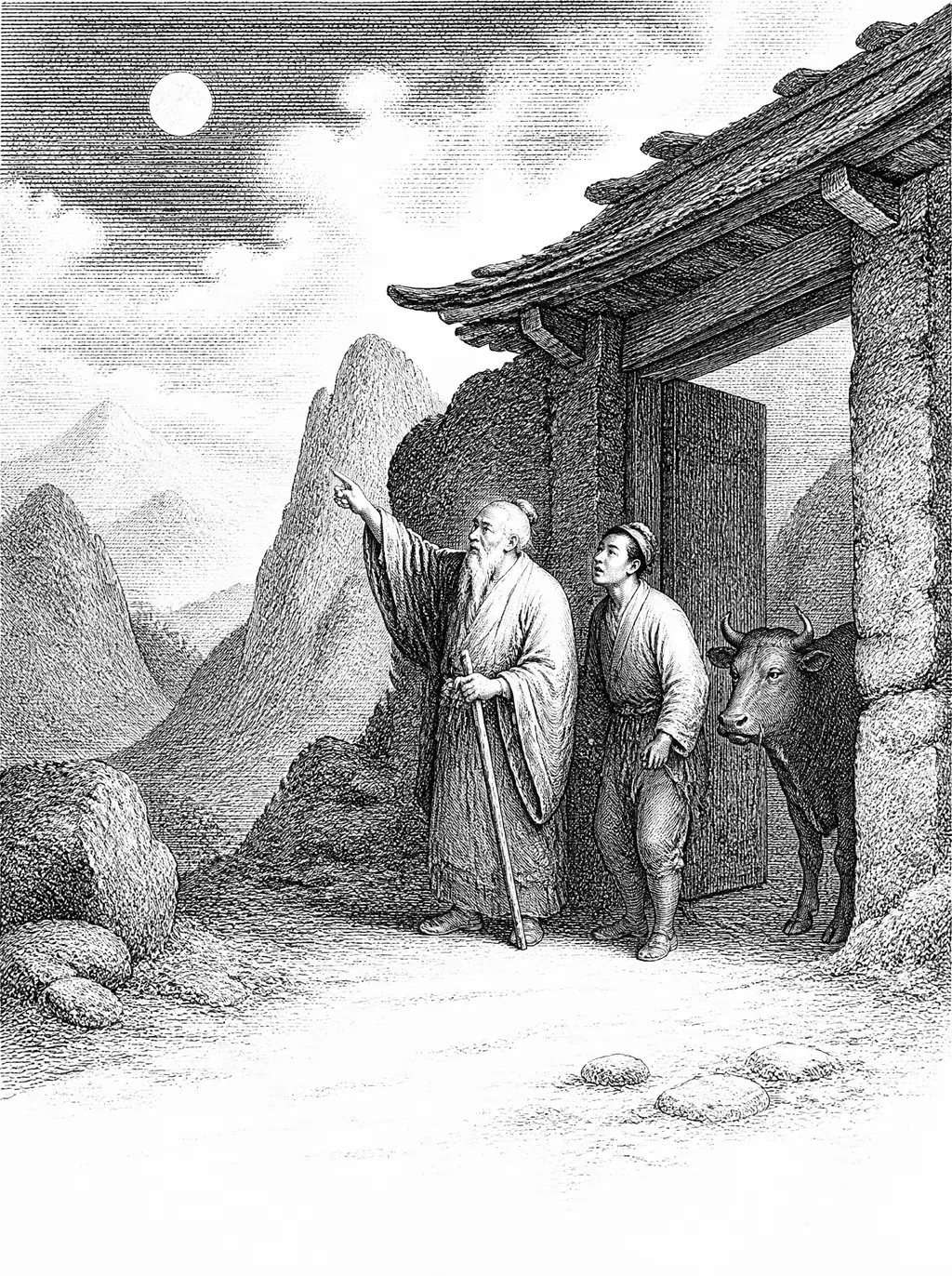
The Tao That Can Be Told
A warning label on the first page
Most teachers open with a claim: here is the truth, follow it. Laozi opens the Tao Te Ching with something closer to a disclaimer. Whatever he is about to name, describe, and circle for the rest of the book is not, he warns immediately, the actual thing itself, only a pointer standing in its place. The move is so unusual that translators have argued for a century about what the first line even says. That argument is itself part of the point. A sentence about the limits of naming turns out to resist being pinned to a single name.
The world it came from
The Tao Te Ching is about five thousand characters in eighty-one short chapters. Tradition credits Laozi, an archivist at the Zhou court who is said to have written it at the frontier before disappearing westward. The historian Sima Qian, around 100 BC, already gave three different candidates for who Laozi was. Modern scholars read the text as a compilation of the fourth and third centuries BC, and manuscripts found at Guodian and Mawangdui show its chapters still moving around near 300 BC. The Warring States were an age of naming: Confucians wanted names rectified so that a father acted as a father, and Mohists and logicians argued about definitions. The opening line pushes back against all of them. Whatever the Way is, it is not what your terms have fixed.
The idea
The Tao that can be spoken, put into words and handed to someone else fully formed, is not the enduring, unchanging Tao. Naming a thing already narrows it to fit inside language, and the deepest reality this book is circling does not fit inside any name without losing something essential in the fitting. Chapter 1 goes on to say that the nameless is the origin of heaven and earth, and the named is the mother of the ten thousand things. Names are not useless. They are just downstream, and the book wants you to remember where the water comes from.
How the reasoning runs
Start with what a name does. It picks something out by drawing a line around it: this, not that. Second, ask what the Tao is supposed to be. Not one thing among others, but the source and course of all of them, the whole process. Third, put those together. A line drawn around the whole leaves nothing outside to distinguish it from, so the naming fails. Fourth, notice the deeper problem: the Tao is constant, and names are conventions that shift with speakers and centuries. Whatever you fix in a word is already a snapshot of a river. Conclusion: any spoken Tao is a stand-in. The book can still be useful, in the way a map is useful, provided you keep remembering that a map is not ground.
Seen in life
Someone asks what your marriage is like, and you say good. Then you hear yourself and wince, because good is a word for a meal. You try again: steady, deep, hard some years. Each word is true and each one shrinks the thing. The twenty years are not in any of them. Later, alone, you catch a moment of it, the way she hums while she reads, and there it is, unnamed and entire. Laozi's warning is about that gap. He is not telling you to stop describing; you will keep answering the question. He is telling you not to confuse the answer with the marriage. The people who do that end up living inside the word and losing the thing.
Why it matters
This warns against mistaking a description for the thing described, a menu for the meal. Plenty of the deepest experiences, love, grief, a direct sense of being alive, resist being fully captured in explanation, and people who mistake their tidy verbal account of something for the thing itself quietly lose touch with it. The warning also guards against a specific vanity: the belief that because you can define something, you understand it. Laozi puts the disclaimer first so that every later chapter is read as a gesture, not a possession.
“The Tao that can be trodden is not the enduring and unchanging Tao. The name that can be named is not the enduring and unchanging name.”
From the source
The Tao Te Ching opens with exactly this warning, before a single further claim about the Tao has even been made: “The Tao that can be trodden is not the enduring and unchanging Tao. The name that can be named is not the enduring and unchanging name.” This is James Legge's 1891 translation, which reads the first Tao as a verb, trodden. Other translators write spoken or told, since the same character means both a road and to speak. The Mawangdui manuscripts, from around 168 BC, place this chapter after the chapters on virtue, which suggests the warning was not always the front door.
The pushback
If the Tao truly cannot be spoken, isn't writing an entire book about it a contradiction, eighty-one chapters spent describing the indescribable? Laozi's defenders answer that pointing at the moon is not the same as claiming to be the moon; the book gestures toward an experience words cannot replace, rather than pretending to replace it. A harder objection comes from the philosophers of names. If nothing true can be said about the Tao, then the sentence the Tao is unnameable is also not true of it, and the book refutes itself in its first line.
The reply
The first objection the tradition answers with the finger and the moon, and the book's own practice backs it: it speaks in images, negations, and paradoxes, rarely in definitions. The second objection is older than most readers realise, and Zhuangzi took it up within a century, remarking that he had just said something about what cannot be spoken of and asking whether he had really said anything. The honest reply is that the opening line is a warning, not a theory of reference. It does not claim to describe the Tao; it claims that descriptions fall short, which is a claim about descriptions. That escapes the strict paradox but leaves the puzzle: the book still has to use names for what it says names miss.
Where it went next
Wang Bi, who died in 249 AD at twenty-three, wrote the commentary that fixed the text's philosophical reading and made the nameless a central term for the Neo-Daoists. Chan Buddhists took the distrust of words into their own practice. In the West the opening line drew the mystics: Christian negative theology had said the same about God, and readers noticed. Tolstoy admired the book; Heidegger tried to translate parts of it with a Chinese scholar in 1946 and gave up. Wittgenstein's Tractatus ends on a related silence, arrived at independently. The Tao Te Ching is now among the most translated books ever written, which is a strange fate for a text that opens by saying it cannot be carried into words at all.
Where this leads
Wu wei is the practical discipline this warning opens directly onto: once you stop mistaking the named, described version of reality for reality itself, acting without forcing your own narrow plan onto it becomes the natural next step to take. The link is the same lesson applied in two places. Chapter 1 warns against forcing the world into names. Wu wei warns against forcing it into plans. Both mistakes come from trusting the map more than the ground it was drawn from.