Symposium · Eastern Philosophy · Pl. 21D. T. Suzuki · 1870–1966
Direct Pointing
A tradition against its own texts
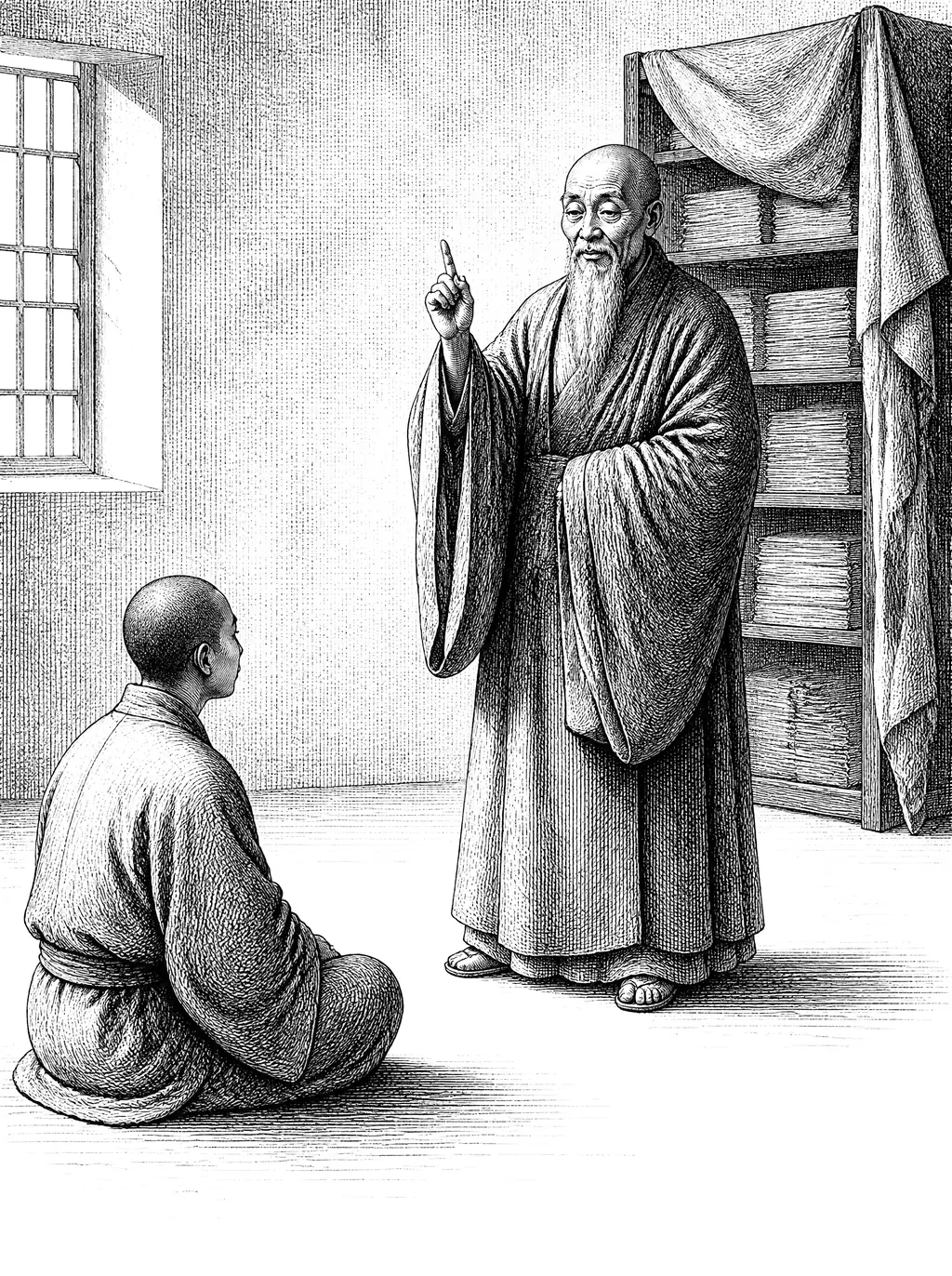
Zen arrived in China as a form of Buddhism, yet almost immediately set itself apart from the endless scriptural commentary that occupied most Buddhist schools of the time. Suzuki, introducing Zen to English readers, opens with the tradition's own four-line summary of itself, a summary that treats scripture as something to be pointed past, not memorized. The gesture is old and deliberately rude. A student asks what the Buddha meant, and the master holds up a finger, or shouts, or points at the cypress tree in the garden. The point is not to be clever. It is to stop the question from becoming another sentence.
The world it came from
Chan took shape in Tang-dynasty China, from the seventh century on, in a Buddhist world crowded with rival schools. Tiantai and Huayan built vast doctrinal systems; Pure Land offered faith in Amitābha; monastic scholars translated and catalogued sutras. Chan positioned itself against all of that: enlightenment came from practice and a teacher's direct confirmation, not from texts. The formula Suzuki quotes is attributed to Bodhidharma, the semi-legendary Indian monk said to have brought the school to China. Historians date the four lines as a set to the Song dynasty, centuries after him. Suzuki himself trained as a layman under Shaku Sōen at Engakuji in Kamakura, spent a decade in Illinois with the publisher Paul Carus, and wrote the Essays in 1927 for readers who knew almost nothing about Zen.
The idea
Zen describes itself as a special transmission outside the scriptures, with no dependence on words and letters, pointing directly at the soul of a person so that, seeing into one's own nature, that person reaches Buddhahood without the detour through doctrine. Understanding is passed mind to mind, in a direct encounter no text can fully substitute for. The scriptures are not banned; Chan monasteries chanted them daily. They are demoted. What matters is the moment a teacher confirms that a student has seen what the words were about.
How the reasoning runs
Begin with what awakening is supposed to be: a direct seeing into your own nature. Second, notice what a text can do. It can describe that seeing, compare it, argue for it, and say what it is not. Third, notice what a description cannot do. Reading about sight does not give a blind man his eyes; a description of taste feeds nobody. Fourth, if the goal is an experience and not a proposition, then no amount of propositions adds up to it. So the transmission has to happen by another route: a teacher who has seen recognises the same seeing in a student, and points, and confirms. Words are kept, but only as fingers. The finger's job ends when the moon is in view.
Seen in life
You have read every book on grief. You can name the stages, quote the studies, and explain to a friend exactly why the third month is worse than the first. Then your father dies, and none of it is where you thought it was. The books were not wrong. They were about something, and now you are inside the something, and the map has quietly stopped being the territory. A friend who lost her mother says almost nothing. She sits with you and, at one point, looks at you in a way that tells you she knows. That look is the transmission. Everything you read was pointing at it, and could not hand it over.
Why it matters
This locates the actual goal somewhere words can only gesture toward, never fully deliver: an experience, not an explanation. A person could master every scripture about awakening and still, on this view, never have awakened, the way memorizing a menu, however completely, still leaves you hungry at the actual table. The claim also protects you from a particular kind of fraud, including self-fraud. Fluency about awakening is easy to acquire and easy to mistake for the thing. Zen's test is not whether you can explain it, but whether a teacher who has it can see it in you.
“A special transmission outside the Scriptures; No dependence upon words and letters; Direct pointing to the soul of man; Seeing into one's nature and the attainment of Buddhahood.”
From the source
Near the opening of his book, Suzuki quotes the classic Zen self-description in full, the four lines the whole tradition is built to embody: “A special transmission outside the Scriptures; No dependence upon words and letters; Direct pointing to the soul of man; Seeing into one's nature and the attainment of Buddhahood.” Suzuki presents the formula as the tradition's own creed. The four lines appear together in Chinese sources from around the twelfth century, though each line is older than that. He was candid that the attribution to Bodhidharma was traditional rather than proven, and he cared less about the date than about what the lines asked of a student.
The pushback
If words and scripture genuinely cannot deliver the goal, why does Zen produce such an enormous body of recorded teachings, koans, and commentary for later students to study? Suzuki's own answer is that these records point at the direct experience without claiming to replace it, the way a finger pointing at the moon is not mistaken for the moon itself. A harder objection came from the historian Hu Shih in 1953: Zen has a history, shaped by politics and lineage disputes, and Suzuki's timeless experience beyond words looks like a modern reconstruction dressed as ancient fact.
The reply
Suzuki answered Hu Shih directly: the historian can trace the school's rise and fall, but cannot, from outside, say what its practice was for. That reply is fair as far as it goes. The tradition's own reply to the first objection is the finger and the moon, and it is a good one: a pointer is useful exactly because it is not the thing. Where the answer is only partial is the standard of confirmation. If words cannot verify awakening, then what a teacher sees in a student cannot be checked by anyone else, and the whole system rests on trust in a lineage. Later scholars, Robert Sharf among them, have pressed that point hard. Zen has not fully answered it.
Where it went next
Suzuki's books shaped how the West heard the word Zen. Alan Watts, Erich Fromm, Thomas Merton, and John Cage all read him; Fromm co-wrote Zen Buddhism and Psychoanalysis with him in 1960. Jack Kerouac and Gary Snyder carried the pointing into the Beat movement. Shunryu Suzuki, no relation, taught the same tradition more plainly in San Francisco, and Zen Mind, Beginner's Mind appeared in 1970. Inside Buddhism the idea stayed alive in Japanese Rinzai and Sōtō, Korean Seon, and Vietnamese Thiền, where Thích Nhất Hạnh made it a practice of everyday attention. Historians such as Bernard Faure and Robert Sharf have since argued that Suzuki's Zen was partly a modern invention, made for export. Both things are true: the pointing is old, and his framing of it was new.
Where this leads
Whereof one cannot speak reaches a strikingly similar limit from an entirely different, twentieth-century European direction, treating the deepest matters as things that can only ever be shown to someone, never straightforwardly stated as ordinary factual claims of any kind. Read the two together and a difference shows. Wittgenstein's silence is a limit he arrives at and then honours. Zen's silence is a method, practised in a room with a teacher, and it expects something to happen on the other side of it.