Symposium · Eastern Philosophy · Pl. 8Miyamoto Musashi · 1584–1645
The Book of Emptiness
The scroll with nothing in it
Four of Musashi's five scrolls are full of instruction: how to hold a sword, how to stand, how to move a body of men, what is wrong with the other schools. The fifth is a single short page. It says that emptiness is where nothing exists and nothing can be known, that what people ordinarily call emptiness is not emptiness at all but confusion, and then it ends. The manuscript closes with a date in the fifth month of 1645, a week or so before he died. A man who had spent two years in a cave writing chose to finish with almost nothing, and meant the nothing as the conclusion.
The world it came from
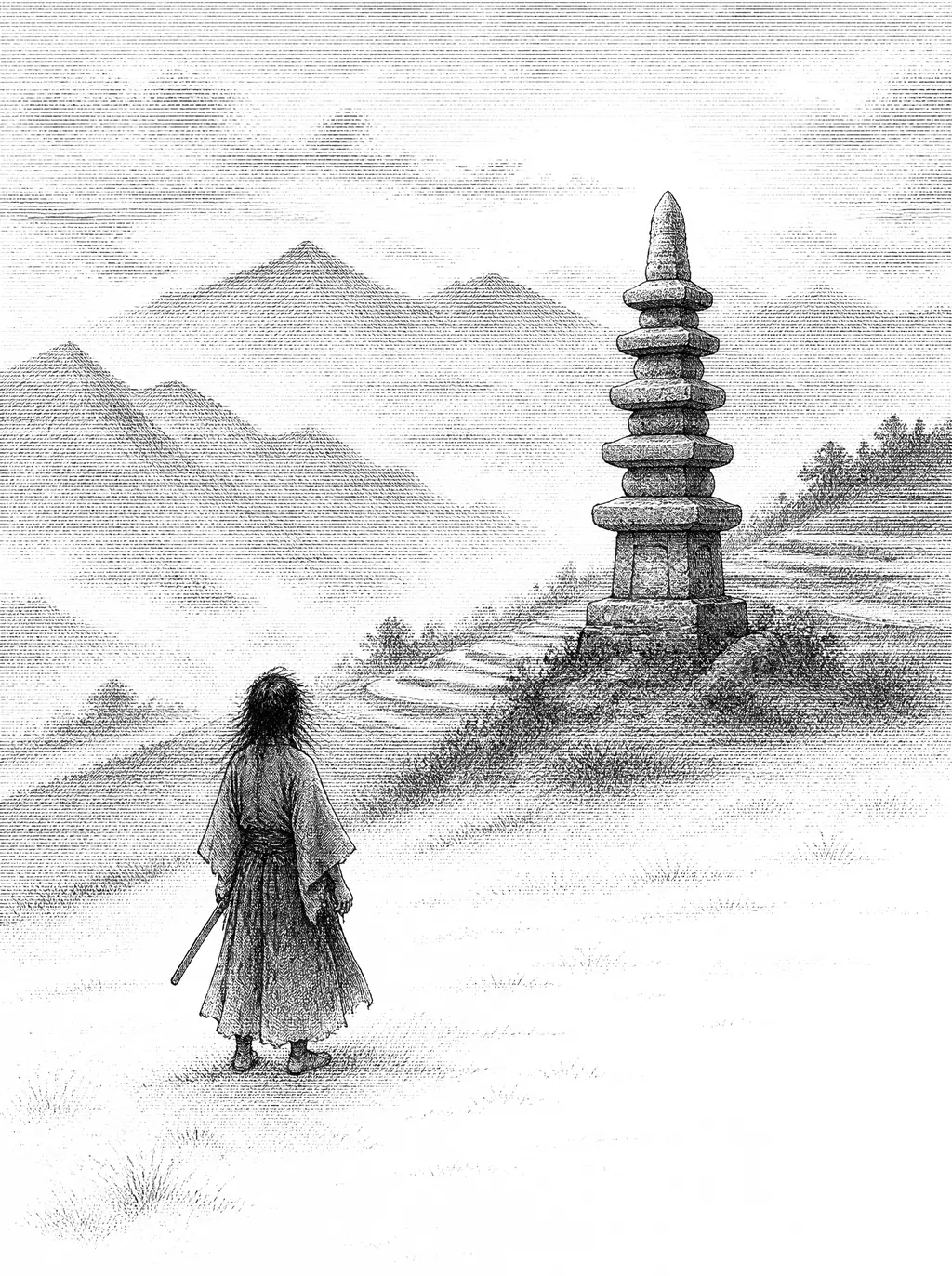
The five scrolls take their names from the Buddhist set of five elements, the same five stacked in the ring-shaped stones of a memorial pagoda: earth, water, fire, wind, emptiness. Each name does real work. The Ground book lays the Way out like a straight road. The Water book treats the single body, taking whatever shape its vessel gives it. The Fire book is the fight, at the scale of one man or ten thousand. The Wind book is other schools, and the character also means style or tradition, so the pun is deliberate. Emptiness is the fifth element and the last word, and it belongs to no technique at all.
The idea
Kū, usually translated as void or emptiness, is not nothing here. It names the state in which everything you had to hold on to has become unnecessary. The rules, the counts, the named stances, the deliberate placing of the eye: all of it is scaffolding, useful only while the building is going up. Musashi's sharpest move is deflationary. He says that what men usually call emptiness is simply the point where their understanding ran out, which is ignorance dressed up. Real emptiness comes after the whole road, and it is the absence of the crutches rather than the absence of the skill.
How the reasoning runs
First: a beginner needs explicit rules, because he cannot yet read the situation in front of him. Second: every rule is a compressed approximation of what a trained perception takes in directly. Third: as perception improves, each rule becomes redundant, and continuing to hold it becomes an error, because a rule is a fixed shape and a situation never is. Fourth: at the end of the road nothing is left to hold. Fifth: that condition cannot be described, because a description would itself be another rule to hold. Sixth, and this is the honest cost: the fifth book therefore has to be nearly empty, and its emptiness can only be recognised by someone who walked the road.
Seen in life
Ask a pianist who has played for thirty years what her hands are doing in a passage she knows. She will play it and then be unable to answer, and if she tries to answer while playing, the passage falls apart. You have the same thing with your own language. Something makes you say big red barn and never red big barn, you have obeyed it in every sentence of your life, and you were never taught it and cannot state it. The knowledge is complete and it is not available as knowledge. That is the state Musashi is pointing at, arrived at by ten thousand ordinary repetitions.
Why it matters
It changes what learning a discipline is for. If the endpoint is a full head, you accumulate: more rules, more frameworks, more named methods, and you feel more expert each time you add one. If the endpoint is emptiness, the middle of the journey is accumulation and the end is shedding, and a person still reciting the framework has not finished. It also supplies a test with teeth. Someone who can only perform well while consulting the checklist is somewhere in the fourth book, not the fifth, however impressive the checklist is.
“Take emptiness as the Way, and see the Way as emptiness.”
From the source
The last line of the last scroll is also its whole doctrine: “Take emptiness as the Way, and see the Way as emptiness.” The page before it does two things. It clears away the cheap version, saying that what people call emptiness is only the limit of what they understand and is not the real thing. Then it names what is left: a spirit unclouded, the mind wide and straight, judgement kept honest, and the Way practised as the ground under all of it. Emptiness in this text is a condition of a trained mind. It is not a claim about the furniture of the universe.
The pushback
Emptiness talk licenses anything. A doctrine whose final state cannot be described, cannot be tested, and can only be recognised by those who claim to have reached it is a doctrine with no brakes. There is also a heavier charge. The tradition of the no-mind in combat, the trained fighter who acts without deliberating, was pressed into service in twentieth-century Japan to sanctify killing, a history Brian Victoria documented in 1997, with D. T. Suzuki, who sold Zen and the sword to Western readers, near the centre of the argument. A philosophy that dissolves the deliberating agent is exactly what an army wants.
The reply
On the first charge Musashi has a decent defence: he is a craftsman, not a mystic. He arrives at emptiness after four scrolls of grips, distances, and criticisms of rival schools, and what he means by it is the disappearance of scaffolding from a skill, which is a claim about expertise rather than about being. On the second, the honest reply is uncomfortable and partial. His own last page demands a mind that is wide, straight, and unclouded, which is a judging mind and not a suspended one. But he wrote for men whose trade was killing, and the misuse was made from this material and not against it.
Where it went next
A generation before Musashi, the monk Takuan Sōhō had written to the shogun's fencing master about the mind that must not stop anywhere, which is the same idea inside Zen vocabulary. D. T. Suzuki carried the pairing of Zen and swordsmanship to English readers, and Eugen Herrigel's Zen in the Art of Archery, published in 1948, made it a Western genre, though later scholarship by Yamada Shōji picked the book apart as a mistranslation of what his teacher actually taught. Sports psychology reinvented the same territory as the zone. Victoria's Zen at War, in 1997, forced the other half of the history back into view.
Where this sits
Laozi begins his book by warning that the book cannot do what it is about to attempt, which is the same structural problem Musashi hits at the end of his. Suzuki's direct pointing is the Zen version, a tradition built to hand you nothing and to gesture instead, and it explains the shape of a fifth scroll that refuses to instruct. Wittgenstein arrives at the identical edge from formal logic, maps precisely what can be said, and then points past the map. Three traditions, no contact between them, and all three end with a sentence saying that the last thing cannot be a sentence.