Symposium · Eastern Philosophy · Pl. 9Miyamoto Musashi · 1584–1645
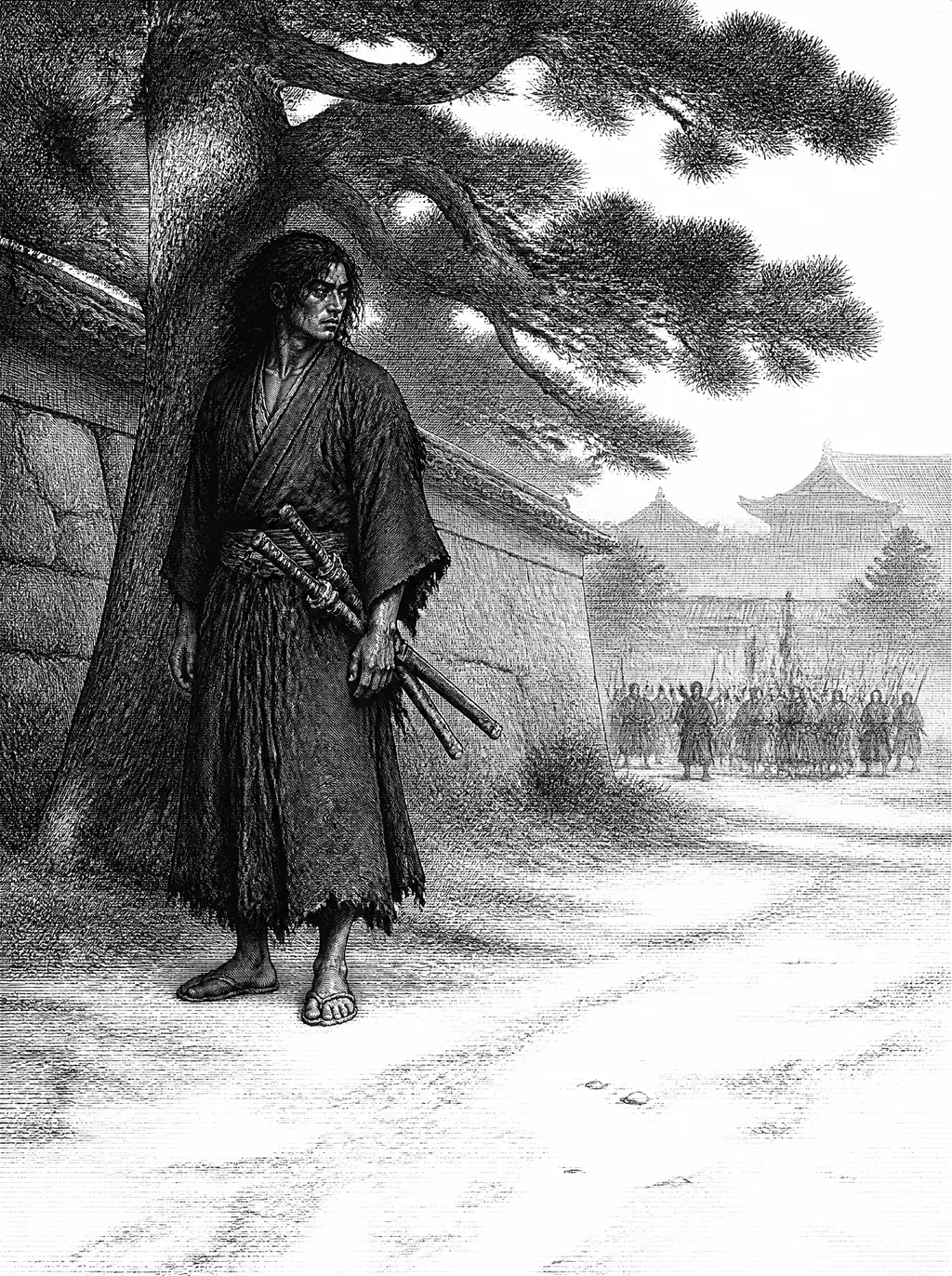
There Is Rhythm in Everything
The pine at Ichijō-ji
Musashi had built a reputation in Kyoto for arriving late. He came late to the first fight with the Yoshioka school and late to the second, and both times the waiting did half the work for him. When the school gathered a third time, at a pine outside the city, with its young heir at the head of an armed party, Musashi came early, waited in the dark, and cut down the boy first. Then he left through men who were still organising themselves. The story survives only in chronicles written a century later, so the details are unreliable. The move in it is not: he changed the beat because the beat had become expected.
The world it came from
The word Musashi builds this on is hyōshi, which is not a fighting term at all. It is the word for beat and measure in music and dance, and he takes it deliberately. Noh drama, the flute and the strings, the steps of a dancer: he lists them, and then he lists the rhythms of things nobody would call performance. A samurai's service rises and falls in a rhythm. So does a merchant's fortune, so does the health of a house. The Ground book introduces the word early, alongside the carpenter analogy he uses for command, and the Fire book spends most of its length applying it to a fight.
The idea
Timing, for Musashi, is not speed. It is the relation between three rhythms: yours, the other man's, and the situation's. Every action has a windup and a commitment, and during the commitment nothing can be changed. So the useful moment is not when your opponent is weak but when he is committed, and Musashi names several: the gap between two of his intentions, the instant his attack begins and can no longer be recalled, the counterstroke that borrows his own tempo. He also insists the same reading applies at the scale of a domain or a career, where the rhythms are years long and just as hard to interrupt.
How the reasoning runs
First: any action divides into preparation and commitment. Second: during commitment the actor cannot adjust, so his options are momentarily fixed and knowable. Third: the value of your action therefore depends almost entirely on where it lands inside his cycle, not on how hard it is. Fourth: the same stroke at two different moments produces opposite results, which means force is the wrong variable to optimise. Fifth: but rhythm is not an object. It is a pattern that only exists across time, so it cannot be pointed at or handed over in a lesson. Sixth: therefore it can be acquired by exposure and cannot be acquired by explanation.
Seen in life
You have one true sentence to say to someone you live with. Say it as they come through the door with their coat still on, and it starts a fight that lasts two days. Say the same words after dinner, and they are heard, considered, and mostly agreed with. Nothing about the sentence changed. What changed was where it landed inside the other person's evening. We almost never diagnose this correctly. We conclude the sentence was wrong, or the person is unreasonable, or the relationship has a problem, and we go looking for better content when the content was already fine.
Why it matters
Most people treat their failures as content problems. The pitch was not good enough, the argument was not clear enough, the request was not reasonable enough. Musashi's claim is that a large share of those are timing problems wearing a content costume, and that the two look identical from inside because the outcome is the only thing you observe. The practical consequence is a habit rather than a technique: before deciding that something did not work, ask when it landed. It costs nothing to check, and it stops you from rewriting a proposal that was already correct.
“There is rhythm in everything, but the rhythm of strategy cannot be reached without training.”
From the source
Musashi states the principle and its price in one sentence: “There is rhythm in everything, but the rhythm of strategy cannot be reached without training.” The passage around it does the widening. He names the rhythms of dance and of the pipes and strings, then the rhythm by which a warrior's fortune rises and falls, and the rhythm of a house that prospers and a house that declines. In each case he distinguishes the rhythm that fits from the rhythm that goes against, and says the strategist's work is to know both, then to strike on the beat the other man has no answer for.
The pushback
Timing is a word we apply afterwards. The man who wins is said to have read the rhythm; the man who dies is said to have mistimed it, and no observation before the event could tell you which you were watching. That makes the concept unfalsifiable and useless for deciding anything in advance. Musashi even concedes the point in the same breath, saying the rhythm of strategy cannot be reached without training, which is a graceful way of saying that nothing he writes here can be checked by a reader. And the wider claim, that a merchant's fortune has a readable beat, is astrology with a sword.
The reply
The narrow claim does make a testable prediction, and it has been tested. Hold the action constant and vary only its position in the other party's cycle, and the outcome changes: this is measured in sport, in interruption studies, and in conversation research, where the gap between speaking turns runs around two hundred milliseconds across every language examined, faster than a word can be retrieved. Listeners must therefore be predicting where a turn will end, which is exactly rhythm reading. The wide claim about fortunes is where Musashi overreaches. He asserts it, offers no argument, and a reader is free to keep the first half without the second.
Where it went next
The Fire book found an unlikely second life in twentieth-century military theory. John Boyd's account of air combat in the 1970s, later compressed into the observe-orient-decide-act loop, argues that a pilot wins by operating inside the opponent's decision cycle, which is Musashi's gap rhythm rewritten for jets. Kendō kept the idea directly as debana-waza, the strike delivered exactly as the opponent begins his own. From the 1980s the business translations pushed the widest version, the rhythms of markets and firms, which is the part of the doctrine Musashi argued least and sold best.
Where this sits
Laozi's wu wei is the same insight told from the other side. Where Musashi looks for the beat on which a small move ends the exchange, Laozi looks for the shape of the situation that makes the move unnecessary, and both are describing a way of acting that costs nothing because it is placed correctly. Water wearing stone away is the version at the slowest tempo, patience as a kind of timing. Aristotle's mean is the neighbouring thought in ethics: the right amount, but also, as he insists, at the right time and towards the right person, which is the part usually left out.